


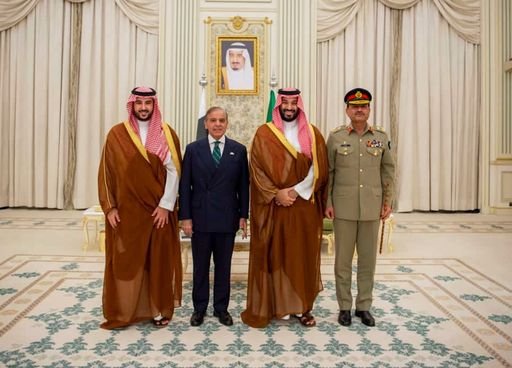
- Muslim Military Alliance talks are advancing as Turkiye seeks to join Pakistan and Saudi Arabia’s security pact.
- Analysts say Ankara is hedging against unreliable U.S. and NATO commitments.
- A three-nation bloc would combine Saudi finances, Pakistan’s nuclear deterrent, and Turkiye’s defence industry.
- Malaysia could emerge as a fourth partner, forming a Muslim answer to the U.S.-India-Japan-Australia Quad.
Turkiye’s reported attempt to join the Pakistan–Saudi mutual defence pact could mark one of the most significant geopolitical realignments in the Muslim world since the Cold War. What began last September as a bilateral agreement between Riyadh and Islamabad is now evolving into the potential foundation of a multi-country security architecture stretching from the Mediterranean to the Arabian Peninsula and the Indian Ocean.
According to Bloomberg, discussions between Ankara and the alliance signatories are at an advanced stage, and insiders say a deal is “very likely.” If confirmed, the pact would combine Saudi Arabia’s energy wealth, Pakistan’s nuclear and ballistic missile capability, and Turkiye’s rapidly expanding, battle-tested defence industry — creating a bloc that could rival existing regional security structures anchored in Washington, Moscow, and Beijing.
Saudi Arabia Ultimatum to UAE Forces Signals Major Shift in Yemen War
Why an Established Power Wants In
Turkiye’s interest may initially appear counterintuitive. A major NATO power with one of Europe’s largest armies, Turkiye is already plugged into some of the most advanced defence networks in the world.
Aidarous al-Zubaidi Skips Riyadh Talks as Saudi-UAE Rift Destabilizes Yemen
But Turkish policymakers no longer see NATO as a fully reliable guarantor.
With the Trump administration again defining security through narrow national interest — and questioning U.S. obligations to NATO — Ankara is hedging its bets. From sanctions over Russian S-400 buys to Western reluctance to support Turkiye’s Syrian border concerns, the gap between Turkish security needs and alliance priorities has widened.
Joining a Muslim-led pact allows Turkiye to rebalance its external posture without formally breaking from NATO. In effect, this is strategic diversification.
A Convergence of Interests
While Turkiye’s motivations may be structural, its timing reflects a new sense of opportunity. After years of diplomatic frost and regional rivalries, Riyadh and Ankara have been knitting ties back together.
Turkey-Saudi–Pakistan Pact And The Security Market That’s Replacing Old Certainties
Saudi Crown Prince Mohammed bin Salman and Turkish President Recep Tayyip Erdoğan have turned the page on old grievances, driven by geopolitical necessity and economic imperatives. Both now prioritise stability, technology partnerships, and defence-industrial growth.
Meanwhile, Pakistan — the nucleus of the pact — offers what neither country has:
- A nuclear deterrent
- A tested missile delivery system
- A large, experienced military force
- A prime geographic position linking the Middle East to South and Central Asia
Turkiye already builds corvette warships for Pakistan’s navy, upgrades the Pakistan Air Force’s F-16s, and exports drones used by dozens of militaries. A formal pact would accelerate joint venture fighter aircraft, naval shipbuilding, and missile technology sharing — including Turkiye’s KAAN fifth-generation jet programme.
The Saudi Equation
For Saudi Arabia, the pact is not just about military muscle — it is about post-oil statecraft.
As Riyadh expands into defence manufacturing under Vision 2030, it needs partners offering know-how, not just weapons. Turkiye’s drone, missile, and aerospace ecosystems provide exactly that.
Combined with Pakistan’s manpower and nuclear umbrella, the kingdom may finally achieve strategic autonomy from U.S. military protection that has defined Gulf security since 1945.
A Fourth Member in Waiting?
Analysts already point to the next possible expansion — Malaysia.
Kuala Lumpur has long argued for an independent Muslim voice in world affairs and previously partnered with Pakistan, Turkiye, and Qatar in the now-suspended Kuala Lumpur Summit initiative.
Its inclusion would transform the pact into a Quad-style formation: Saudi Arabia + Pakistan + Turkiye + Malaysia — spanning West Asia, South Asia, and Southeast Asia.
What Comes Next
Even without Malaysia, the emerging tripartite configuration offers something the Muslim world has rarely possessed:
a coordinated, capable security bloc led not by external powers, but by states with financial, industrial, and nuclear capability.
Whether the pact becomes a formal NATO-style mutual defence structure or a looser strategic alignment, its implications are far-reaching.
It challenges the U.S.–led security umbrella in the Gulf, reshapes the balance of power with Iran and Israel, adds strategic depth against India, and offers a model of Muslim cooperation driven by national interest rather than ideology.
What began as a bilateral treaty could become the most formidable Muslim security alliance of the 21st century — with Turkiye asking not just to join, but to help lead.