


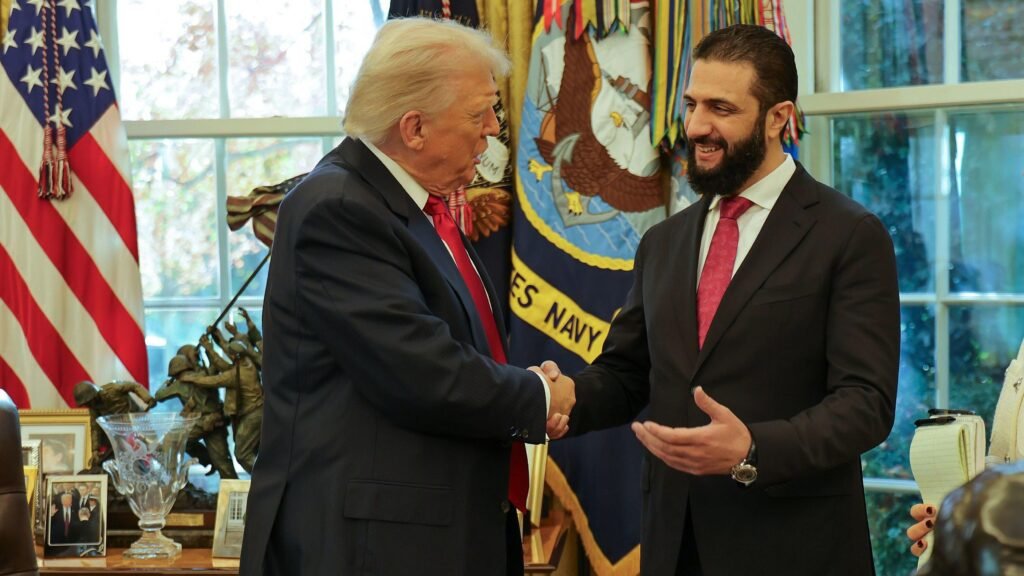
- Al-Sharaa provides critical tactical intelligence to the U.S. military based on his firsthand experience with militant strategies.
- Operation Hawkeye Strike successfully targeted over 70 ISIS sites across central Syria in a massive retaliatory wave.
- The collaboration follows a string of global ISIS-inspired attacks, including incidents in Australia and at Brown University.
- Syrian security forces are working alongside 1,000 U.S. troops to ensure no safe havens remain for extremist groups.
For over a decade, the consensus in Washington was that Syria was a problem to be contained, not a partner to be courted. That paradigm collapsed on Friday as U.S. Central Command (CENTCOM) launched Operation Hawkeye Strike, a massive retaliatory campaign against more than 70 Islamic State (ISIS) targets across central Syria. The strikes were not merely a display of American kinetic power; they were the first major operational validation of a jarring new alliance between the United States and Syrian President Ahmed al-Sharaa.
The operation—employing F-15E Strike Eagles, A-10 Warthogs, and HIMARS rocket systems—was a direct response to a December 13 “insider attack” in the desert town of Palmyra. In that incident, an ISIS sympathizer within the Syrian security forces killed two U.S. Army soldiers and a civilian interpreter.
Defense Secretary Pete Hegseth described the response as a “declaration of vengeance,” but the deeper significance lies in the man standing beside the Americans: a former jihadist commander now serving as the lynchpin of U.S. counterterrorism strategy in the Levant.
Al-Sharaa: The Architect of a New Intelligence
President al-Sharaa, once known by his nom de guerre Abu Mohammad al-Julani, has transitioned from a specially designated global terrorist to a transitional head of state recognized by the Trump administration. His value to the coalition is not merely symbolic. Having spent years leading Hay’at Tahrir al-Sham (HTS), Sharaa possesses a granular, firsthand understanding of the militant tradecraft that ISIS utilizes to survive in Syria’s “ungoverned spaces.”
READ MORE: Trump says US has launched large-scale attacks on ISIL in Syria
During a landmark November visit to the White House—the first by a Syrian leader in 80 years—Sharaa reportedly handed over high-fidelity intelligence on sleeper cells and logistics hubs.
This “insider knowledge” has allowed the U.S. to navigate the treacherous Badia desert with unprecedented precision. As one senior official noted, Sharaa is effectively “turning the table” on his former rivals, using their own tactical playbooks against them.
A Tsunami of Tragedy
The urgency of this partnership is fueled by a “tsunami” of ISIS-inspired violence that spanned three continents last weekend:
- Bondi Beach, Australia: A horrific mass shooting at a Hanukkah celebration left 15 dead. Prime Minister Anthony Albanese confirmed that the suspects, a father and son, had pledged allegiance to ISIS.
- Brown University, USA: A deadly shooting on the Ivy League campus has triggered federal probes into domestic radicalization among students.
- The Pakistan Connection: Earlier this week, Pakistani intelligence arrested Sultan Aziz Azam, a high-ranking ISIS-K spokesperson. Information extracted from Azam has provided a strategic link, allowing the coalition to map recruitment pipelines connecting the Syrian interior to global terror networks.
The Caesar Act and the Price of Peace
Parallel to the military offensive, the U.S. has moved to secure Sharaa’s domestic legitimacy. On December 18, the U.S. Senate passed the FY 2026 National Defense Authorization Act, which officially repealed the Caesar Act. The lifting of these “maximum pressure” sanctions marks a historic pivot, ending a decade of financial strangulation.
ALSO READ: Palmyra Attack Kills U.S. Soldiers and Civilians: A Direct Challenge to Trump, Allies, and the Syrian Regime
The economic implications are immediate. Syria is expected to rejoin the SWIFT banking network, a move vital for stabilizing the Syrian pound and facilitating a projected $28 billion in regional investment. Qatar and Saudi Arabia have already pledged a combined $13 billion for infrastructure and energy projects, betting on the stability of Sharaa’s transitional government.
The Long Road Ahead
Critics argue that Washington is repeating the mistakes of the past by empowering a former militant to maintain order. The World Bank warns that the $216 billion needed for full reconstruction is far from guaranteed, and the “insider attack” in Palmyra highlights the fragility of Sharaa’s control over his own security apparatus.
However, in a region where “least-bad” options are the norm, the Sharaa-Washington alliance represents a cold, pragmatic calculation. By leveraging Sharaa’s tactical expertise and rewarding him with the end of sanctions, the U.S. is betting that a stable, reintegrated Syria is the best defense against a resurgent global caliphate.