


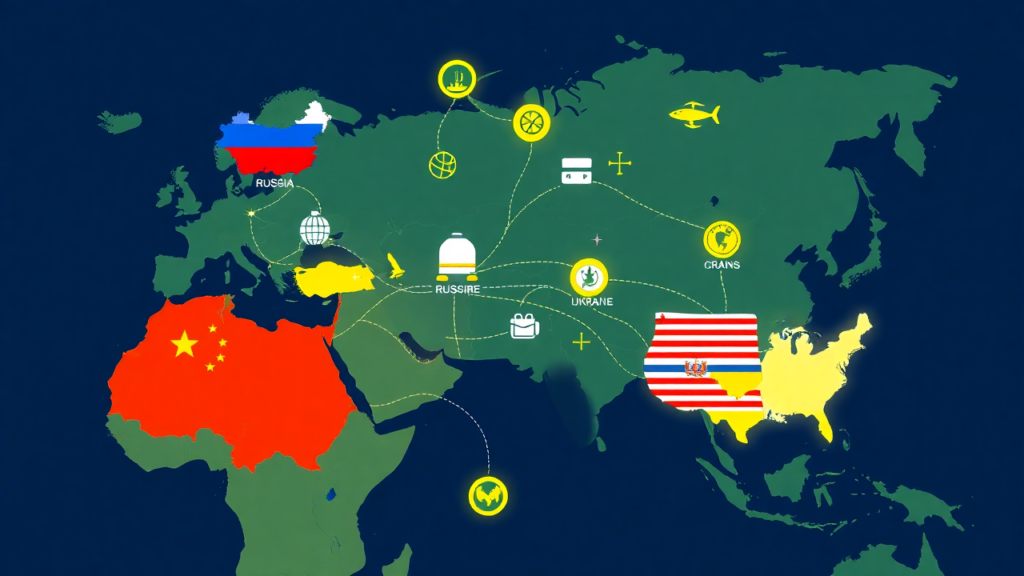
- China’s Rising Power: How the U.S. can counter Beijing’s influence in trade, tech, and military.
- Russia’s Aggression: Why Putin’s ambitions in Ukraine are a test of global democracy.
- Economic Resilience: The shift toward economic nationalism and what it means for global trade.
- Climate Diplomacy: America’s opportunity to lead the fight against climate change globally.
In an age of shifting global alliances, America stands at a critical juncture. As old rivalries rekindle and emerging powers stake their claim on the world stage, the United States faces an increasingly complex web of foreign policy challenges. From the rise of China to the war in Ukraine, and from climate change to economic competition, America’s role as a global leader is being tested like never before. How the U.S. chooses to navigate this evolving landscape will define not only its future but also the trajectory of international order.
The China Conundrum
Perhaps the most pressing issue in American foreign policy is the relationship with China. No other country poses a greater challenge to U.S. dominance—economically, militarily, and technologically. The rivalry is playing out on multiple fronts: trade wars, military buildups in the South China Sea, and competition for technological supremacy in areas like artificial intelligence and quantum computing.
Under the Biden administration, the U.S. adopted a strategy of “strategic competition,” aiming to counterbalance China’s growing influence without sparking outright conflict. But with Beijing’s aggressive foreign policy under President Xi Jinping, including its saber-rattling over Taiwan and its Belt and Road Initiative, this balancing act is becoming increasingly difficult.
China has poured billions into forging economic and political ties across Africa, Asia, and Latin America—regions where U.S. influence has waned in recent decades. Take, for example, China’s growing footprint in Africa, where it is financing infrastructure projects, building ports, and securing mineral resources critical for the technologies of the future, such as electric vehicles and renewable energy.
The question for Washington is: How does the U.S. counter this? Should America double down on its military presence in Asia, risk escalating tensions over Taiwan, or focus on economic partnerships like the Indo-Pacific Economic Framework? The stakes couldn’t be higher. A misstep could trigger a conflict that would have devastating global consequences.
The Russian Resurgence
Then there’s Russia, an old adversary that refuses to fade quietly into the background of global politics. The war in Ukraine has revealed the lengths to which Vladimir Putin is willing to go to reassert Russia’s influence. While the U.S. has led NATO in supplying billions of dollars in military aid to Kyiv, it’s unclear how long this united front can hold.
European capitals tread cautiously after week of mixed salvoes from Trump
The war is not just a battle for Ukraine’s sovereignty; it’s a test of the liberal world order. If Russia succeeds in carving out territories by force, it sets a dangerous precedent for other authoritarian regimes. Yet, the American public’s patience for funding foreign wars is waning. With a presidential election on the horizon, candidates from both parties are already questioning whether the U.S. can afford to keep writing blank checks to Ukraine.
Russia’s influence also extends beyond Europe. In the Middle East, Moscow has positioned itself as a power broker, maintaining ties with Iran, Syria, and even Saudi Arabia. This complicates U.S. efforts to stabilize the region and reduce its reliance on fossil fuels from autocratic regimes.
The Middle East Puzzle
For decades, the Middle East has been a focal point of U.S. foreign policy, but the region’s importance is shifting. The U.S. has gradually reduced its military presence in the region, focusing instead on pivoting toward Asia. However, tensions in the Middle East remain a persistent thorn in America’s side.
Iran’s nuclear ambitions continue to threaten regional stability. Despite years of negotiations and sanctions, Tehran is closer than ever to acquiring a nuclear weapon. The U.S. has attempted to rally its allies in the region, including Israel and Saudi Arabia, but these partnerships are fraught with challenges. Saudi Arabia’s human rights record and its cozying up to China have strained relations with Washington, while Israel’s hardline government under Benjamin Netanyahu has made the prospect of a two-state solution with Palestine increasingly unlikely.
Rivalry Redefined: US-China Relations in the Trump Administration
At the same time, new opportunities are emerging. The Abraham Accords, brokered under the Trump administration, have opened the door for improved relations between Israel and several Arab states. If the U.S. can build on this momentum, it could reshape the geopolitical landscape of the Middle East in its favor.
Climate Diplomacy: A Growing Imperative
Climate change is no longer a secondary issue in foreign policy—it’s a central one. The Biden administration has sought to position the U.S. as a global leader in combating climate change, rejoining the Paris Agreement and pledging to cut greenhouse gas emissions. But the U.S. faces stiff competition from Europe and China, both of which are investing heavily in green energy.
One area where the U.S. could assert leadership is in setting international standards for carbon emissions and renewable energy technologies. For example, by investing in green energy infrastructure in developing countries, the U.S. could counter China’s Belt and Road Initiative while promoting sustainable development.
Domestically, however, political polarization makes it difficult to maintain a consistent climate policy. Republican lawmakers have criticized the Biden administration’s environmental agenda, arguing that it puts American jobs at risk. This domestic divide weakens America’s credibility on the global stage, making it harder to rally other nations to the cause.
Economic Competition and Trade
Trade has always been a cornerstone of U.S. foreign policy, but globalization is now under scrutiny. The pandemic exposed the vulnerabilities of global supply chains, and the U.S. is increasingly looking inward, promoting domestic manufacturing through policies like the Inflation Reduction Act.
This shift toward economic nationalism has its risks. For one, it could alienate traditional allies in Europe and Asia who rely on access to American markets. Secondly, it could exacerbate tensions with China, which remains a critical supplier of goods to the U.S.
At the same time, the U.S. has an opportunity to lead on trade by forging new partnerships. Initiatives like the USMCA (United States-Mexico-Canada Agreement) and the Indo-Pacific Economic Framework could strengthen economic ties with allies while reducing dependence on adversaries. However, these agreements must be carefully crafted to ensure they benefit American workers and address issues like labor rights and environmental standards.
The Decline of Multilateralism
One of the most alarming trends in recent years has been the decline of multilateralism. Institutions like the United Nations, the World Trade Organization, and even NATO have come under attack, not just from adversaries but from within. Former President Donald Trump’s “America First” doctrine dealt a significant blow to these institutions, and while President Biden has worked to rebuild alliances, the damage lingers.
The world is increasingly polarized, with democratic nations on one side and authoritarian regimes on the other. In this context, multilateral institutions are more important than ever. They provide a platform for dialogue, conflict resolution, and cooperation on global challenges like pandemics and climate change. Yet, these institutions are only as strong as their members’ commitment to them. The U.S. must lead by example, showing that multilateralism is not just an ideal but a practical necessity.
The Path Forward
As America navigates these challenges, one thing is clear: there are no easy answers. The world is more interconnected than ever, and the actions of one nation ripple across the globe. For the U.S. to maintain its leadership role, it must adapt to this new reality.
First, Washington must invest in its own strength—economically, militarily, and technologically. This means not only increasing defense spending but also investing in education, infrastructure, and innovation. A strong America at home is a strong America abroad.
Second, the U.S. must rebuild trust with its allies. This requires consistent policies and a willingness to listen as much as lead. Whether it’s coordinating sanctions on Russia, negotiating trade agreements, or combating climate change, alliances are America’s greatest asset.
Finally, the U.S. must remain committed to its values. In a world where authoritarianism is on the rise, America’s greatest strength is its commitment to democracy, human rights, and the rule of law. These principles are not just moral imperatives; they are strategic advantages.
The challenges are daunting, but America has faced difficult times before. With the right leadership and a clear vision, the U.S. can navigate this complex landscape and emerge stronger, reaffirming its place as a beacon of hope in an uncertain world