


-
Trade Fragmentation Deepens: The omission of multilateral language from the declaration signals an irreversible move toward regional and bilateral trade systems.
-
China Gains Diplomatic Ground: Xi’s leadership presence positions China as a key architect of post-WTO economic norms.
-
U.S. Strategy Shifts to Selective Engagement: Trump’s bilateral deals reflect Washington’s pivot toward transactional trade diplomacy.
-
APEC’s Institutional Relevance Questioned: Without consensus on core issues like AI and supply chains, APEC risks fading into irrelevance.
The APEC Summit 2025 concluded on Saturday with a cautiously worded joint declaration that underscored “resilience” and “shared benefits” in trade — but conspicuously avoided references to multilateralism or the World Trade Organization (WTO). The omission reflected what many economists now describe as a historic shift: the decline of a unified global trade order.
The meeting, hosted by South Korea in Gyeongju, unfolded against a turbulent geopolitical backdrop — from Washington’s revived protectionism to Beijing’s strategic assertiveness. Leaders from the 21-member bloc sought to project unity, yet the final declaration exposed underlying fractures that could reshape Asia-Pacific trade for decades.
Trump’s Absence Leaves a Leadership Vacuum
U.S. President Donald Trump’s abrupt departure from Seoul before the summit began left an unmistakable void. While he touted new bilateral trade deals with South Korea and China earlier in the week, his absence at the main session sent a powerful signal: Washington’s pivot away from multilateralism is now policy, not rhetoric.
READ MORE: Trade Tensions Shift As Trump Cuts Asia Deals
For many APEC members, the U.S. withdrawal from leadership roles in global trade institutions has created uncertainty. “We cannot deny anymore that there is a paradigm shift in the global trade order,” said Heo Yoon, an international trade expert at Sogang University. “The U.S. no longer champions multilateral frameworks; instead, it is reverting to transactional deals that prioritize American interests.”
Analysts say Trump’s approach reflects a broader skepticism about shared trade governance. The omission of WTO language from the joint declaration underscored that shift — a subtle yet significant signal that global trade rules are now being rewritten through competing power centers rather than consensus.
Xi Jinping Positions China as Defender of Free Trade
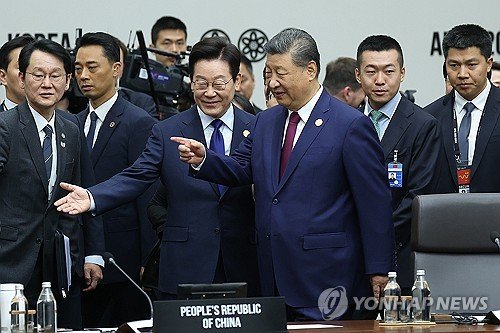
In Trump’s absence, Chinese President Xi Jinping seized the diplomatic spotlight. Declaring that China will host the next APEC summit in Shenzhen in 2026, Xi positioned Beijing as the stabilizing force for the Asia-Pacific’s economic future.
ALSO READ: When Trump Met Xi: Inside the Seoul Summit That Shook the World Economy
During the closing session, Xi proposed the creation of a World Artificial Intelligence Cooperation Organization, signaling China’s ambition to lead not just in trade, but also in next-generation technologies. While the proposal drew interest, no consensus emerged on regulating artificial intelligence — a reminder that APEC’s capacity for collective action remains limited.
“China is clearly taking advantage of Trump’s absence at APEC,” said Li Xing of the Guangdong Institute for International Strategies. “Beijing is courting countries that are anxious about America’s retreat and offering them an alternative model — one centered on infrastructure, digital trade, and AI cooperation.”
However, the declaration’s carefully neutral tone showed that APEC members remain cautious about China’s intentions. Few are ready to embrace a trade order that sidelines the U.S., even as Beijing’s influence expands through initiatives like the Belt and Road and the RCEP trade bloc.
South Korea’s Lee Balances Between Washington and Beijing
For host nation South Korea, the APEC summit was both a diplomatic test and a strategic tightrope walk. President Lee Jae Myung, who took office earlier this year after the ouster of his hawkish predecessor, aimed to reestablish Seoul as a bridge between the region’s two dominant powers.
Lee’s bilateral meetings with Trump and Xi highlighted his pragmatic diplomacy. With Trump, he signed a surprise trade deal lowering U.S. tariffs in exchange for new South Korean investment in America. With Xi, he emphasized “mutually beneficial cooperation” and sought help on engaging North Korea — an issue largely absent from Chinese state media coverage.
“We must go beyond simple restoration to find a path of cooperation that benefits both sides,” Lee said during his joint press conference with Xi.
Analysts believe Lee’s efforts reflect Seoul’s long-term goal of diversifying its alliances. “Lee’s approach is transactional but strategic,” noted one Seoul-based economist. “He knows South Korea’s export-driven economy cannot afford to alienate either Washington or Beijing.”
North Korea, Taiwan, and Regional Flashpoints Resurface
Although not central to APEC’s trade agenda, North Korea’s nuclear ambitions and Taiwan’s semiconductor security loomed large over the summit.
President Lee reportedly asked Xi for China’s assistance in resuming dialogue with Pyongyang, but China avoided any explicit commitment. Hours later, North Korea dismissed denuclearization efforts as a “pipe dream,” reaffirming its strategic defiance.
Meanwhile, Taiwan’s delegate, Lin Hsin-i, met with U.S. Treasury Secretary Scott Bessent on the sidelines to discuss semiconductor supply chains — a conversation that hinted at ongoing U.S.-Taiwan coordination to reduce dependence on Chinese tech manufacturing.
These developments underscored how economic and security concerns are increasingly intertwined in the Asia-Pacific, making trade diplomacy inseparable from military and technological competition.
The Future of APEC: Fragmentation or Reinvention?
The APEC Summit 2025 ended with more questions than answers about the organization’s relevance in a fractured world. The absence of consensus on trade governance, AI regulation, and supply chain realignment revealed that APEC’s traditional role as a consensus-driven platform is under threat.
Experts predict that the forum may evolve into a “dual-track” system — one led by U.S.-aligned economies pursuing selective decoupling, and another orbiting around China’s trade and digital initiatives.
“The future of APEC will depend on whether it can adapt to overlapping economic realities,” said Heo. “If it cannot reconcile the competing visions of Washington and Beijing, it risks becoming a symbolic club rather than a driver of integration