


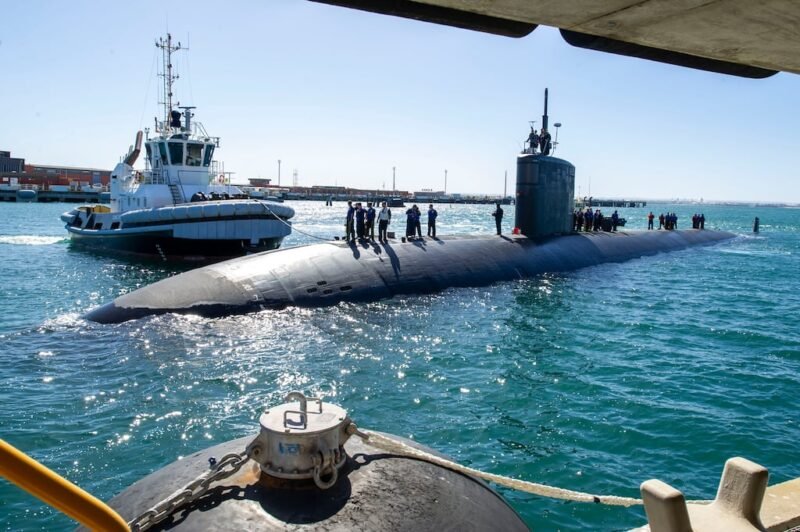
- AUKUS Shipyard at Osborne to receive A$3.9 billion in initial funding.
- Total facility costs projected to reach A$30 billion by 2050.
- The project supports 10,000 jobs and the construction of SSN-AUKUS boats.
- Investment signals Australian commitment ahead of Xi-Trump talks.
ADELAIDE – In a move that has sent ripples through the strategic corridors of the Indo-Pacific, the Australian government announced a massive A$3.9 billion ($2.76 billion) initial investment to fast-track the construction of a state-of-the-art shipyard in Osborne, South Australia.
World Leaders Including Australian Prime Minister Condemn Trump’s “Appalling” NATO Remarks
This “down payment” is the cornerstone of the AUKUS pact—a trilateral security alliance between Australia, the United States, and the United Kingdom—designed to equip the Royal Australian Navy with elite nuclear-powered submarine capabilities.
The timing of the announcement is as clinical as it is provocative. Coming just days before a scheduled summit between U.S. President Donald Trump and Chinese President Xi Jinping, the investment serves as a tangible reminder of the “wall of steel” being erected to maintain a rules-based order in the face of Beijing’s naval expansion.
The Financial and Industrial Blueprint
The Osborne shipyard is slated to be the heart of Australia’s sovereign shipbuilding industry. While the initial commitment is nearly A$4 billion, official projections estimate the total cost of the facility will swell to A$30 billion over the coming decades.
Denmark Greenland Visit: Royal Unity Tested as US Presses Europe Over Arctic Future
This facility will not only maintain the aging Collins-class fleet but will also be the birthplace of the SSN-AUKUS, a new class of submarine combining British design with cutting-edge American combat systems. According to the AUKUS “Optimal Pathway”:
-
2027: U.S. and UK nuclear submarines will begin rotational presence at Fleet Base West.
-
Early 2030s: Australia will purchase at least three Virginia-class submarines from the U.S.
-
Early 2040s: The first Australian-built SSN-AUKUS will be delivered from the Osborne yard.
High-Stakes Diplomacy: The Trump-Xi Shadow
The move is widely viewed as a calculated “strategic signal.” By locking in billions in domestic infrastructure, Prime Minister Anthony Albanese is demonstrating to the Trump administration that Australia is a “burden-sharing” ally, a key requirement for the “America First” foreign policy.
Australia pledges $2.7 billion to progress nuclear submarine shipyard build
“Investing in the submarine construction yard at Osborne is critical to delivering Australia’s conventionally-armed, nuclear-powered submarines,” Albanese stated, emphasizing that this is a “driver of national security and economic prosperity.”
Conversely, for Beijing, the development is an “alarm bell.” China has long criticized AUKUS and the Quad (U.S., India, Japan, Australia) as remnants of a “Cold War mentality.” The appearance of China’s own next-generation Type 09Vnuclear submarine in recent satellite imagery suggests a frantic undersea arms race is already underway.
Policy Maker Insights
South Australian Premier Peter Malinauskas hailed the investment as a generational shift, noting it would support a 10,000-strong workforce. “This is just the beginning,” he said, pointing to the enabling infrastructure required to handle nuclear technology.
However, the path is not without friction. A recent U.S. Congressional Research Service report raised concerns about whether the U.S. can meet its own submarine production targets while fulfilling the sale to Australia. Critics argue that any delay in the Virginia-class transfer could leave a “capability gap” in the mid-2030s.
Future Perspective: Strategic Deterrence or Provocation?
As 2026 unfolds, the Indo-Pacific stands at a crossroads. From Washington’s perspective, AUKUS and the Quad are not tools of provocation but essential mechanisms of “integrated deterrence.” By hardening Australia’s naval reach and aligning the democratic “top four,” the U.S. aims to create a multi-layered defense that raises the cost of any potential Chinese aggression.
However, from Beijing’s viewpoint, this “mosaic” of alliances—now including the emerging “Squad”—is a classic encirclement strategy. Critics argue that by introducing nuclear-powered technology and high-end military drills, the U.S. risks a security dilemma, where defensive moves by one side trigger offensive escalations by the other, potentially turning the region into a 21st-century “powder keg.”