


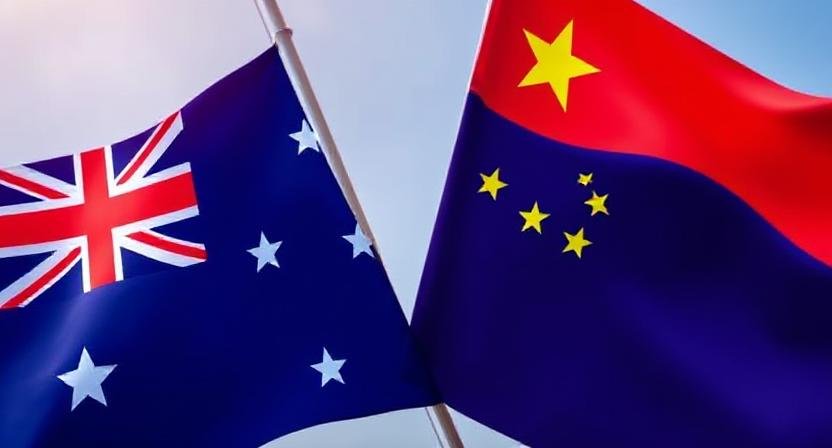
- Australia-China trade relations are entering a new phase as both countries prioritize cooperation over past tensions.
- Prime Minister Anthony Albanese’s upcoming visit aims to strengthen Australia-China trade relations through expanded investment and technology partnerships.
- Australia-China trade relations are set to benefit from discussions on AI, clean energy, digital economy, and critical minerals.
- With bilateral trade exceeding AU$327 billion, Australia-China trade relations remain crucial for regional economic stability and growth.
As Australian Prime Minister Anthony Albanese prepares for his second official visit to China this weekend, there is a renewed sense of optimism that two of the Asia-Pacific’s most important economies are finally moving past years of strained relations to embrace a new era of trade and investment cooperation.
Albanese will travel to Shanghai, Beijing, and Chengdu starting Saturday, in a trip that signals both sides are eager to deepen economic ties despite lingering geopolitical sensitivities. His visit follows a historic thaw in 2023, when Albanese became the first Australian leader to visit Beijing in seven years, breaking a long diplomatic freeze that saw relations deteriorate over issues such as security, trade bans, and political tensions.
“China is our largest trading partner and an essential component of Australia’s economic future,” Albanese told reporters ahead of his trip. “We must continue to engage, to talk, and to seek common ground, while also standing firm on our values.”
BRICS Flexes Economic Muscle as Trump Slams Bloc as ‘Anti-American’
For both nations, the stakes are high. China accounted for 26% of Australia’s total goods and services trade in 2023-24, amounting to more than AU$327 billion (US$220 billion), according to the Australian Department of Foreign Affairs and Trade. Australia remains a critical supplier of iron ore, coal, and increasingly, lithium — a key mineral in the green energy transition.
But the relationship goes beyond commodities. In Beijing, Albanese is expected to discuss expanding the decade-old China-Australia Free Trade Agreement (ChAFTA) to include future-focused sectors such as artificial intelligence (AI), renewable energy, critical minerals, healthcare, and the digital economy. Chinese Ambassador to Australia Xiao Qian has already called for a “high-standard” review of ChAFTA to inject new vitality into bilateral ties.
READ MORE: Australia-China trade ties hold vast potential
“We are willing to review the agreement with a more open attitude and higher standards,” Xiao wrote in The Australian Financial Review this week.
One pressing issue on Albanese’s agenda will be navigating sensitive topics such as Chinese investment in Australian strategic assets, notably the controversy surrounding Chinese ownership of the Darwin Port, which the Australian government is reviewing over national security concerns.
Despite such challenges, leading experts say both countries have much to gain by focusing on economic complementarities rather than political disputes.
“The bilateral relationship is very strong in terms of trade volume, but mutual investment remains underdeveloped,” said Professor Hans Hendrischke from the University of Sydney Business School. He noted that Chinese foreign direct investment (FDI) in Australia accounted for just 4% of total FDI as of 2023, making China Australia’s fifth-largest foreign investor. By comparison, Australian investment in China stood at a modest AU$1.4 billion last year.
Sectors ripe for expansion include agriculture, where Australia could boost exports of premium food products to meet the rising demands of China’s growing middle class, and clean energy, where Australia’s vast natural resources could support China’s ambitious carbon-neutral goals. Lithium, in particular, is emerging as a strategic area, with Australia supplying over half of the world’s lithium — an essential component in electric vehicle batteries and renewable energy storage.
“The potential is enormous, but confidence on both sides is still fragile,” Hendrischke said. “We need to move beyond the political friction and let businesses lead the way.”
ALSO READ: Exclusive: China Eyes Major Investment in Brazil’s Forest Fund, Boosting Climate Ties and Bilateral Trade
The global economic context is also playing a role. China’s government recently set an annual GDP growth target of around 5%, underlining its commitment to stability and continued openness to foreign investment — a signal welcomed by Australian exporters and investors.
Chinese investment flows, however, have increasingly shifted toward Southeast Asia and Europe, where Chinese capital is attracted to advanced manufacturing and innovation ecosystems. Analysts caution that unless Australia presents itself as an open and secure destination for Chinese capital, it risks missing out on billions in future investments, particularly in technology, manufacturing, infrastructure, and healthcare.
“Investment that once flowed to Australia is now going elsewhere,” said Hendrischke. “There is still untapped potential in Australia for Chinese companies, especially in emerging industries, but it requires a reset in political tone and greater strategic trust.”
For now, both sides appear willing to make the effort. In a world increasingly shaped by geopolitical rivalries and economic realignments, Australia and China seem to have decided to learn from history — setting aside past grievances in favor of pragmatic partnership.
If Albanese’s visit delivers even modest breakthroughs, it could mark the beginning of a brighter chapter for two economies whose futures are deeply intertwined.