


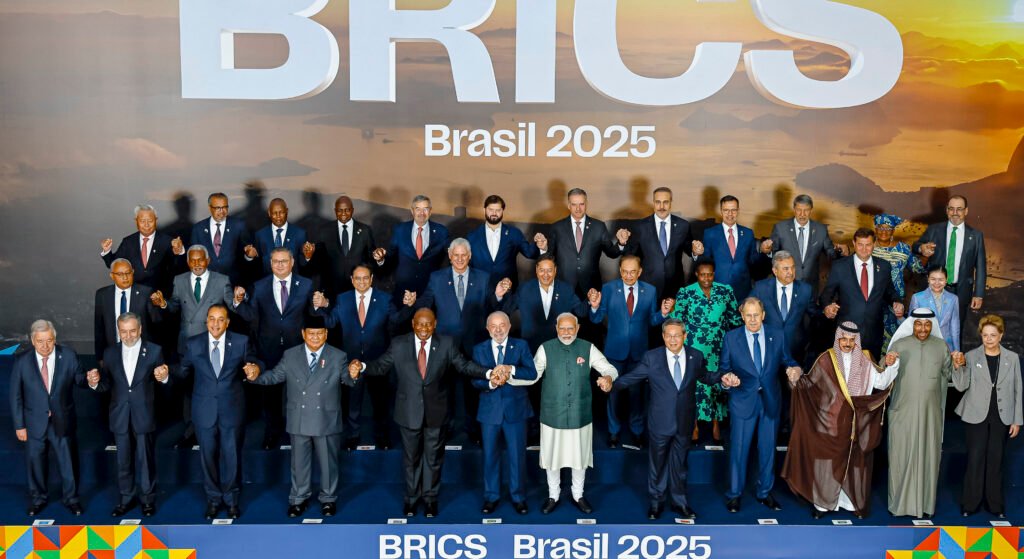
- BRICS Summit 2025 showcased unity as members rejected Trump’s “anti-American” label and emphasized multilateral cooperation.
- The inclusion of Saudi Arabia in the BRICS Summit 2025 could push the bloc’s GDP beyond $30 trillion, enhancing its global influence.
- Trade among member states discussed at the BRICS Summit 2025 nears $600 billion annually, with increasing focus on de-dollarization.
- Leaders at the BRICS Summit 2025 called for global financial reforms, environmental action, and fairer trade rules.
RIO DE JANEIRO—As leaders of the BRICS nations gathered under the golden skies of Rio de Janeiro on Monday, the air was thick with both opportunity and confrontation. The fast-expanding economic bloc, long viewed as the voice of emerging powers, brushed off U.S. President Donald Trump’s accusation that BRICS had turned into an “anti-American” alliance, even as the American leader threatened fresh tariffs that could roil global markets.
The summit’s core message was clear: multilateralism, not confrontation. From Beijing to Pretoria, from Moscow to New Delhi, BRICS leaders emphasized cooperation, sustainable growth, and fair trade. Chinese foreign ministry spokesperson Mao Ning captured the sentiment succinctly, stating, “Tariffs should not be used as a tool for coercion and pressuring,” adding that BRICS advocates “win-win cooperation” and is not aimed “against any country.”
Yet the gathering was impossible to separate from Trump’s escalating tariff threats, which have already hit South Africa and Malaysia, and the U.S. president’s claims that the bloc’s rise challenges American influence.
What Was Discussed and Agreed?
At the heart of the summit was a renewed call for reforming global institutions like the IMF and WTO to better reflect the realities of a multipolar world. Environmental cooperation, digital economy frameworks, and cross-border public health initiatives also dominated the agenda. In a joint statement, BRICS leaders condemned the recent bombing of member-state Iran and warned that rising protectionism—implicitly referring to Trump’s tariffs—posed a danger to global trade stability.
READ MORE: BRICS Summit in Russia: A Step Toward a Multipolar World
Brazilian President Luiz Inacio Lula da Silva, hosting the summit, underscored the importance of “inclusive economic development” and environmental stewardship. Russia, increasingly isolated in the West, echoed calls for a fairer international order.
Is BRICS Really Anti-American?
Despite Trump’s rhetoric, no BRICS leader endorsed an anti-American stance. Even South Africa, targeted by steep U.S. tariffs, emphasized that its trade relationship with Washington remained “constructive and fruitful.” The Kremlin insisted that BRICS cooperation is based on “a common world view” not directed against third parties.
ALSO READ: BRICS nations resist ‘anti-American’ label after Trump tariff threat
However, Trump’s labeling of BRICS as “anti-American” reflects growing unease in Washington over the bloc’s expanding influence. The recent inclusion of nations like Egypt, Ethiopia, Iran, Indonesia, and the UAE—and now potentially Saudi Arabia—has transformed BRICS from a modest forum into a geopolitical heavyweight.
BRICS Summit 2025: The Saudi Factor: A Game Changer?
Saudi Arabia is not yet a full BRICS member but has formally accepted an invitation and participated in Rio as a partner. Should Riyadh officially join, the combined GDP of BRICS nations would soar from approximately $28.5 trillion (around 28% of global GDP) to over $30 trillion, accounting for roughly 31% of global output—surpassing even the G7 in economic heft.
More crucially, the inclusion of Saudi Arabia, the world’s largest oil exporter, would dramatically increase BRICS’ energy dominance and strategic leverage in global markets. With both Russia and Saudi Arabia on board, the bloc would control over 40% of the world’s oil production.
Intra-BRICS Trade: A Rising Powerhouse
Trade between BRICS members has steadily climbed, reaching an estimated $600 billion annually, driven by resource exchanges, manufactured goods, and increasing investment in technology and infrastructure. China’s trade with fellow BRICS nations accounts for nearly $400 billion alone. The rise of digital currencies, non-dollar trade settlements, and cross-border payment systems discussed at the summit points toward growing financial independence from Western systems.
The Bigger Picture
With over 30 countries expressing interest in joining the BRICS framework, the bloc’s gravitational pull is undeniable. Trump’s tariff threats may aim to slow that momentum, but for many developing nations, BRICS represents a rare platform for global influence beyond the confines of Western-dominated institutions. Whether the U.S. labels it anti-American or not, the bloc’s expansion is reshaping the global balance of power—and Saudi Arabia’s inclusion may only accelerate that transformation.