


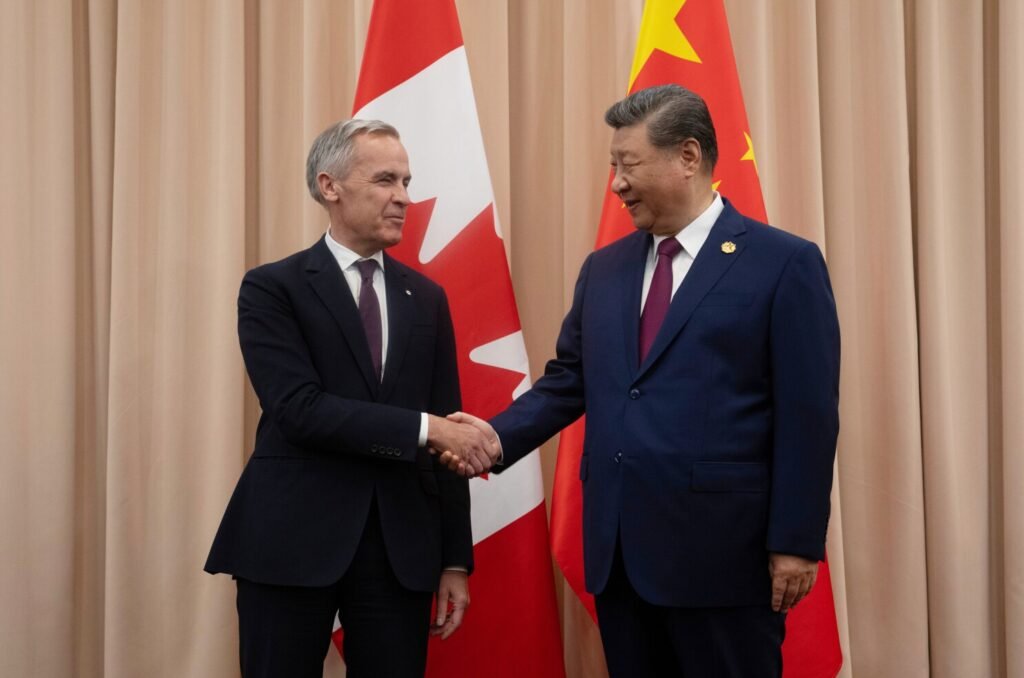
- Canada-China Relations are being redefined as PM Carney seeks to diversify trade amid growing tensions with the United States.
- This visit marks the first time a Canadian leader has visited China since 2017, aiming to end the “canola-EV” trade war.
- Key opportunities include securing a processing deal for rare earth minerals and expanding energy exports.
- The visit signals a move from “reliance” on the U.S. to “resilience” through Asian market integration.
As Prime Minister Mark Carney arrives in Beijing today, January 13, 2026, he carries more than just a diplomatic portfolio; he carries the blueprint for a fundamental shift in Canada’s global identity. This visit—the first by a Canadian Prime Minister in nearly a decade—comes at a moment of profound systemic disruption.
Canada to Trump: “Not for Sale” — PM Carney Rejects 51st State Proposal
With the United States under President Donald Trump signaling a retreat into protectionism and levying 35% tariffs against its northern neighbor, Ottawa is forced to look west. The “reliance to resilience” strategy isn’t just a slogan; it is a geopolitical necessity.
The Background: A Decade of Frost and Friction
The road to Beijing has been paved with diplomatic landmines. The relationship reached its nadir in 2018 following the arrest of Huawei CFO Meng Wanzhou in Vancouver and the subsequent “tit-for-tat” detention of Canadians Michael Kovrig and Michael Spavor. Under the former Trudeau administration, ties remained largely frozen, characterized by mutual suspicion over election interference and human rights.
US Tariffs Deliver Major Blow to Pakistan’s Fragile Economy
However, the global calculus changed in late 2025. Facing “annexation threats” and a crumbling CUSMA (USMCA) framework, Carney met President Xi Jinping in South Korea last October, signaling a thaw. Today’s visit aims to transform that thaw into a functional, pragmatic partnership where economic interests provide a buffer against ideological friction.
Potential Breakthroughs: The “Grand Bargain”
The primary goal of this mission is to resolve the high-stakes trade war involving Electric Vehicles (EVs) and Canola. In 2024, Canada imposed 100% tariffs on Chinese EVs; China retaliated by effectively shutting down the Canadian canola market. Experts anticipate a phased resolution: a “tariff-rate quota” system that would allow Canadian agricultural products back into Chinese ports in exchange for a gradual easing of EV restrictions, perhaps linked to Chinese manufacturing investment in Ontario’s auto hub.
Canada to Trump: “Not for Sale” — PM Carney Rejects 51st State Proposal
Beyond agriculture, a significant breakthrough is expected in energy. With the United States pivoting toward Venezuelan oil, Canada is looking to redirect its crude. The Trans Mountain Pipeline (TMX) has already seen a surge in exports to China, reaching record highs of over 350,000 barrels per day in 2025. A long-term energy security agreement could solidify China as a primary customer for Canadian heavy crude.
The Critical Mineral Exchange: Rare Earths for Raw Ore
Perhaps the most strategic opportunity lies in the “Rare Earth” paradox. Canada possesses vast, unrefined deposits of critical minerals essential for the green transition, yet it lacks the processing capacity that China has mastered.
- The Opportunity: Canada may offer China stable access to raw lithium, copper, and iron ore.
- The Return: In exchange, Canada seeks “midstream” technology transfers or a bilateral legal framework for the processing of Rare Earth Elements (REEs) within Canadian borders. This would allow Canada to build its own domestic supply chain while leveraging Chinese expertise, a move that bypasses the “decoupling” demands of Washington in favor of “prudent de-risking.”
Bilateral Trade Data: 2021–2025
Despite the political “ice age,” merchandise trade has proven remarkably resilient, recently crossing the $120 billion threshold.
| Year | Total Bilateral Trade (CAD) | Export Volume (to China) | Import Volume (from China) |
| 2021 | $114.1 Billion | $28.8 Billion | $85.3 Billion |
| 2022 | $116.5 Billion | $29.2 Billion | $87.3 Billion |
| 2023 | $119.8 Billion | $30.5 Billion | $89.3 Billion |
| 2024 | $118.7 Billion | $29.9 Billion | $88.8 Billion |
| 2025 (est.) | $124.0 Billion | $32.5 Billion | $91.5 Billion |
Note: 2025 saw a 9% year-over-year increase in H1, driven largely by energy exports.
Opportunities to be Explored: A New Roadmap
To move toward a more balanced $150 billion trade target by 2030, several unexplored sectors require attention:
-
Agri-Tech & Food Security: Beyond grain, exporting Canadian expertise in sustainable farming and satellite-based crop monitoring.
-
Carbon Capture & Storage (CCS): China’s “Double Carbon” goals create a massive market for Canadian-led CCS technology.
-
The Northward Bridge: Utilizing Arctic shipping routes (the “Polar Silk Road”) for faster, lower-emission transit between Canadian ports and East Asia.