


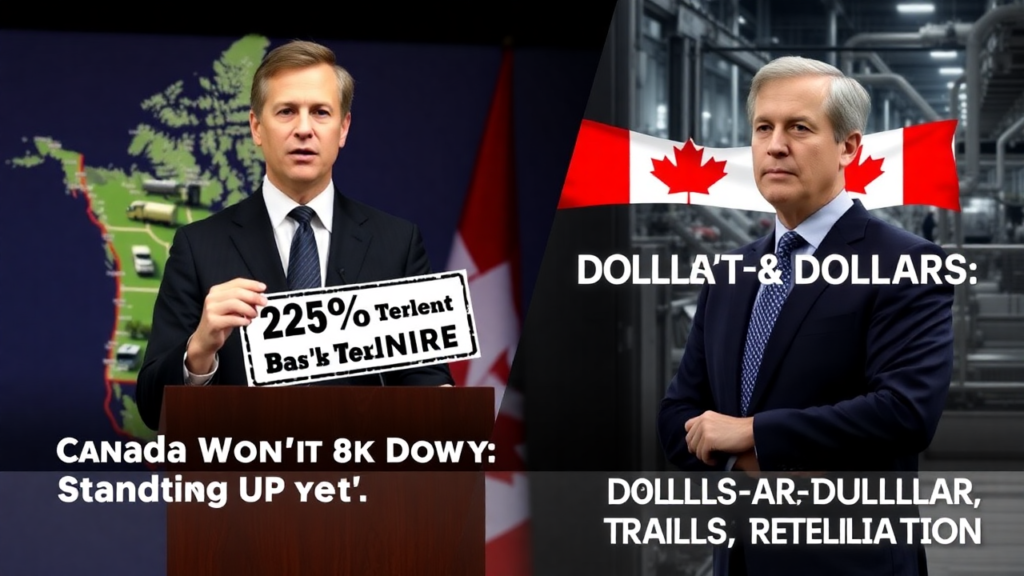
- Canada’s Firm Stance: Mark Carney, the frontrunner for Canada’s next prime minister, vows to match U.S. tariffs dollar-for-dollar, signaling Canada’s refusal to back down in the face of economic pressure.
- Economic Fallout: Trump’s tariffs threaten Canadian industries and could raise prices for American consumers, creating a lose-lose scenario for both nations.
- Unity in Response: Outgoing Prime Minister Justin Trudeau and Carney present a united front, emphasizing Canada’s determination to stand up to bullying tactics.
- Global Implications: The tariffs risk damaging the U.S.’s reputation and undermining the rules-based global trading system, pushing allies like Canada to seek stronger international partnerships.
Mark Carney, the frontrunner to become Canada’s next prime minister, has sent a clear message to the world: Canada will not back down in the face of economic aggression. In an exclusive interview with BBC Newsnight, Carney, the former governor of the Bank of Canada and the Bank of England, declared that Canada is prepared to respond to U.S. President Donald Trump’s latest tariffs with a firm, dollar-for-dollar retaliation. This bold stance underscores Canada’s resolve to defend its economic interests and stand up to what Carney describes as “bullying” tactics from its southern neighbor.
The announcement of Trump’s tariffs—a 25% levy on Canadian imports, alongside similar measures targeting Mexico and China—has sparked outrage in Canada. For a country that has long prided itself on its close trade relationship with the United States, this move is seen as a betrayal. Carney, who announced his candidacy for the leadership of Canada’s governing Liberal Party in January, minced no words in his response. “President Trump probably thinks Canada will cave in,” he said. “But we are going to stand up to a bully. We’re not going to back down.”
High-Stakes Showdown: U.S. and Canada’s Taiwan Strait Passage Sparks China’s Fury
This tit-for-tat approach is not just about economics; it’s about principle. Canada has always been a steadfast ally and trading partner to the United States, but it refuses to be pushed around. Carney’s comments reflect a broader sentiment among Canadians: enough is enough. The tariffs, which are set to take effect on February 18, are not just an attack on Canadian industries; they are an affront to the longstanding partnership between the two nations.
A History of Partnership Under Threat
The U.S.-Canada trade relationship is one of the most robust in the world, with billions of dollars in goods and services crossing the border each year. The North American Free Trade Agreement (NAFTA), which came into effect in the 1990s, was a cornerstone of this relationship, fostering economic growth and integration between the U.S., Canada, and Mexico. In 2020, the agreement was updated and rebranded as the U.S.-Mexico-Canada Agreement (USMCA), a move that was supposed to solidify trade ties for the 21st century.
High-Stakes Showdown: U.S. and Canada’s Taiwan Strait Passage Sparks China’s Fury
Yet, less than four years later, the U.S. has once again taken steps that undermine this partnership. Carney pointed out that this is the second time in less than a decade that the U.S. has “ripped up a trade agreement with its closest trading partner.” The first was Trump’s renegotiation of NAFTA, which caused significant uncertainty for Canadian businesses. Now, with the imposition of new tariffs, the U.S. is once again jeopardizing the stability of North American trade.
The Economic Fallout
The immediate impact of these tariffs on Canada’s economy could be devastating. Industries such as steel, aluminum, and automotive manufacturing, which rely heavily on cross-border trade, are likely to bear the brunt of the new levies. Economists warn that the tariffs could lead to job losses, reduced investment, and slower economic growth in Canada.
But the damage won’t be limited to Canada. American consumers and businesses will also feel the pinch. Higher tariffs on Canadian imports mean higher prices for American goods, from cars to construction materials. Inflation, already a concern in the U.S., could rise further, prompting the Federal Reserve to hike interest rates. As Carney noted, these tariffs are “going to hit growth, move up inflation, and raise interest rates.” In other words, Trump’s protectionist policies could backfire, harming the very economy he claims to be protecting.
A United Front
What’s striking about Canada’s response is the sense of unity. Outgoing Prime Minister Justin Trudeau has vowed that Canada’s retaliation will be “forceful” and “immediate.” Carney, who has secured significant support among Liberal MPs in the ongoing leadership race, has echoed this sentiment, emphasizing that Canada is “united” in its resolve to stand up to the U.S.
Canada Accuses India in High-Profile Murder, Straining Diplomatic Ties and Stalling Trade Talks
This unity is crucial. In the face of economic pressure, a divided nation is a vulnerable one. But Canada’s political leaders, across party lines, have shown a remarkable willingness to put aside differences and present a united front. This solidarity sends a powerful message to the U.S. and the world: Canada will not be intimidated.
The Broader Implications
Trump’s tariffs are not just a problem for Canada; they are part of a broader pattern of protectionism that threatens the global trading system. By imposing tariffs on Canada, Mexico, and China, the U.S. is undermining the rules-based international order that has underpinned global economic growth for decades. Carney warned that these actions are “going to damage the U.S.’s reputation around the world.”
Indeed, the U.S. risks alienating its closest allies at a time when global cooperation is more important than ever. The European Union, which Trump has also threatened with tariffs, is likely to take a similarly firm stance. If the U.S. continues down this path, it could find itself increasingly isolated on the world stage.
Canada’s Moment of Reckoning
For Canada, this is a moment of reckoning. The country has long relied on its trade relationship with the U.S., but Trump’s tariffs are a stark reminder of the risks of over-dependence on a single trading partner. In the long term, Canada may need to diversify its trade relationships, strengthening ties with Europe, Asia, and other regions.
Trump will impose new tariffs on Mexico, Canada and China on Saturday, White House says
In the short term, however, the focus is on standing firm. Carney’s promise to “match dollar for dollar” the U.S. tariffs is a clear signal that Canada will not be pushed around. This is not just about protecting jobs and industries; it’s about defending Canada’s sovereignty and its place in the world.
As the Liberal leadership race heats up, Carney’s strong stance on this issue is likely to resonate with Canadians. The winner of the race, who will be announced on March 9, will inherit the challenge of navigating this fraught relationship with the U.S. But one thing is clear: Canada is ready to fight back.
Road Ahead Fore Canada
Donald Trump’s tariffs are a test of Canada’s resolve, and the country is rising to the challenge. Under the leadership of figures like Mark Carney, Canada is sending a clear message: it will not be bullied. By standing up to the U.S., Canada is not just defending its economic interests; it is upholding the principles of fairness and reciprocity that underpin the global trading system.
In the coming months, as the tariffs take effect and the political drama unfolds, one thing is certain: Canada will not back down. This tit-for-tat approach may be fraught with risks, but it is a necessary response to an unprecedented challenge. As Carney put it, “We’re united, and we will retaliate.” In the face of adversity, Canada is proving that it is ready to stand tall.