


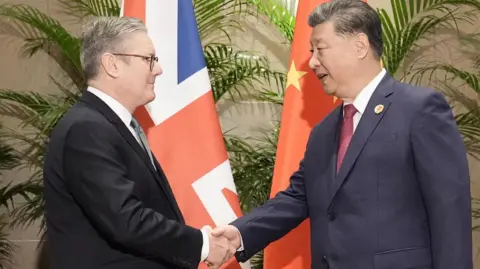
As British Prime Minister Keir Starmer steps onto Chinese soil this week for the first UK prime ministerial visit in nearly seven years, the moment carries symbolism far beyond ceremonial handshakes and polished communiqués. It marks a quiet but profound recalibration in global power dynamics — one shaped less by ideology and more by economic reality.
Only a year ago, Washington under President Donald Trump reignited its hardline “America First” posture, unleashing sweeping tariffs, technology restrictions, and diplomatic pressure aimed squarely at Beijing. The ripple effects were immediate. Traditional U.S. allies — from the UK and Canada to the European Union and South Korea — aligned with Washington’s aggressive approach. Chinese firms such as Huawei were sidelined, investment reviews tightened, and strategic decoupling became fashionable policy language.
Yet history has once again shown that geopolitics rarely moves in straight lines.
Rather than responding with impulsive retaliation, President Xi Jinping chose patience — redirecting China’s economic engine toward new markets, reinforcing domestic resilience, and positioning Beijing as a stable alternative to an increasingly unpredictable United States.
The results have been nothing short of historic.
China closed 2025 with a record trade surplus of $1.2 trillion. Monthly foreign exchange inflows surged to an unprecedented $100 billion in December alone. Official forex reserves climbed to a decade-high of $3.36 trillion. Even amid global volatility and deflationary pressures at home, China met its 5% growth target — a feat many advanced economies struggled to approach.
While Chinese exports to the U.S. dropped by 20%, Beijing seamlessly pivoted elsewhere. Shipments jumped 25.8% to Africa, 13.4% to Southeast Asia, 8.4% to the European Union, and 7.4% to Latin America. The message was clear: China no longer depends on any single market.
This economic rebalancing has transformed political relationships.
Canada’s Prime Minister Mark Carney made a groundbreaking visit to Beijing earlier this month — the first since 2017 — signing an economic framework aimed at tearing down trade barriers and establishing a “new strategic partnership.” Carney openly described China as a “predictable and reliable partner,” a striking contrast to rhetoric just a year earlier.
Now Britain is following suit.
Starmer’s four-day visit is expected to focus on reviving business cooperation in finance, green energy, technology, healthcare, and infrastructure — sectors where UK firms once enjoyed privileged access before relations soured. Prior to tensions, bilateral trade between China and the UK hovered around $110 billion annually, with China being Britain’s third-largest trading partner.
British businesses, particularly in banking, insurance, asset management, and renewable technologies, are eager to regain momentum in the world’s second-largest economy — now backed by a $20 trillion GDP and capital markets valued at nearly $45 trillion.
China’s financial resilience has further enhanced its appeal.
The Shanghai Composite Index surged 27% over the past year, outperforming U.S. equities. Market turnover hit record highs. Perhaps most transformative has been the expanding global role of the yuan. More than half of China’s cross-border transactions are now settled in its own currency — up from virtually zero fifteen years ago. Nearly half of China’s overseas lending is now denominated in renminbi.
With Trump’s erratic trade diplomacy making the dollar less attractive for long-term stability, major global banks are rapidly boosting yuan liquidity across Asia, Europe, and the Middle East. Faster yuan settlement frameworks are being built along China’s key trade corridors.
In essence, Beijing is not just reshaping trade flows — it is quietly rewriting the architecture of global finance.
China has also moved to open its domestic economy further. Pilot programs in Beijing, Shanghai, and other regions now allow expanded foreign participation in telecoms, healthcare, education, and professional services. These steps are designed to reassure investors that China remains committed to integration, not isolation.
For leaders like Starmer, the calculation is increasingly pragmatic.
While the U.S. remains a vital ally, its shifting policies, tariff reversals, and confrontational diplomacy have injected uncertainty into global markets. In contrast, Beijing has deliberately cultivated an image of predictability — positioning itself as a long-term partner willing to engage even former critics.
As Boston College economist Aleksandar Tomic observed, “The more the U.S. becomes difficult to deal with, the more space opens up for China.”
Yet the pivot toward Beijing is not without caution.
Analysts in Washington and parts of Europe warn that distrust of U.S. volatility does not automatically translate into trust in China. Concerns remain over trade practices, geopolitical leverage, and unresolved regional disputes. But in today’s economic climate, strategic hesitation is increasingly outweighed by commercial necessity.
What is unfolding is not a sudden ideological embrace of Beijing — but a recognition of where economic gravity now lies.
Xi Jinping’s long game appears to be paying off.
His sweeping anti-corruption campaigns strengthened state authority at home. Massive investments in infrastructure, technology, green energy, and manufacturing moved China up the global value chain. And his disciplined foreign economic strategy ensured that when pressure came from Washington, China had alternatives ready.
Now, former critics are lining up at Beijing’s door.
From Ottawa to London, from Brussels to emerging markets across Africa and Southeast Asia, governments are recalibrating their policies around China’s undeniable economic weight.
Keir Starmer’s arrival in Beijing is therefore more than a diplomatic visit — it is a public acknowledgement of a shifting world order.
Old alliances remain, but new realities are shaping decisions.
In a global system once dominated by Western economic leadership, China has emerged as the central pillar of trade growth, financial expansion, and strategic stability.
The era of unquestioned U.S.-led economic alignment is fading.
A multipolar world is taking form — and at its core stands China.
As Britain’s prime minister is welcomed in Beijing, the moment underscores a simple but powerful truth: in global politics, patience often outlasts pressure.
And in today’s evolving order, it is China — steady, resilient, and increasingly indispensable — that is setting the pace for the future.