


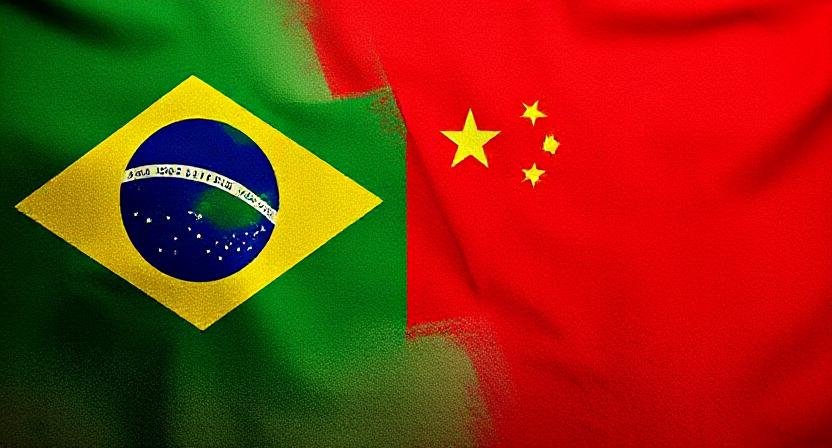
- China signals readiness to invest in Brazil’s $125 billion Tropical Forests Forever Facility (TFFF), a bold step in global climate finance.
- Bilateral trade between China and Brazil soared to a record $176 billion in 2024, with projections of $25 billion in new Chinese investments by 2030.
- China’s involvement could transform emerging economies’ role in climate action, amid Western nations’ retreat from major funding commitments.
- Key Chinese investments target Brazil’s renewable energy, lithium mining, infrastructure, and agricultural sectors, redefining South-South cooperation.
In a groundbreaking shift in global climate diplomacy and South-South cooperation, China has signaled its intention to invest in Brazil’s ambitious “Tropical Forests Forever Facility” (TFFF)—a multilateral climate fund aimed at conserving the world’s endangered tropical forests, sources with direct knowledge of the negotiations revealed exclusively to The Islamabad Telegraph.
World Markets Surge as U.S. and China Begin Dismantling Trade Barriers in Landmark Breakthrough
The Chinese investment, which Brazilian officials view as imminent, could mark a historic turning point in climate financing, traditionally dominated by wealthy industrialized nations. The move comes amid an era of retreat by the U.S. and other developed countries from their earlier financial pledges to support global climate action.
“China’s commitment sends a powerful message: emerging economies are stepping up where the old guard is faltering,” said a senior Brazilian diplomat involved in the talks, speaking on condition of anonymity.
Brazil-China Climate Partnership: A New Chapter
The decision emerged from high-level discussions on the sidelines of the BRICS finance ministers’ meeting this week in Rio de Janeiro, where Chinese Finance Minister Lan Fo’an conveyed China’s readiness to support the TFFF to his Brazilian counterpart, Fernando Haddad.
“Minister Lan expressed genuine interest in the fund and assured Brazil that China will collaborate,” confirmed a senior Brazilian official who witnessed the conversation. While the exact financial commitment remains undisclosed, diplomatic sources say a formal announcement is likely at COP30, scheduled for November in Belem, deep in the heart of the Amazon.
The TFFF is envisioned as a $125 billion fund that would combine sovereign and private contributions. The fund aims to offer annual stipends to countries based on the extent of their preserved tropical forests—a bold and innovative model blending conservation incentives with sustainable development.
READ MORE: U.S. and China Reach Rare Earths Deal, Reviving Trade Hopes and Easing Supply Chain Tensions
Climate Leadership Beyond the West
Brazilian President Luiz Inácio Lula da Silva, a vocal champion of Amazon conservation, first raised the TFFF proposal during his May 2023 visit to Beijing, where he held discussions with President Xi Jinping. Since then, Brazil has been actively courting not just China but also Middle Eastern, European, and ASEAN nations to back the initiative.
Key Highlights:
-
$176 billion: Current China-Brazil annual trade volume (2024)
-
$25 billion: Projected new Chinese investments in Brazil by 2030
-
$125 billion: Size of proposed Tropical Forests Forever Facility
-
Top Sectors: Renewable energy, infrastructure, EVs, mining, agriculture
The significance of China’s role cannot be overstated. The country is not only the largest emitter of greenhouse gases but also the single largest trading partner for Brazil, giving this move added economic and geopolitical weight.
The Numbers: China-Brazil Trade Booming
China and Brazil’s economic relationship has flourished in recent years. In 2024, bilateral trade reached a record $176 billion, up from $150 billion in 2023—a nearly 17% annual increase, according to Brazil’s Ministry of Economy.
ALSO READ: Exclusive: China signals investment in Brazil-led global forest fund, sources say
China is Brazil’s top export destination, with major Brazilian exports including soybeans, iron ore, oil, and beef. In return, Brazil imports Chinese machinery, electronics, and manufactured goods.
Economic analysts project that Chinese investments in Brazil could surpass $100 billion by 2030, with up to $25 billion earmarked for new investments over the next five years. The sectors attracting the most Chinese interest include:
-
Renewable Energy: Wind, solar, and hydroelectric projects in Brazil’s vast landscapes.
-
Electric Vehicles (EVs) and Lithium Mining: With Brazil’s untapped lithium reserves, Chinese battery and EV giants are eyeing joint ventures.
-
Infrastructure: Railroads, ports, and digital infrastructure, including 5G networks led by Chinese telecoms.
-
Agriculture and Food Processing: As China seeks food security, Brazil’s agri-sector remains key.
“The China-Brazil economic corridor is evolving from pure trade into deeper investment and technology transfer,” said Maria Solange Vieira, a leading economist at the Federal University of Rio de Janeiro.
A Greener Bilateral Future
The TFFF marks a new dimension in China-Brazil ties—one that transcends commerce and enters the realm of shared global responsibility. It comes at a time when many developed countries are scaling back their financial commitments, including the United States, whose early support for the fund waned under former President Donald Trump’s withdrawal from the Paris Agreement.
At last year’s COP28 in Dubai, developing nations lambasted wealthy countries for falling short on the $300 billion annual global finance goal, far below the $1.3 trillion economists say is needed annually to meet climate challenges.
The involvement of China, alongside early signals of support from the UK, France, Germany, Norway, Singapore, and the UAE, breathes new life into the climate financing debate and offers hope for nations with dwindling forest cover.
Global Stakes in the Amazon
Preserving the Amazon rainforest is not just a Brazilian priority—it’s a planetary necessity. Tropical forests absorb up to 30% of the world’s carbon emissions and are home to unparalleled biodiversity.
“If we fail to protect the Amazon, the climate battle is already lost,” said Carlos Nobre, a Brazilian climate scientist and member of the UN Intergovernmental Panel on Climate Change (IPCC).
Outlook: From Trade to Environmental Powerhouse
Looking ahead, Brazil and China’s relationship could evolve into a model for green development and climate cooperation among emerging economies. The anticipated Chinese investments, both in the TFFF and in key sectors, are set to:
-
Boost Brazil’s economy through sustainable growth,
-
Position China as a global environmental leader in addition to its industrial might,
-
Provide new diplomatic leverage for both countries in multilateral platforms such as BRICS, the G20, and COP.
Diplomatic insiders suggest that the next phase may involve joint China-Brazil-led initiatives in the Amazon, including technology transfers, satellite monitoring of deforestation, and renewable energy projects that benefit local communities.
As the world gears up for COP30 in Belem, all eyes will be on Brazil and China—two emerging giants potentially reshaping not just the global economy, but the global environmental agenda.