


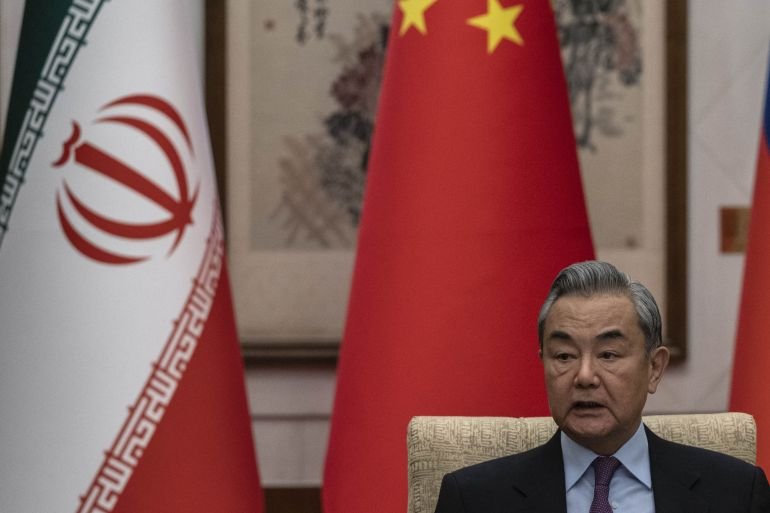
- China Iran US crisis deepens after U.S. blockade of Iranian ports following failed diplomacy
- Beijing urges restraint and positions itself as a key power broker in the Gulf
- Strait of Hormuz disruption threatens global oil supply and economic stability
- Pakistan-backed ceasefire hangs in the balance amid rising military pressure
The air in Islamabad had barely settled after what diplomats described as “marathon but inconclusive” talks when the crisis took a sharper, more dangerous turn. The Pakistan-brokered ceasefire between Washington and Tehran—hailed just days earlier as a rare diplomatic breakthrough—now hangs by a thread.
At the center of this renewed tension is Donald Trump, whose decision to impose a sweeping naval blockade on Iranian ports marks a dramatic escalation. Within hours, the Strait of Hormuz—the world’s most critical energy artery—was thrust back into the spotlight, its narrow waters once again a stage for great power confrontation.
But while Washington flexes its military muscle and Tehran signals defiance, a quieter, more calculated power is moving behind the scenes: China.
Strait of Hormuz Blockade Triggers Global Economic Shock After Failed US-Iran Talks
Beijing’s response was swift but measured. At a routine press briefing, Chinese officials called for “calm and restraint,” urging all parties to respect the ceasefire framework that Pakistan had painstakingly assembled. Yet beneath the diplomatic language lies a deeper strategic calculation—one that could ultimately determine whether this crisis spirals into war or retreats into uneasy peace.
China is not a bystander in this conflict. It is, in many ways, the unseen stakeholder with the most to lose—and potentially, the most to gain.
Before the war disrupted regional flows, China was the primary destination for Iranian oil, quietly sustaining Tehran’s economy even under the weight of Western sanctions. That economic lifeline has now become a pressure point. For Iran, alienating Beijing is not an option. For China, preserving stability in the Gulf is not just about energy—it is about safeguarding its global economic ambitions.
Iran releases assets of women’s football captain in Australia asylum row
This is where Beijing’s leverage begins to take shape.
Unlike the United States, China does not issue ultimatums. It signals. It nudges. It recalibrates. A slowdown in oil purchases, a delay in financial settlements, or even a subtle shift in diplomatic tone—these are the instruments through which China can influence Tehran’s calculus without firing a single shot.
Yet China’s reach extends beyond Iran.
The U.S. blockade, if sustained, risks triggering a global economic shock. Any disruption in the Strait of Hormuz would send oil prices surging, rattling markets from Asia to Europe. For Washington, this is not just a military gamble—it is a political one. Rising energy costs could reverberate domestically, testing economic resilience and public patience.
US-Iran Talks Islamabad: JD Vance, Kushner Arrive as Pakistan Sets Stage for Historic Negotiations
Here, China finds its second lever: global pressure.
Through platforms like the United Nations and through backchannel diplomacy with European and Gulf states, Beijing can build a coalition of concern—one that quietly pushes Washington toward de-escalation. It is a strategy rooted not in confrontation, but in convergence of interests.
And then there is Pakistan.
Often underestimated in global diplomacy, Islamabad has once again positioned itself as a bridge between adversaries. The recent talks—though inconclusive—were themselves a breakthrough, bringing American and Iranian officials to the same table. China understands the value of this channel. As Pakistan’s closest strategic partner, Beijing can reinforce and expand this diplomatic corridor, transforming a fragile ceasefire into a more durable framework.
But China’s approach is not without its constraints.
It lacks the military footprint of the United States in the Gulf. It cannot enforce maritime security in the way Washington can. Its strength lies elsewhere—in patience, in economic gravity, and in its ability to operate in the grey zones of diplomacy.
Still, in a conflict where both sides face mounting costs, that may be enough.
For Iran, escalation risks economic suffocation. For the United States, a prolonged blockade risks global backlash and strategic overreach. China, positioned carefully between the two, offers something neither side can ignore: an exit without humiliation.
The coming days will be critical.
If Beijing can translate its calls for restraint into coordinated diplomatic action—leveraging Islamabad’s role, engaging global stakeholders, and quietly pressuring both Tehran and Washington—it may yet succeed in pulling the region back from the brink.
If it fails, the consequences will not be confined to the Gulf.
They will ripple across global markets, redraw alliances, and test the limits of diplomacy in an increasingly fragmented world.
For now, all eyes remain fixed on the Strait of Hormuz—where war and peace are separated by little more than calculation, and where China’s silent hand may prove decisive.