


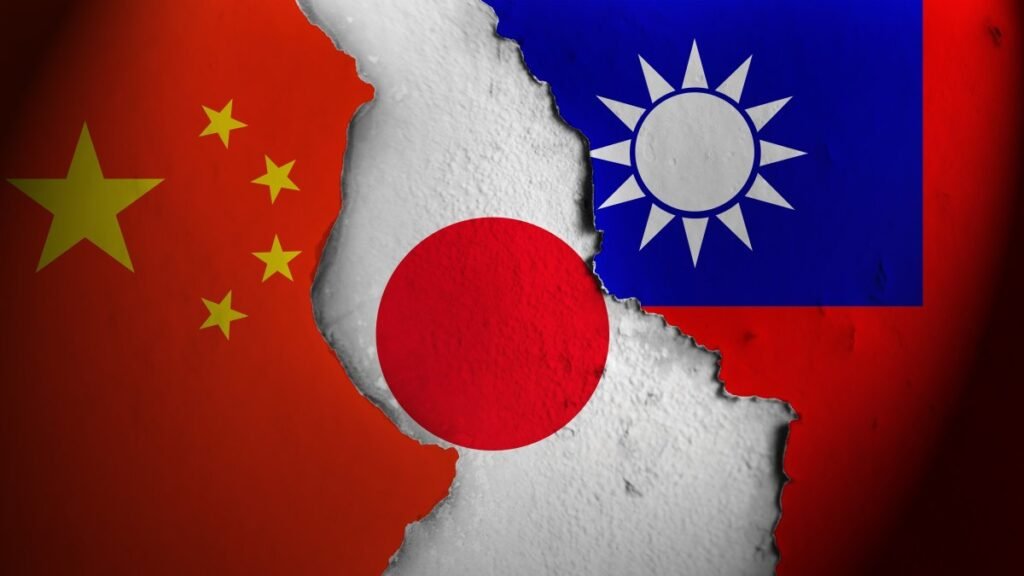
- China-Japan tensions escalate as Japan’s PM Takaichi pushes for constitutional remilitarization and a more assertive stance on Taiwan.
- Taiwan’s semiconductor industry, crucial to AI and global technology, faces unprecedented geopolitical risk from rising regional hostilities.
- A worst-case U.S.–China conflict over Taiwan could shrink global GDP by $10.6 trillion in the first year, impacting economies across Asia, Europe, and the United States.
- Even limited escalations, including blockades or military skirmishes, could severely disrupt trade routes, supply chains, and global markets.
China and Japan are entering a perilous phase of geopolitical friction following Japanese Prime Minister Sanae Takaichi’s decisive electoral victory, raising alarm bells across Asia and global boardrooms. Takaichi, known for her assertive stance on Taiwan, has signaled plans to enshrine the Self-Defense Forces into Japan’s Constitution, a move Beijing says signals a dangerous drift toward remilitarization.
At a press briefing on Tuesday, Jiang Bin, spokesperson for China’s Ministry of National Defense, condemned Japan’s ambitions. “For a long time, the Japanese government has used the trick of so-called constitutional reinterpretation to repeatedly break through the limits of its exclusively defense-oriented policy,” Jiang said. “Japan seeks to revive the evil path of militarism, cloaked hypocritically in the guise of the rule of law.” He urged the international community to remain vigilant and resist such maneuvers.
Takaichi’s rise has emboldened Japan’s right-wing factions, which analysts say could destabilize the post-war regional order. Taiwan is at the center of the AI-driven global economy, housing roughly 90% of advanced semiconductor manufacturing, supplying critical chips for smartphones, automobiles, and defense technology. Any disruption in Taiwan could ripple across the global economy, affecting trade, supply chains, and markets.
Bloomberg Economics has modeled five potential scenarios in the Taiwan Strait, ranging from détente to full-scale conflict. In a worst-case U.S.–China war over Taiwan, global GDP could contract by $10.6 trillion (9.6%) in the first year—worse than the 2008 financial crisis or the COVID-19 pandemic. Taiwan’s economy could shrink by 40%, China’s by 11%, and the U.S. by 6.6%, with Europe and East Asia also suffering severe losses.
The United States plays a pivotal role in this equation. Washington has long maintained strategic ambiguity toward Taiwan, committing to its defense without formally recognizing independence. Yet Takaichi’s assertive posture, combined with Japan’s growing military capacity, could draw the U.S. into direct involvement. Senior U.S. officials have reportedly begun recalibrating force deployments in the Western Pacific, including rapid-reinforcement options and expanded joint exercises with Japan. Analysts warn that any misstep could escalate a regional standoff into a global crisis.
Even less extreme scenarios—a naval blockade, limited skirmishes, or heightened military posturing—could trigger serious economic damage. Semiconductor shortages could stall global industries from AI-driven cloud computing to automotive manufacturing. The Taiwan Strait, one of the busiest maritime corridors in the world, could see disrupted trade in energy, commodities, and finished goods, amplifying supply-chain fragility.
China’s growing military capabilities, coupled with uncertainty over U.S. commitment, have eroded the fragile status quo. Experts caution that Takaichi’s constitutional revision agenda and aggressive Taiwan rhetoric could be the spark that ignites a wider crisis. “A little spark can turn into a flash point,” said a senior regional analyst. “The economic and strategic costs of miscalculation are almost unimaginable.”
Japan frames these constitutional changes as defensive modernization, but Beijing interprets them as a provocative escalation. Analysts suggest Japan’s militarization ambitions, if unchecked, could trigger a regional arms race, increase defense spending across Asia, and shift global supply chains as corporations hedge against potential conflict risks. The U.S., meanwhile, faces the delicate task of balancing deterrence, alliance commitments, and economic exposure.
For CEOs, policymakers, and international think tanks, the warning is clear: Taiwan is no longer just a regional concern—it is a global economic and security fulcrum. With China-Japan tensions rising, and the U.S. positioned as a central actor, the world faces a potential trillion-dollar flashpoint that could reshape trade, investment, and defense strategies for decades.