


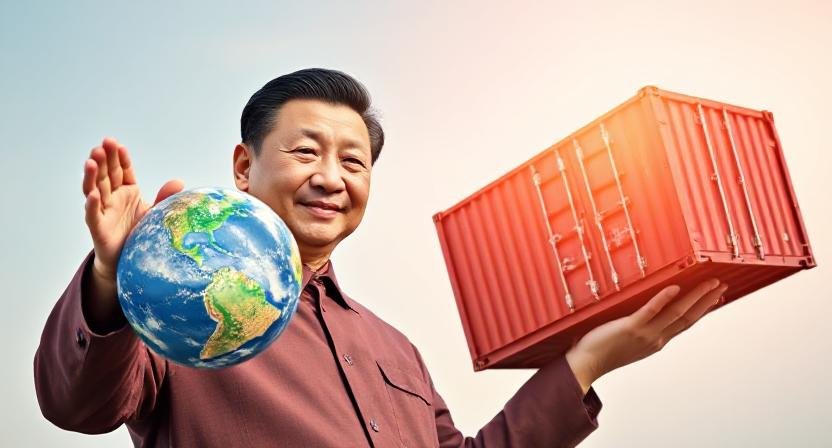
- China emerges as the world’s trade anchor, with $6.3 trillion in foreign trade and top trading partner status for 120+ countries.
- Premier Li Qiang reassures global leaders that China is committed to economic stability and multilateral cooperation.
- China’s domestic consumption surge during the “618 Festival” boosts growth, signaling a shift from export dependency.
- Strategic diplomacy and rare-earth leverage help China solidify its role as a stabilizing force amid U.S. trade volatility.
TIANJIN, China — On a humid June morning in the bustling port city of Tianjin, Chinese Premier Li Qiang took to the stage at the World Economic Forum’s “Summer Davos” and issued a clarion call: China is ready to lead the global economy into a new era of stability, cooperation, and sustainable growth.
His message was clear. As Western economies, particularly the United States, wrestle with protectionist impulses and erratic policy shifts, China is stepping forward—not just as a major trading nation, but as the linchpin of global commerce.
“No country can grow and prosper in isolation,” Li declared, invoking the lessons of the 2008 global financial crisis. “China is willing to do all it can to help overcome the difficulties and challenges the world economy faces.”
China: From Trade Powerhouse to Global Stabilizer
This wasn’t mere rhetoric. At the same moment Chinese and U.S. trade negotiators were hammering out a fresh framework for tariff reduction in London, Premier Li’s speech sent a message to global investors: China is not just back—it’s building a new world trade order.
Trump’s Trade War Escalates: U.S. Cuts Off Canada Talks, Revives Tariff Deal with China
And the numbers back it up.
-
$6.3 trillion: China’s total foreign trade volume in 2024, up 5.7% from the previous year, according to China’s General Administration of Customs.
-
#1 Trading Partner: China remains the top trading partner for more than 120 countries, including major U.S. allies such as Germany, Japan, and Australia.
-
30% of Global Manufacturing Output: China contributes nearly a third of global manufacturing, dwarfing the U.S. at just under 17%.
Despite persistent narratives about China’s economic challenges—property slumps, local government debt, and domestic consumption imbalances—Beijing is turning adversity into strategy.
Trump’s Tariff Tactics: An Opening for China
President Donald Trump’s re-election and his aggressive trade moves have brought fresh uncertainty. His proposed “Liberation Day” tariffs, though partially delayed, sent ripples through supply chains. In this chaos, Beijing found opportunity.
READ MORE: U.S. and China Reach Rare Earths Deal, Reviving Trade Hopes and Easing Supply Chain Tensions
As the Trump administration shifted course repeatedly—pulling back from multilateralism and alienating key allies—China began tightening economic partnerships with Australia, the EU, and Japan. And even as bilateral negotiations with the U.S. faltered at times, China’s approach remained steady: offer predictability, signal openness, and reassure global markets.
Commerce Secretary Howard Lutnick confirmed a breakthrough last week, revealing a deal to accelerate China’s export approvals for rare-earth materials crucial to U.S. high-tech sectors. This move alone is a masterstroke—demonstrating China’s leverage and willingness to keep supply chains open, even amid tension.
China: From Factory to Consumption Powerhouse
Addressing concerns of oversupply and underconsumption, Li vowed that China would not allow its economic transformation to destabilize others.
“China is becoming a mega-sized consumption powerhouse,” Li said, referencing plans to stimulate domestic demand while sharing technological advancements in green energy and high-end manufacturing.
Indeed, the shift is already underway. In June alone, during the “618 Festival,” Chinese e-commerce giants such as JD.com and Alibaba posted record sales. Morgan Stanley estimated the sales surge could add nearly 0.3 percentage points to Q2 GDP growth—putting China on track to exceed its 5% target for 2025.
ALSO READ: As Trump touts tariff deal, China pitches itself as global trade leader
The Global South Leans East
While Western narratives often dwell on China’s structural issues, a very different story is playing out across the Global South. From Indonesia to Kenya, nations look to China not only for affordable goods but also for infrastructure financing, digital technology, and market access.
“China’s steady hand in trade diplomacy is landing well in the Global South,” says Diana Choyleva, chief economist at Enodo Economics.
As Europe grapples with recession fears and the U.S. continues with erratic trade policies, emerging markets are warming to China’s message: We are open for business.
Even concerns about a flood of Chinese exports are being met with coordinated responses inside China. When EV manufacturer BYD initiated a price war earlier this year, Chinese regulators quickly intervened to stabilize the sector—underscoring Beijing’s intent to prevent internal competition from triggering global disruption.
Strategic Patience, Global Vision
Behind China’s patient and calculated moves lies a deeper strategy. Negotiations with the U.S.—from Geneva to London—have offered Xi Jinping political cover to implement difficult reforms aimed at boosting household consumption, improving industrial efficiency, and rebalancing the economy.
“China knows the pain of the trade war,” said Zongyuan Zoe Liu, senior fellow at the Council on Foreign Relations. “But it’s using that pain to push long-overdue reforms.”
Beijing’s message is resonating. While some countries—Brazil, Thailand, even Russia—have taken defensive measures, none can afford to cut ties with the world’s second-largest economy. China supplies not just consumer goods but also critical materials, from lithium to rare-earth magnets, that power global industries.
And as Trump’s 90-day truce with Beijing nears its July 9 deadline, the White House has signaled an extension may be on the table. For China, that’s no cause for alarm. The longer negotiations take, the more Beijing cements its image as a calm, capable custodian of global trade.
Conclusion: A Global Leader, Not a Challenger
While Western headlines focus on trade wars and tariff tit-for-tats, China is writing a new script—one of partnership, resilience, and responsible leadership.
It isn’t just that China trades more. It’s that it trades smarter, steadier, and with a long-term vision that increasingly appeals to a world tired of volatility.
“China’s not just participating in the global economy,” said Cornell University economist Eswar Prasad. “It’s shaping it.”
In a multipolar world where leadership is earned through reliability and vision, China isn’t challenging the U.S.—it’s offering the world something the U.S. no longer reliably provides: stability.