


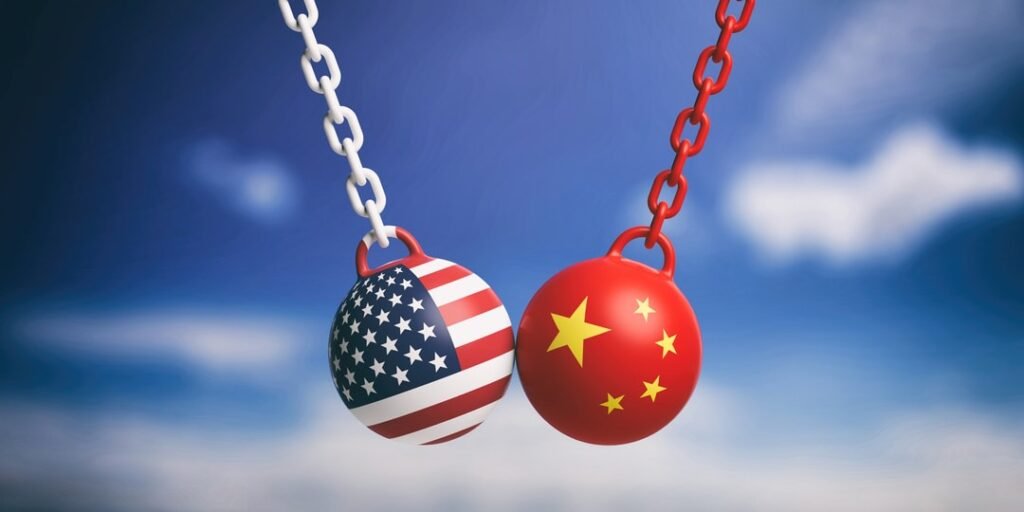
- China says the U.S. “grossly distorted” its rare earth policy to stir panic and misinformation.
- U.S. officials accuse Beijing of attempting to dominate the global supply chain for critical minerals.
- The rare earths dispute threatens to derail the upcoming Trump–Xi meeting in South Korea.
- Analysts warn of a looming “Critical Minerals Cold War” that could reshape global trade and technology.
China has accused the United States of deliberately “stoking panic” and “grossly distorting” facts surrounding its rare earth export controls, escalating tensions just weeks before President Donald Trump and Chinese leader Xi Jinping are set to meet in South Korea. The rebuke, delivered through both official statements and the Communist Party’s flagship newspaper, marks a fresh turning point in a trade relationship already strained by tariffs, technology bans, and personal jabs between negotiators.
He Yongqian, spokesperson for China’s Ministry of Commerce, said at a Thursday press conference that Washington’s response to the rare earth controls was “a deliberate attempt to mislead global markets and sow unnecessary confusion.”
“Provided export licence applications are compliant and intended for civilian use, they will be approved,” He clarified, rejecting claims that Beijing was plotting to weaponize its dominance in the global rare earth supply chain.
The accusation came after U.S. Treasury Secretary Scott Bessent called China’s chief trade negotiator, Li Chenggang, “unhinged and disrespectful,” while alleging Beijing’s new export regime represented a “global supply chain power grab.”
Background: A Strategic Resource War
Rare earth elements—17 minerals essential for high-tech manufacturing, from electric vehicles to missile systems—have long been a quiet battlefield between Washington and Beijing. China controls nearly 70% of global production and an even greater share of processing capacity, giving it a powerful lever in geopolitical disputes.
The U.S., meanwhile, has sought to diversify its supply chain through partnerships with allies like Australia and Canada, while investing heavily in domestic mining projects. Yet despite years of effort, Washington remains vulnerable to Chinese policy shifts.
The immediate trigger for the current flare-up dates back to late September, when the U.S. expanded its “Entity List” to include Chinese firms accused of evading chip export restrictions. In what many analysts interpreted as retaliation, Beijing tightened its licensing requirements for rare earth exports—measures set to take effect on November 8.
Trump, describing China’s move as “shocking,” threatened 100% tariffs on Chinese goods unless Beijing rolled back the controls. That ultimatum has cast a shadow over the planned Trump–Xi summit, seen as a critical opportunity to stabilize relations after months of diplomatic turbulence.
Trading Accusations and Tense Diplomacy
The rhetoric has grown increasingly personal.
Bessent accused Vice Minister Li of “threatening to unleash chaos on the global system” if the U.S. implemented new port fees, claiming Li had “invited himself to Washington” for talks in August. Beijing rejected that characterization as “absurd and disrespectful.”
“The relevant remarks of the U.S. side seriously distort the facts,” He Yongqian said Thursday. “China has taken the initiative to negotiate and communicate with the United States in good faith. It is hoped that Washington will cherish the achievements of earlier economic and trade talks and correct its wrongdoings immediately.”
The People’s Daily, in a rare direct intervention, published a seven-point rebuttal comparing China’s export controls with Western standards. One graphic pointed out that the U.S. controls more than 3,000 items under its own export regime—far greater than China’s 900.
“Implementing such export controls is consistent with international practice,” the newspaper declared, accusing Washington of “weaponizing hypocrisy” and “hiding protectionism behind the veil of national security.”
Global Stakes: Markets and Manufacturing on Edge
Global markets, already rattled by the specter of renewed tariffs, have so far avoided a major panic. Investors are clinging to hopes that the upcoming Trump–Xi meeting in South Korea will yield a truce similar to the one struck in September after the Madrid TikTok summit, where both sides claimed a diplomatic win.
Still, analysts warn the rare earth issue could spiral quickly if politicized further.
“Rare earths are China’s ace in the deck,” said Dr. Elaine Cho, an energy economist at the University of Seoul. “If Beijing feels cornered, it can disrupt not just U.S. manufacturing, but the entire global clean tech sector overnight.”
American companies, particularly in defense, semiconductors, and renewable energy, are already lobbying Washington for clarity. A prolonged standoff could choke supply chains and derail production across industries dependent on Chinese materials.
Prophecy: The Coming “Critical Minerals Cold War”
The latest episode signals a deeper structural shift in U.S.-China relations—one that transcends tariffs and trade. The real battle, experts say, is for technological sovereignty. Rare earths are not just metals; they are the bedrock of strategic autonomy in the 21st century.
If Washington and Beijing fail to de-escalate before the November 8 deadline, analysts foresee the emergence of a “Critical Minerals Cold War,” where countries align not by ideology but by resource security.
China, sitting atop the largest reserves and most advanced refining network, could leverage its dominance to cement new partnerships across Africa, Latin America, and Central Asia—regions eager for investment. The United States, meanwhile, may deepen alliances with mineral-rich democracies but faces the uphill task of rebuilding domestic capability.
In this unfolding drama, both sides appear to be testing each other’s limits—Trump through economic brinkmanship, Xi through calculated restraint. Yet behind the posturing lies an uneasy truth: neither can afford a rupture that sends markets into freefall.
For now, the world watches as two superpowers lock horns over the invisible materials powering modern civilization. What began as a trade dispute has evolved into a contest over the future of industrial supremacy—and the outcome could define the balance of global power for decades to come.