


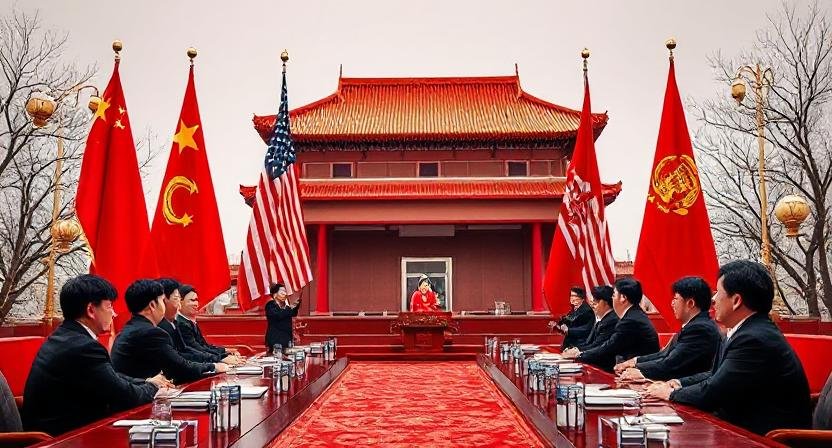
STOCKHOLM — With the world economy on edge, top U.S. and Chinese officials gathered in Sweden’s capital on Tuesday for a second day of tense, high-stakes trade talks aimed at defusing a rekindled economic war between the globe’s two largest economies. The meetings — held discreetly at Rosenbad, the Swedish Prime Minister’s official office — have not produced immediate breakthroughs but could pave the way for another 90-day truce in a tariff war threatening global supply chains.
Leading the U.S. delegation is Treasury Secretary Scott Bessent, while China is represented by Vice Premier He Lifeng. The urgency behind the talks is clear: a looming August 12 deadline could snap tariffs back to triple-digit levels, effectively amounting to a partial trade embargo unless a fresh deal is struck.
“The risks of failure are massive — not just for Beijing and Washington but for the entire global economy,” said Dr. Anna Helgesson, senior fellow at the Stockholm Institute for International Economics. “The resumption of these talks signals both sides understand they are playing with fire.”
U.S.–Japan Trade Deal Lowers Tariffs, Calms Market Jitters Amid Economic Uncertainty
The negotiations follow President Donald Trump’s recent landmark trade deals with the European Union and Japan. The EU deal, slashing tariffs on most goods by 15%, was hailed by Washington but triggered backlash in Brussels. France condemned it as “a submission,” and Germany warned of “significant economic dislocation.”
- High-Level Diplomacy: U.S. Treasury Secretary Scott Bessent and China’s Vice Premier He Lifeng resumed talks in Stockholm to avert tariff escalations.
- Rare Earth Leverage: China holds strategic advantage through its dominance in rare earth minerals crucial for global manufacturing and defense.
- Summit Speculation: Trump denies actively seeking a meeting with Xi Jinping despite media reports of paused tech export bans.
- Global Stakes: Without a deal by August 12, tariffs could snap back to triple-digit levels, risking a trade freeze with global consequences.
Beijing, meanwhile, is adopting a more calculated stance. Unlike the EU, China does not rely on U.S. military security guarantees and retains powerful leverage — particularly in rare earth minerals, which are essential to everything from electric vehicles to missile systems. The flow of these materials was halted by China earlier this year in retaliation for U.S. technology restrictions.
“China knows it has leverage, especially with rare earth exports and its centrality to manufacturing supply chains,” said Cyrus de la Rubia, chief economist at Hamburg Commercial Bank. “Unlike Europe, it won’t be pushed into a corner.”
READ MORE:US, China resume talks in Stockholm to ease tariff hostilities
Still, tensions remain acute. At the heart of Washington’s grievances is China’s state-led economic model, which the U.S. says distorts global markets by flooding them with subsidized goods. Beijing, in turn, accuses the U.S. of weaponizing national security laws to impose tech export bans that hobble Chinese innovation.
The talks have also been clouded by uncertainty around a potential summit between Trump and Chinese President Xi Jinping. While the Financial Times reported that the U.S. paused certain tech export restrictions to facilitate such a meeting, Trump dismissed suggestions he was actively seeking it.
“This is not correct, I am not SEEKING anything!” Trump wrote on Truth Social. “I may go to China, but it would only be at the invitation of President Xi, which has been extended. Otherwise, no interest!”
ALSO READ:EU-U.S. Tariff Truce: Trump’s Scotland Deal Calms Markets, Raises Strategic Questions
The ambiguity has only added to market jitters, with global traders closely watching Stockholm for signals. Monday’s closed-door session lasted over five hours, and both sides remained silent afterward. Observers believe the most likely outcome is a tactical pause — another 90-day extension to the truce struck in May — rather than a sweeping deal.
Washington hopes to push Beijing toward a structural shift away from exports to domestic consumption — a transformation U.S. policymakers have sought for decades. Bessent has signaled openness to a deadline extension but warned time is running out.
“It’s a window, not a solution,” said Helgesson. “Unless there’s real movement, we’ll be back at square one by fall — and the tariffs will be the least of our worries.”
Whether this round of diplomacy can defuse one of the most consequential economic rivalries of the 21st century remains uncertain. What is clear, however, is that both Beijing and Washington have recognized that brinkmanship now comes with escalating global costs — from tech disruption and commodity volatility to strategic alliances under strain.