


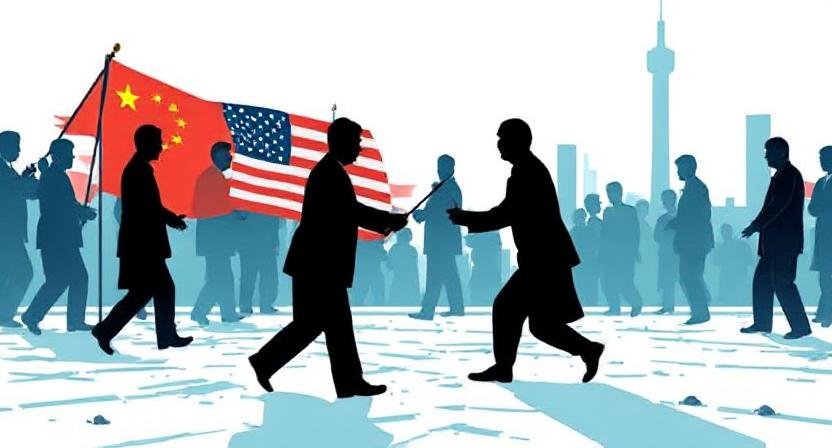
- U.S. and China strike limited trade reset after intense London negotiations, reversing some punitive measures amid ongoing economic tensions.
- Rare earth restrictions eased by China, while the U.S. rolls back proposed visa limits and export controls—raising security concerns.
- Tariffs remain largely unchanged, despite Trump touting a 55% rate; legal challenges to tariff authority continue in U.S. courts.
- Experts warn of strategic concessions, noting that national security tools were put on the table, potentially weakening U.S. leverage.
In a development pitched by former President Donald Trump as a “done deal,” the United States and China have agreed to reverse some of the punitive steps each nation had taken amid a months-long trade and tech standoff. The accord, reached after two intense days of closed-door negotiations in London, reportedly restores conditions similar to a trade truce first struck in May—but analysts suggest the cost to U.S. leverage may be higher than the fanfare suggests.
Announcing the deal in his signature bombastic style on Truth Social, Trump declared: “OUR DEAL WITH CHINA IS DONE, SUBJECT TO FINAL APPROVAL WITH PRESIDENT XI AND ME. RELATIONSHIP IS EXCELLENT!” Yet for all the celebratory rhetoric, substantive details remain scarce, raising questions about what concessions were made and who truly benefited.
According to preliminary accounts from both sides, the agreement sees China loosening restrictions on the export of rare earth minerals and industrial magnets—resources the U.S. manufacturing sector critically relies upon. In return, the Trump administration has reportedly agreed to rescind proposed limits on Chinese student visas and to ease controls on certain exports, including components used in aerospace manufacturing and semiconductor production. Also on the rollback list are tariffs targeting American ethane exports to China, a key issue for U.S. energy producers.
News Analysis: As U.S. Tariffs Loom, Peru’s Blueberry Boom Finds a New Route to China
Notably, however, there is no change to the tariff levels themselves. Trump has claimed that tariffs on Chinese goods now total 55%—an arithmetic fusion of a 30% rate levied during his second term and 25% duties from his earlier presidency. In practice, actual tariffs vary widely across products, with some as low as 7.5% and others exceeding 200%, depending on specific trade categories.
The détente follows a turbulent escalation cycle that began in April, when Trump unilaterally imposed what he branded as “Liberation Day” tariffs—measures that drew an immediate, mirror-image response from Beijing. The trade tit-for-tat disrupted global supply chains, froze much of U.S.-China commerce, and inflicted economic pain on industries on both sides of the Pacific. Beijing further compounded tensions by introducing a licensing regime on the export of seven rare earth minerals—materials largely monopolized by Chinese producers and indispensable for technologies ranging from electric vehicles to defense systems.
READ MORE: Trump Hails Progress With China, but Details Are Sketchy
It was in this climate of economic brinkmanship that the two countries reconvened in Geneva last month, agreeing to a 90-day freeze on further escalation. The London meetings, spurred by a 90-minute Trump-Xi phone call earlier this month, aimed to capitalize on that temporary pause. Negotiators worked late into Tuesday night, with reports of frayed tempers and near breakdowns.
U.S. Commerce Secretary Howard Lutnick emerged from the London talks insisting that American grievances over mineral supply disruptions had been “resolved in a balanced way.” His Chinese counterpart, Vice Commerce Minister Li Chenggang, described the talks as “professional” and “candid”—language often used by Beijing to acknowledge sharp disagreements while preserving diplomatic decorum.
While the White House trumpeted the outcome as a breakthrough, policy veterans urged caution. Wendy Cutler, vice president at the Asia Society and a former U.S. trade negotiator, warned that the U.S. may have conceded too much by placing technology export controls on the table—an area Washington has traditionally shielded from transactional trade deals.
“For years, we’ve maintained that national security tools should be non-negotiable. Reversing that now opens a Pandora’s box,” Cutler said, adding that the London outcome could mark a turning point in the structure of U.S.-China economic engagement.
MUST READ: U.S.-China Trade Talks: Signs of a Thaw in a Fractured Economic Relationship
This shift comes amid growing bipartisan concern in Washington over American reliance on China for critical materials. The U.S. possesses just one rare earth mine—Mountain Pass in California—and has minimal capacity to refine or manufacture rare earth magnets. Jim Hedrick, a former U.S. Geological Survey official, estimated that even with accelerated investment, it could take five years for the U.S. to reduce its dependence meaningfully.
“China has a 30-year head start,” Hedrick said. “The U.S. is catching up, but progress is uneven and politically sensitive.”
Trump’s decision to rescind proposed student visa restrictions also drew mixed reactions.
Critics argue the visa rollback may undercut long-standing efforts to limit academic espionage and technology transfer risks, particularly in research-intensive universities and national labs. Proponents, however, see it as a pragmatic step to prevent the exodus of international talent—especially in STEM fields—at a time when U.S. higher education is already reeling from declining foreign enrollments and growing competition from institutions in Canada, the U.K., and Australia.
“If we shut the door on Chinese students entirely, we risk isolating ourselves from the global brain economy,” said Dr. Alan Wu, a policy analyst at the American Council on Education. “But it’s also true that a rollback without proper safeguards will be viewed as capitulation by security hawks in Washington.”
The timing of the announcement also raised eyebrows, coming just hours before a U.S. federal appeals court granted Trump’s administration a temporary reprieve to continue levying controversial tariffs. A lower court had ruled the duties exceeded presidential authority under trade law—a decision that could have unraveled the legal foundation of Trump’s economic policy toward China. The stay buys time for federal attorneys to defend the tariffs, but the legal battle is far from over.
Despite the deal’s diplomatic sheen, negotiators did not reach consensus on other flashpoints such as intellectual property protections, data governance, or enforcement mechanisms for trade infractions—issues that have long bedeviled U.S.-China economic diplomacy. In fact, multiple sources confirmed that the London meetings deliberately avoided broader structural disputes, focusing instead on short-term de-escalation.
“This wasn’t a grand bargain. It was crisis management,” said Henrietta Treyz, director of economic policy at Veda Partners. “Both sides went in to stop the bleeding and preserve face, not to craft a new paradigm.”
Even so, the agreement appears to have achieved its most immediate aim: calming jittery markets and averting further damage to trans-Pacific supply chains. With China’s hold on rare earths—and the U.S.’s reactionary trade barriers—creating bottlenecks in industries from electric vehicles to defense contracting, any easing of restrictions is likely to bring short-term relief.
Still, longer-term concerns persist. While Chinese state media cautiously framed the outcome as an “in-principle” agreement, some analysts suggest Beijing may see the deal as a tactical win—especially if it confirms that Washington is willing to treat national security tools like export controls as part of routine economic bargaining.
“China didn’t have to give up much structurally, and yet it’s regained a level of access and goodwill it had lost,” said Evan Medeiros, a former White House Asia advisor. “That sets a dangerous precedent, especially if future U.S. administrations feel compelled to maintain this approach.”
As of now, there’s no firm schedule for follow-up talks, though both sides agreed to “stay in regular contact,” according to U.S. Commerce officials. The 90-day tariff truce agreed in Geneva is set to expire in August. Whether that pause is extended will likely depend on both the perceived success of the London deal’s implementation—and the political winds in Washington.
Back home, Trump’s base has largely rallied behind the deal, touting it as a reaffirmation of his self-styled prowess as a dealmaker. Yet critics within his own party—particularly China hawks in the Senate—have begun raising concerns that the short-term win may have come at the cost of long-term strategic leverage.
In sum, while the London agreement may mark a tactical cooling of U.S.-China tensions, it falls short of resolving the deeper fissures that continue to define the bilateral economic relationship. Both governments appear eager to avert economic fallout for now—but the fundamental mistrust, asymmetries, and strategists think otherwise.