


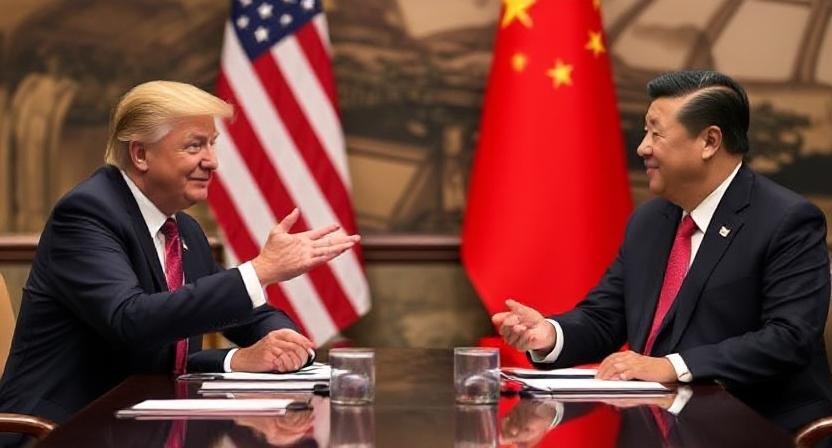
- Tariff Tensions Loom: Without a deal by August 12, tariffs could rise to 145% on U.S. goods and 125% on Chinese imports, shaking global supply chains.
- Trump’s Strategy Intensifies: Trump pushes hardline bilateral deals, using tariffs to press for economic restructuring in China.
- Possible Trump-Xi Summit: The Stockholm talks could set the stage for a high-stakes Trump-Xi meeting in October.
- China Seeks Concessions: Beijing wants relief from multi-layered U.S. tariffs and an easing of tech export restrictions that have curbed growth.
STOCKHOLM, Sweden — July 27, 2025 — In a high-stakes diplomatic engagement with global repercussions, top negotiators from the United States and China convened in Stockholm on Monday in a bid to resolve long-standing economic disputes that have reignited tensions between the world’s two largest economies. The meeting marks a pivotal moment in efforts to avert a re-escalation of the trade war that once brought global supply chains to the brink of collapse.
The talks are led by U.S. Treasury Secretary Scott Bessent and Chinese Vice Premier He Lifeng. Their goal: to extend a fragile truce struck in June and prevent a steep tariff hike scheduled to take effect on August 12. Without an agreement, tariffs could snap back to punitive levels—145% on some U.S. imports and 125% on Chinese goods—threatening renewed turbulence for manufacturers, exporters, and consumers worldwide.
China US Trade Tensions Persist Despite Recent Engagements: Analysis
The latest round of negotiations follows weeks of behind-the-scenes diplomacy, including meetings in Geneva and London, where both sides made limited progress in reducing retaliatory tariffs and restoring suspended trade in strategic goods such as rare earth minerals and AI semiconductors. Yet despite modest gains, the structural issues at the heart of the dispute remain unresolved.
A Complex Economic Battleground
At the core of Washington’s grievances is China’s state-led economic model, which U.S. officials say floods global markets with underpriced goods, distorting fair competition. Beijing, in turn, argues that U.S. export controls on high-tech components—such as AI chips and advanced semiconductors—are designed to curb Chinese innovation under the guise of national security.
US, China to resume tariff talks in effort to extend truce
The Stockholm session is widely viewed as the most substantive engagement yet in the current phase of the U.S.-China trade saga. “This is the first time both sides are sitting down to discuss the architecture of the trade relationship, not just tit-for-tat tariffs,” said Bo Zhengyuan, a partner at Plenum, a Shanghai-based consultancy. “It could pave the way for a broader economic détente.”
Still, the prospect of a breakthrough remains uncertain. The U.S. side has made clear it is open to extending the August 12 deadline but is demanding structural changes from China, including rebalancing its economy to encourage domestic consumption over export dependence. Bessent has also raised the need for Beijing to address its real estate crisis and build stronger social safety nets to bolster consumer demand.
Trump’s Tariff Playbook
President Donald Trump, who is seeking a legacy-defining victory in trade diplomacy during his second term, has already extracted tariff concessions from several trading partners, including Japan, Vietnam, and the Philippines. His approach—a blend of personal diplomacy and hardball economics—has seen mixed results in the European theater, where EU officials met him this week in Scotland to finalize a separate trade pact. That deal is expected to institute a 15% baseline tariff on most European goods.
Exclusive: China Slaps 6-Month Limit on Rare Earth Exports to U.S. Amid Fragile Trade Truce
Two of Trump’s most trusted trade aides, Commerce Secretary Howard Lutnick and U.S. Trade Representative Jamieson Greer, have joined the talks in Sweden following their participation in the Scotland meetings. Analysts say the presence of such high-level officials signals the seriousness of the administration’s intent.
“Trump believes in deals, not multilateral institutions,” said Wendy Cutler, vice president of the Asia Society Policy Institute and a former U.S. trade negotiator. “He’s trying to craft bilateral arrangements that serve American manufacturing interests, and the Stockholm round could be the linchpin.”
Trump-Xi Summit on the Horizon?
Hovering over the talks is the prospect of a historic summit between Trump and Chinese President Xi Jinping, tentatively being discussed for late October. Both sides are carefully choreographing moves to ensure the political atmosphere is conducive to such a high-level meeting.
“The Stockholm meeting is an opportunity to lay the diplomatic groundwork,” Cutler noted. “But any flare-up in tariffs could derail it completely.”
While Beijing is seeking a rollback of tariffs totaling nearly 55% on most of its exports—many of them imposed during Trump’s first term—it also faces new levies tied to unrelated disputes, such as the fentanyl crisis. U.S. tariffs on Chinese goods currently span categories as diverse as industrial machinery, textiles, and electronics.
A Glimpse into the Future
The long-term outlook for U.S.-China economic relations hinges on whether both sides can shift from short-term concessions to structural realignment. Michael Froman, a former U.S. Trade Representative under President Obama and now president of the Council on Foreign Relations, warned against overreliance on tariffs as a strategic tool.
“Using tariffs to compel systemic change is a high-risk gambit,” Froman said. “The U.S. has sought to get China to pivot toward domestic-led growth for over two decades. Whether this time is different depends on political will on both sides.”
For now, the world watches Stockholm. A successful outcome could not only stabilize trade flows but also set the stage for a political thaw between Washington and Beijing. Failure, on the other hand, could reignite one of the most disruptive economic conflicts of the 21st century.