


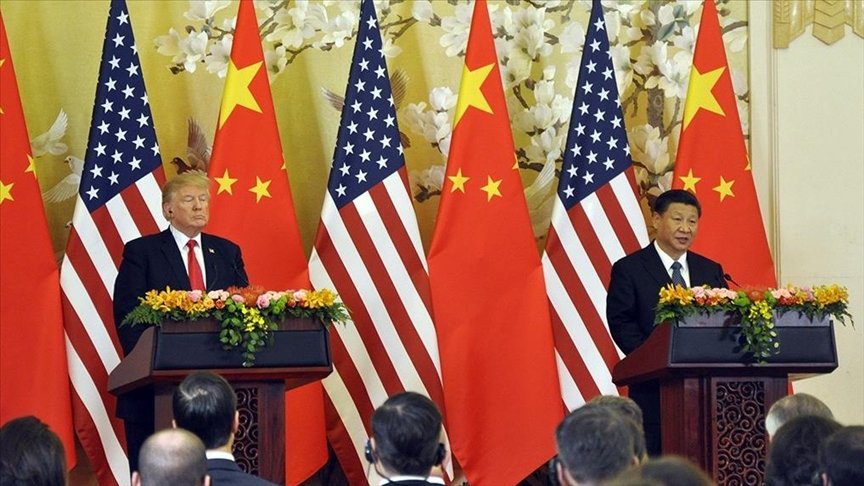
- Speculation intensifies over Trump China Visit as Beijing prepares for its grand military parade on September 3.
- Sources in Washington reveal Trump is open to a Trump China Visit if formally invited by President Xi Jinping.
- Nvidia CEO Jensen Huang may carry a secret message to Xi ahead of a possible Trump China Visit, adding intrigue to U.S.-China ties.
- A potential Trump China Visit could reshape global perceptions, unsettling allies in Japan and Europe.
WASHINGTON/BEIJING — As China prepares for its grand military parade on September 3 to mark the 80th anniversary of its victory over Japan, a swirl of diplomatic intrigue is unfolding behind the scenes. Sources close to senior U.S. officials told The Islamabad Telegraph that while President Donald Trump has not yet received an official invitation to attend the parade in Beijing, he has privately indicated that if invited, he “wouldn’t hesitate to go.”
The political theater doesn’t stop there. Nvidia’s CEO Jensen Huang, the world’s most watched tech leader, is set to meet Trump before heading to Beijing for scheduled meetings with top Chinese officials. Multiple sources in Washington and Beijing suggest that Huang may carry a personal message from Trump to Chinese President Xi Jinping—a development that could either thaw or further complicate the icy relationship between the world’s two largest economies.
“Jensen is the perfect bridge,” one senior U.S. diplomat told The Islamabad Telegraph under the condition of anonymity. “He is deeply embedded in both American innovation and Chinese markets. If anyone can deliver a discreet message, it’s him.”
What the message may contain remains a tightly guarded secret. But officials in Washington hinted it could relate to three pressing flashpoints: ongoing technology restrictions, rare earth supplies, and backchannel talks on Ukraine. The mere possibility of such a message underscores how the Trump-Xi dynamic, sidelined in recent years by mutual distrust and trade spats, could be approaching an unexpected reset.
Trump China Visit: The Symbolism of Tiananmen
The possibility of Trump standing shoulder-to-shoulder with Xi Jinping and Vladimir Putin atop Tiananmen Gate during China’s most symbolic military event has set off alarm bells across U.S. foreign policy circles. For China, such an image would project global power and diplomatic triumph. For Trump, it could reinforce his image as a dealmaker unafraid to break with convention.
READ MORE: Trump’s Invitation to Xi: A High-Stakes Gamble in U.S.-China Relations
“It’s precisely the kind of drama Trump thrives on,” said Dr. Margaret Reed, a senior fellow at the Wilson Center in Washington. “But the optics of a U.S. President applauding Chinese military hardware—flanked by Putin—would be unprecedented and controversial, to say the least.”
Trump’s White House is reportedly divided over the issue. Some advisers see the parade as an opportunity to extract economic concessions, including Chinese pledges to ramp up purchases of American goods—something Trump would eagerly brandish as a political victory. Others warn of geopolitical risks, especially as the U.S. faces criticism for its uneven stance on Ukraine and China’s expanding global influence.
ALSO READ: China Should Invite Trump to Its Military Parade
Japan and Europe: Nervous Allies
Japan’s government, already rattled by Kyodo News’ bombshell report about Trump’s potential attendance, views the prospect as a diplomatic nightmare. “It would be a deeply unsettling message to Tokyo,” said a senior Japanese official familiar with the discussions. “It risks signaling a U.S. pivot towards China at the expense of longstanding alliances.”
The unease is shared in Europe. At a time when Russia’s invasion of Ukraine has fractured Western unity, a public display of camaraderie between Trump, Xi, and Putin could sow doubts over America’s commitment to NATO and Ukraine.
In fact, officials in Brussels have quietly conveyed concerns to Washington, according to sources close to the European External Action Service. “Even the perception of such a realignment could embolden both Moscow and Beijing,” a European diplomat told The Islamabad Telegraph.
Jensen Huang: The Unlikely Diplomatic Messenger?
The subplot involving Jensen Huang adds yet another layer of intrigue. The tech titan’s scheduled meetings with Chinese officials—including possible sit-downs with Vice Premier He Lifeng—are raising speculation in diplomatic circles. Some see Huang as a “non-political backchannel” who could pave the way for a low-key Trump-Xi meeting, possibly outside the glare of the military parade.
Beijing has so far remained deliberately noncommittal. Chinese Foreign Ministry spokesperson Mao Ning, when asked about the possible Trump invitation, said: “I have no information to share at the moment”—a carefully crafted ambiguity that keeps all options open.
The Bigger Picture
Whether Trump attends the Beijing parade or not, the speculation alone is already reshaping perceptions. A trilateral scene of Trump, Xi, and Putin—whether at Tiananmen or in a more discreet setting—would send shockwaves through global capitals.
What is clear is that in the volatile chessboard of 2025, no scenario is off the table. Trump’s unpredictability, combined with Beijing’s appetite for diplomatic spectacle, makes for a combustible mix. And with the soft-spoken Jensen Huang quietly stepping into the role of potential envoy, a new chapter in U.S.-China relations could be quietly unfolding—out of sight, but not out of mind.