


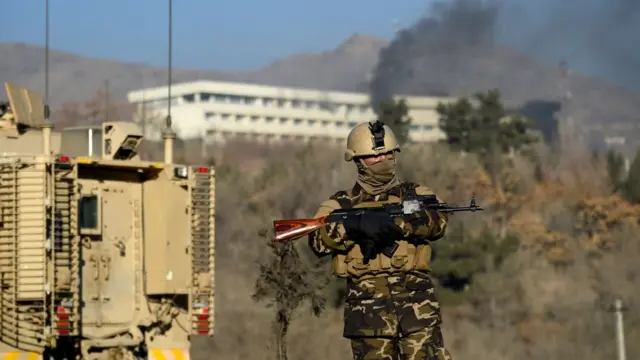
- Chinese nationals Targeted: A coordinated bomb and gun attack in Kabul killed seven people at a hotel popular with foreigners.
- Security investigations reveal that Chinese nationals were the prime targets of the assault.
- Two Chinese nationals were seriously wounded and are receiving treatment at the EMERGENCY hospital.
- This is the fourth attack involving Chinese nationals in the region over the past four months.
KABUL, Afghanistan — A devastating bomb and gun attack ripped through a hotel in central Kabul’s Shahr-e-Naw district on Monday afternoon, killing at least seven people and wounding dozens more. The assault targeted a venue on Gulfaroshi Street known to be a frequent hub for foreign visitors, particularly Chinese entrepreneurs and diplomats. Preliminary investigations by local security sources and eyewitness accounts suggest that Chinese nationals were the primary intended victims.
The Italian NGO EMERGENCY, which operates a surgical center near the blast site, confirmed the influx of casualties. “Twenty people have been received at EMERGENCY’s Surgical Centre in Kabul following an explosion this afternoon,” the organization stated. “Among those received were seven people dead on arrival.” The injured reportedly include four women and one child, some of whom were rushed into emergency surgery.
Coordinated Assault on a “Secure” Zone
Kabul police spokesman Khalid Zadran confirmed the blast occurred in the heart of the capital’s commercial district, an area usually regarded as one of Kabul’s most secure neighborhoods due to its proximity to embassies and shopping complexes. However, the attack bypassed these security layers with lethal efficiency.
Witnesses described a scene of chaos as smoke billowed from the “Lanzhou Beef Noodles” restaurant and adjacent hotel rooms. China’s state news agency, Xinhua, reported that at least two Chinese citizens were seriously wounded in the incident. A spokesperson for the Taliban regime later confirmed that multiple foreigners were among those evacuated to hospitals.
A Pattern of Targeted Violence
While no organization has officially claimed responsibility for this specific strike, the methodology bears the “striking similarities” to recent operations by the Islamic State-Khorasan (ISIS-K). The group has increasingly focused its propaganda and kinetic operations on Chinese interests, viewing Beijing’s growing economic ties with the Taliban as a strategic target.
This incident marks the fourth major attack in the region within the last four months where Chinese nationals have been killed or injured. This surge follows a string of violent episodes:
- November 2025: Two separate cross-border attacks from Afghanistan into Tajikistan killed five Chinese road construction workers.
- January 2025: A Chinese national was killed at a gold mine in Takhar Province in an attack later claimed by ISIS.
- Late 2024: A suicide bombing targeted a PRC delegation outside the Foreign Ministry in Kabul.
Regional Implications
The recurring nature of these strikes highlights a profound security challenge for the Taliban administration. Since taking power in 2021, the Taliban has marketed Afghanistan as a safe destination for foreign investment, particularly for China’s Belt and Road Initiative (BRI). Beijing remains one of the few global powers to maintain an active embassy in Kabul, having recently accepted the credentials of a Taliban-appointed ambassador.
However, the persistent threat from ISIS-K and affiliated Uyghur militant groups—like the East Turkestan Islamic Movement (ETIM)—is eroding that confidence. Security analysts suggest that ISIS-K is leveraging grievances over Beijing’s domestic policies to recruit disaffected militants, specifically to sabotage the Taliban’s primary source of potential international economic support.
The Taliban’s Interior Ministry has vowed to bring the perpetrators to justice, but the sophistication of the Shahr-e-Naw attack suggests that militant cells remain deeply entrenched in the capital. For Beijing, the safety of its citizens is becoming a non-negotiable prerequisite for further investment, placing immense pressure on the “Islamic Emirate” to prove it can truly govern a secure state.