


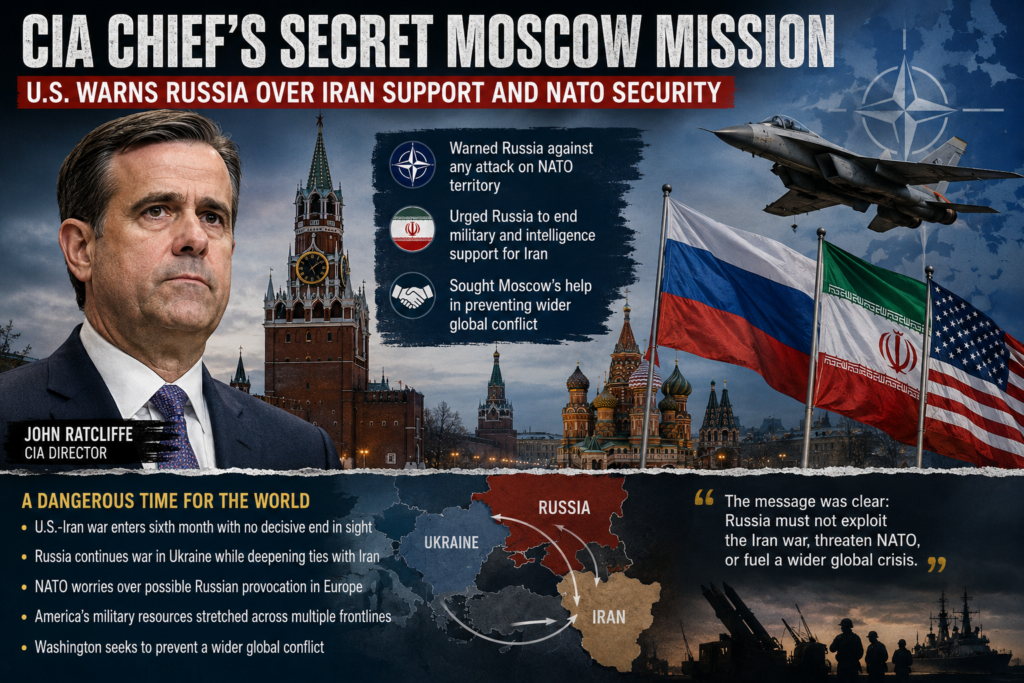
- CIA chief John Ratcliffe secretly traveled to Moscow amid the escalating U.S.-Iran war and growing tensions with Russia.
- Washington warned Moscow against any attack or covert operation targeting NATO territory while urging Russia to reduce military and intelligence support for Iran.
- The secret mission reflects growing U.S. fears that Russia and China are helping Iran withstand American and Israeli military pressure.
- The Iran and Ukraine wars are increasingly interconnected, raising concerns that America’s military resources are becoming overstretched.
- NATO faces renewed security concerns as Russia could potentially exploit U.S. military commitments in the Middle East to test the alliance in Europe.
WASHINGTON — CIA Director John Ratcliffe made a secret and highly unusual trip to Moscow this week carrying a message that underscores the widening strategic consequences of the U.S.-Iran war: Washington wants Russia to stay out of any confrontation with NATO and stop providing Iran with military and intelligence assistance.
Ratcliffe’s unannounced mission came as U.S. intelligence indicated that the Kremlin increasingly believes the United States has been weakened by the six-month war with Iran and may have less capacity to respond to a new crisis in Europe.
According to people familiar with the matter cited in U.S. media reports, Ratcliffe warned Russian officials against overt or covert attacks on NATO territory while also pressing Moscow to reduce its economic and military support for Tehran. The mission was conducted through intelligence channels rather than a formal diplomatic visit. The Kremlin confirmed that Ratcliffe met Russian intelligence counterparts but said he did not meet President Vladimir Putin.
The Washington Post reported that a classified CIA assessment had indicated Putin saw an opportunity in the pressures created by the Iran war.
READ NEXT: Is China Taking Russia’s Military Market in Central Asia
The timing of the mission is significant.
The United States and Israel have now spent six months fighting Iran in a conflict that has evolved from an intensive air campaign into a broader struggle involving sanctions, naval pressure, missile warfare and economic warfare. Iran has suffered major military and political losses, but Tehran has remained capable of sustaining resistance, while the conflict has imposed substantial costs on the United States.
Reuters reported this week that the war has reached a costly stalemate, with Washington shifting increasing attention toward economic pressure as military operations have failed to produce a decisive political settlement.
That stalemate has created an opening for Russia.
Moscow has emerged as one of Tehran’s most important strategic partners. U.S. intelligence has previously indicated that Russia provided Iran with information that could assist attacks against American military assets, including warships and aircraft operating in the region.
That relationship has become particularly sensitive because Washington increasingly believes the Iran conflict cannot be viewed separately from the wider confrontation between the United States, Russia and China.
READ MORE: Secret CIA visit highlights Putin and Trump’s common strategic trap
Russia and China are widely perceived in Washington as providing Tehran with varying forms of economic, technological, diplomatic or intelligence support. Beijing remains particularly important because China is a major destination for Iranian oil and a crucial economic lifeline for Tehran as Washington attempts to isolate the Iranian economy.
Moscow’s relationship with Iran is different but equally consequential. Russia and Iran signed a comprehensive strategic partnership treaty in January 2025, while Tehran previously supplied Russia with Shahed drones used in the war against Ukraine.
The Iran and Ukraine wars have therefore become increasingly interconnected.
Trump’s Middle East Strategy
Russia is fighting its fifth year of war against Ukraine, while the United States is simultaneously committing substantial military resources to the Middle East. The result is growing concern inside NATO that America’s ability to respond rapidly to a Russian escalation in Europe could be constrained.
The warning is not theoretical.
The U.S. military is facing serious pressure on missile-interceptor stocks after heavy expenditure in the Iran war and years of support for Ukraine. The Associated Press reported that U.S. Patriot interceptor inventories in Europe have reached what officials described as a “beyond critical” level, raising concerns about NATO’s ability to defend against a potential Russian missile threat.
For NATO governments, that creates an uncomfortable strategic calculation.
Russia does not need to launch a full-scale invasion of a NATO country to create a major crisis. A limited military probe, cyberattack, sabotage operation, drone incident or confrontation in the Baltic region could test whether the alliance is prepared to respond while the United States remains heavily engaged in the Middle East.
armenia
That appears to be one reason Ratcliffe’s message in Moscow was reportedly unusually direct.
The CIA director was not simply discussing Ukraine. He was communicating a broader warning: Russia must not interpret America’s engagement in Iran as an invitation to test NATO.
At the same time, Washington appears to want Moscow to restrain its partnership with Tehran.
That demand may prove difficult to achieve.
Russia benefits strategically from America’s prolonged involvement in Iran. The longer U.S. forces remain tied down in the Middle East, the greater the pressure on American weapons inventories and the greater the opportunity for Moscow to challenge Washington elsewhere.
The same logic applies to China.
Beijing has strong economic interests in maintaining access to Iranian energy and has rejected Washington’s efforts to impose comprehensive economic isolation on Tehran. Washington therefore faces a three-front strategic problem: sustaining the war against Iran, supporting Ukraine and maintaining credible deterrence against Russia and China.
Ratcliffe’s journey to Moscow may consequently represent more than an intelligence meeting.
It was a signal that Washington understands the danger of allowing the Iran war to trigger a second confrontation in Europe.
The Kremlin, meanwhile, appears to understand the leverage created by America’s strategic overstretch.
President Donald Trump has publicly insisted that Putin will not attack NATO territory and has continued to express hopes of ending the Ukraine war. But U.S. intelligence assessments reportedly indicate that Moscow may perceive the current moment differently.
The CIA mission was therefore a rare exercise in crisis management between two nuclear powers.
Washington is trying to prevent the Iran war from becoming a bridge to a wider confrontation with Russia. Moscow is calculating how much pressure the United States can sustain simultaneously in Iran, Ukraine and the wider global competition with China.
The immediate objective of Ratcliffe’s secret mission may have been to prevent a Russian attack on NATO and reduce Moscow’s support for Tehran.
Its larger significance is much bigger.
Three wars — Iran, Ukraine and the broader U.S.-China-Russia confrontation — are increasingly becoming parts of the same strategic contest.
And Washington now appears determined to ensure that its war with Iran does not become the opening Russia has been waiting for in Europe.