


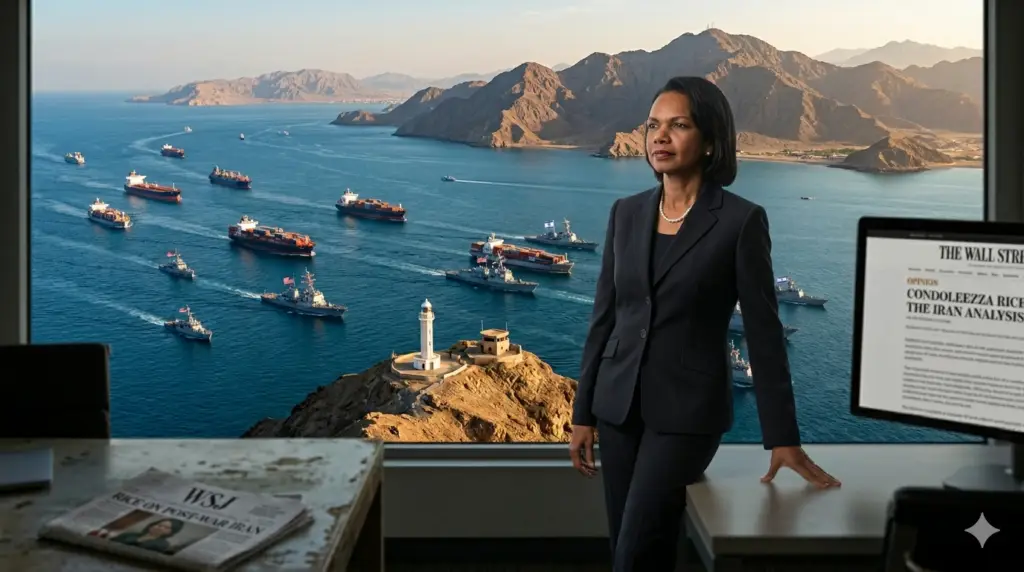
- Condoleezza Rice Iran Analysis reveals that while Operation Epic Fury successfully degraded Tehran’s physical infrastructure, it leaves the long-term ideological framework intact.
- The strategic realignment between Israel and Arab Gulf states hinges on economic modernization but faces deep-seated vulnerabilities regarding regional public sentiment.
- The temporary closure of the Strait of Hormuz exposed critical gaps in Western energy security planning despite decades of military simulation exercises.
- Imposing absolute financial isolation without a diplomatic off-ramp may incentivize a fractured regime to employ unpredictable, asymmetric grey-zone tactics.
The recent military campaign against Iran marks a critical turning point in Middle East geopolitics, prompting intense debate among international strategists. Writing for The Wall Street Journal, Condoleezza Rice—former U.S. Secretary of State and current director of Stanford University’s Hoover Institution—offers a striking assessment of this “limited war.”
She argues that while the conflict’s outcome remains inconclusive, the strategic landscape has shifted decisively in favor of the United States and its regional allies. However, an independent analysis of her blueprint reveals a complex reality where tactical degradation meets long-term geopolitical unpredictability.
Rice’s core premise rests on the significant degradation of Iran’s conventional forces, missile stockpiles, and proxy networks through targeted operations like Operation Epic Fury. By asserting that Iran’s conversion facilities are destroyed and its premier nuclear scientists eliminated, Rice presents a picture of a severely weakened adversary. From an independent journalistic perspective, this physical containment is undeniable in the short term.
The destruction of key infrastructure temporarily halts Tehran’s immediate nuclear ambitions. Yet, history suggests that localized kinetic strikes rarely extinguish deep-seated ideological momentum or technical knowledge, which can be reconstituted covertly or relocated underground.
A central pillar of Rice’s argument in The Wall Street Journal is the accelerated political realignment in the region. She emphasizes that defense cooperation and intelligence sharing have drawn America, Israel, and Arab states into a closer, more cohesive security architecture. In her view, the shared motivation for economic modernization and technological integration now outweighs historical animosities regarding Israel’s legitimacy.
While this anti-Iran coalition appears robust on paper, an independent view must account for the fragile domestic realities within Arab states. Public sentiment across the region remains deeply sensitive to the plight of Palestinians, creating a persistent friction point between ruling elites and their populations that could destabilize this alignment if the broader conflict remains unresolved.
Rice also contextualizes the conflict within global great-power competition, sharply criticizing China for remaining on the sidelines while regional economic infrastructure was attacked. She contrasts this with Ukraine’s defensive contributions, framing Kyiv as a vital asset to Western security and urging the U.S. to press its advantage against a strategically overextended Russia.
While this aligns with Washington’s broader containment strategy, it may underestimate Beijing’s long-term diplomatic flexibility. By avoiding direct military entanglement, China preserves its role as an economic partner and potential mediator, positioning itself to fill the diplomatic vacuums that Western military interventions often leave behind.
Furthermore, Rice addresses the economic vulnerabilities exposed during the conflict, expressing surprise that the Trump administration appeared caught off guard by Iran’s temporary closure of the Strait of Hormuz. This chokepoint remains a vital artery for global energy security, and its closure underscores the delicate balance of international markets.
Rice argues that the subsequent U.S. blockade demonstrated the limits of Tehran’s leverage by threatening severe economic retaliation. However, the initial shock to global supply chains serves as a stark reminder that even a weakened Iran retains the asymmetric capability to inflict substantial global economic pain, rendering any future containment strategy highly volatile.
Looking ahead, Rice advocates for a strategy of “strategic patience,” asserting that the U.S. does not strictly need a new nuclear agreement unless it enforces absolute financial isolation on Tehran. She insists that no frozen assets or sanctions relief should be granted, while maintaining a credible military threat. This zero-sum diplomatic framework assumes that economic strangulation will widen the internal fractures within the Islamic Revolutionary Guard Corps (IRGC) and the secretive leadership under Supreme Leader Mojtaba Khamenei.
Ultimately, Rice’s analysis provides a sophisticated neoconservative framework for post-war management, emphasizing military deterrence and rigid economic containment. While her assessment in The Wall Street Journal rightly highlights Iran’s current operational vulnerabilities, independent observers must remain cautious. Managing a fractured, isolated, yet deeply resilient regional power requires more than tactical dominance; it demands a sustainable diplomatic off-ramp to prevent a weakened regime from turning to desperate, asymmetric measures.