


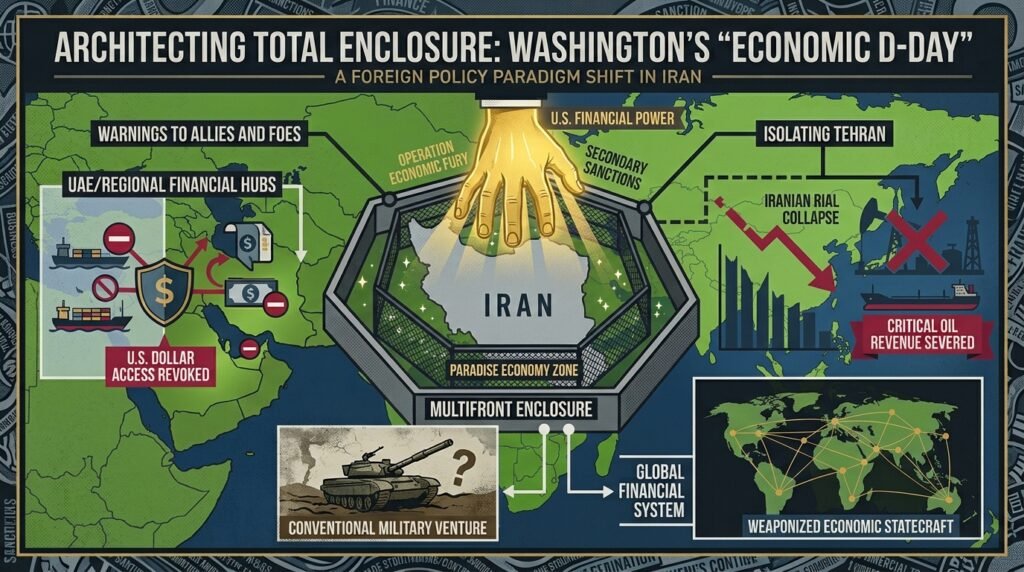
Economic isolation of Iran is no longer a secondary instrument of American policy. Under President Donald Trump, it is becoming the central mechanism through which Washington is trying to convert military pressure into strategic leverage over Tehran.
For decades, the United States demonstrated that it could strike Iran but struggled to compel Tehran to change its fundamental strategic calculations. Military campaigns could destroy facilities and disrupt operations, but they could not prevent Iran from rebuilding, finding partners or exploiting gaps in the international system.
Trump is now attempting something more ambitious: economic isolation of Iran on multiple fronts at once.
His declaration of an “Economic D-Day” is the clearest expression yet of this approach. The Wall Street Journal’s report on Trump’s “Economic D-Day” reported that Trump is threatening unprecedented economic pressure on Iran and on countries or entities that continue doing business with Tehran. The United Arab Emirates’ decision to suspend financial and economic transactions with Iran is especially significant because Dubai has long served as a commercial and financial gateway for Iranian trade. That suggests economic isolation of Iran is beginning to produce the third-country response Washington has been seeking.
The strategy is larger than sanctions.
Washington is attacking the networks that allow Iran to evade sanctions: oil traders, shipping companies, financial intermediaries, exchange houses, front companies and alternative payment channels. The objective is to make dealings with Tehran progressively more expensive and risky for everyone involved.
That is the real innovation behind economic isolation of Iran.
Foreign Policy’s analysis of the UAE’s move to isolate Iran shows how the pressure is spreading beyond American borders. The significance is that a state with substantial commercial interests in Iran is calculating that access to the wider global economy is more valuable than preserving those relationships.
The Washington Post’s latest assessment highlights another dimension: Trump is increasingly pressuring partners as he seeks results from a war that has not forced Tehran to surrender. This suggests economic isolation of Iran is being used not as an alternative to military pressure, but as its next phase.
Economic isolation of Iran: Trump’s Combination Matters
Military power constrains Iran physically. Sanctions restrict its finances. Secondary sanctions pressure its trading partners. Diplomatic threats increase the cost of defiance. Together, these instruments create an enclosure rather than a conventional blockade.
What military force could not achieve by itself may therefore be approached through economic isolation of Iran.
A missile can destroy an oil facility. It cannot persuade a foreign bank to stop financing Iranian trade. A warship can intercept a vessel. It cannot force an insurer to withdraw coverage. Economic power can influence both.
The strategy nevertheless has limits. Iran has survived decades of sanctions. The Wall Street Journal reports that Tehran is adapting toward a “survival economy,” while China and Russia remain potential lifelines. That means economic isolation of Iran is not guaranteed to succeed.
China is the decisive test. If Chinese companies continue buying Iranian oil and maintaining commercial channels, Tehran will retain an important escape route. Washington may therefore face its hardest confrontation not with Iran itself, but with countries willing to absorb the costs of continuing trade with Tehran.
Foreign Policy’s recent assessment of the UAE’s move shows why this matters beyond the Gulf. The Islamabad Telegraph’s reporting on the Baltic drone confrontation in the Russia-Ukraine war likewise illustrates a broader shift toward targeting strategic infrastructure and networks rather than relying only on conventional battlefield pressure. In that sense, economic isolation of Iran belongs to a wider transformation in modern power: states increasingly seek to control the systems that allow adversaries to trade, move and sustain themselves.
Trump Appears to Understand This Shift.
His warnings to allies and adversaries create a choice: remain economically connected to Iran or remain fully integrated with the American-led financial system. The more countries choose the latter, the more effective economic isolation of Iran becomes.
For now, however, the direction is unmistakable.
Economic isolation of Iran is becoming the battlefield itself.
Trump has changed the equation by combining military pressure with financial coercion and by extending the threat of punishment to countries that provide Tehran with lifelines. The UAE response suggests that the message is being heard. For Washington, that is the practical test of economic isolation of Iran.
Iran has not surrendered or been completely isolated. China remains capable of complicating Washington’s strategy. But the United States is achieving something previous administrations struggled to achieve: making Iran’s foreign economic relationships themselves a source of vulnerability.
That is the deeper significance of economic isolation of Iran.
What military adventure could not accomplish alone may now be pursued through banks, shipping lanes, insurance markets, oil revenues and the global dollar system.
Trump is not simply sanctioning Tehran. He is attempting to change the international environment in which Tehran survives.
If the campaign continues to produce defections among Iran’s commercial partners, Washington may eventually force a strategic choice: endure deeper economic isolation or negotiate from sharply reduced leverage.
That would represent a profound change in American policy.
And it would mean that economic isolation of Iran has evolved from a sanctions policy into a new form of geopolitical warfare.