


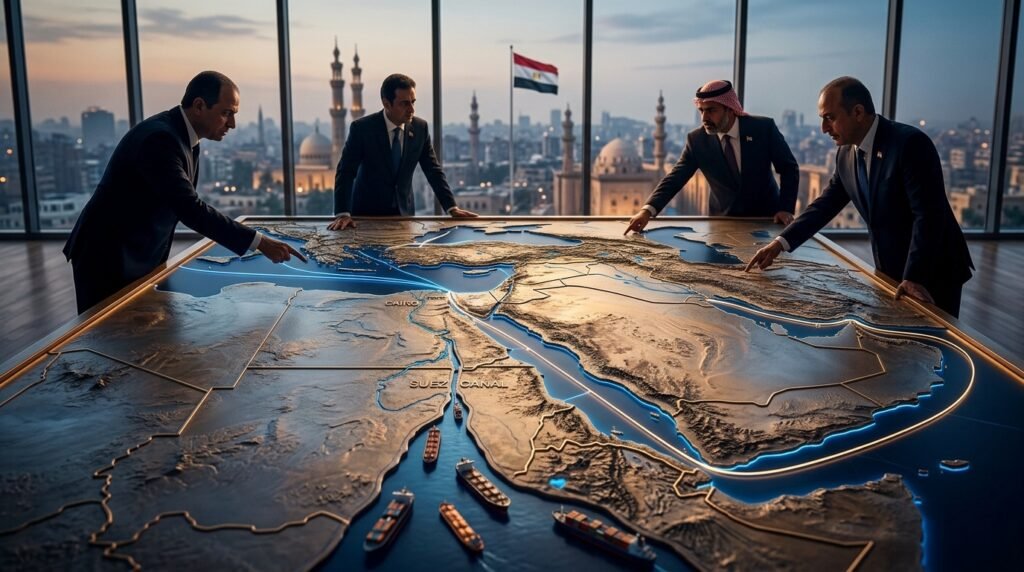
- Egypt Iran War diplomacy: Cairo is using the four-country mechanism with Pakistan, Saudi Arabia and Turkey to support regional de-escalation.
- Egypt’s Suez Canal gives Cairo major strategic importance as the Iran conflict disrupts maritime routes around Hormuz and the Red Sea.
- Egypt must balance its relationships with Washington, Gulf partners and regional diplomatic channels while seeking to prevent a wider Middle East conflict.
As the conflict in Iran continues to reshape the political and security landscape of the Middle East, one nation has emerged as a pivotal — though often understated — actor: Egypt. While not a direct participant in the fighting, Cairo’s geographic position, diplomatic reach, and longstanding relationships across rival blocs give it significant influence over both the trajectory and the potential resolution of the war.
Egypt’s role is not merely symbolic. The war has already affected its economy, security environment, and regional alliances, compelling Cairo to take a more assertive stance as a mediator and stabilizing force.
Egypt’s Strategic Weight in a Region at War
Egypt occupies a unique position in Middle Eastern geopolitics. Its control of the Suez Canal, one of the world’s most critical maritime chokepoints, gives it leverage over global trade and military logistics. Its diplomatic networks span Washington, Riyadh, Abu Dhabi, Ankara, and even limited backchannels with Tehran. And its military, among the largest in the Arab world, provides tangible support to regional security coalitions.
READ NEXT: Iran War Cost to Americans Surpasses $107 Billion as Oil Shock Hits Households
As the Iran war escalated, Egypt aligned itself with Gulf partners, deploying Rafale fighter jets and air‑defense assets to bolster regional defenses. Cairo also refrained from publicly criticizing U.S.–Israeli strikes on Iranian targets, signaling its desire to maintain strategic balance while avoiding direct confrontation.
This careful positioning reflects Egypt’s broader objective: preventing regional collapse while preserving its leadership role in Arab diplomacy.
How Egypt Is Directly Impacted
Economic Shockwaves
The conflict has severely disrupted shipping in the Red Sea, particularly due to attacks linked to Iranian‑aligned groups. As vessels reroute away from the Suez Canal, Egypt faces major revenue losses, compounding an already fragile economic situation marked by inflation and currency pressure.
The war has also contributed to rising global fuel prices — a critical concern for a country heavily dependent on energy imports.
Security Concerns
Egypt views the stability of Gulf states as inseparable from its own. Millions of Egyptians work in Saudi Arabia, the UAE, and Kuwait, and these nations are among Cairo’s most important financial supporters. Iranian strikes on Gulf infrastructure therefore pose direct risks to Egyptian citizens and economic lifelines.
READ MORE: Egypt stands firm on Arab security and Gaza ceasefire: Sisi to CIA Director
Additionally, Egypt fears that a sudden collapse of Iran’s political system could unleash extremist groups, destabilize the Levant, and spill over into North Africa — a scenario Cairo is determined to prevent.
Diplomatic Stakes
Egypt’s regional influence depends on its credibility as a mediator. A prolonged war threatens to:
- Undermine Arab unity
- Strengthen non‑Arab regional powers
- Reduce Egypt’s diplomatic leverage
These concerns have driven Cairo to join a new informal coordination group with Pakistan, Turkey, and Saudi Arabia, aimed at de‑escalation and conflict management.
Egypt Iran War diplomacy: Egypt’s Relationships with the United States and Iran
Cairo and Washington: A Strategic Partnership
Egypt’s relationship with the United States remains one of its most important alliances. The two countries cooperate closely on:
- Military aid and training
- Counterterrorism operations
- Intelligence sharing
- Regional security initiatives
This partnership explains Egypt’s cautious response to U.S.–Israeli military actions. Cairo has urged Washington to pursue diplomacy, but it has avoided public criticism, reflecting both strategic alignment and economic dependence.
Cairo and Tehran: A History of Mistrust
Egypt and Iran have maintained strained relations since 1979. Key points of friction include:
- Egypt’s sheltering of the Shah after the Iranian Revolution
- Cairo’s peace treaty with Israel
- Support for Iraq during the Iran–Iraq War
- Competition for influence in the Arab world
While occasional diplomatic overtures have occurred, deep mistrust persists. Egypt views Iran as a destabilizing actor but also fears the consequences of a power vacuum in Tehran. Cairo prefers a contained, stable Iran over regional chaos.
What Egypt Can Do to Help End the War
Diplomatic Mediation
Egypt has already initiated backchannel communications with Iranian officials and supported Pakistan’s ceasefire framework. Cairo can expand these efforts by:
- Coordinating with Turkey, Saudi Arabia, and Pakistan
- Facilitating indirect U.S.–Iran dialogue
- Proposing confidence‑building measures
Strengthening Regional Security
Egypt’s military deployments to Gulf states serve as a deterrent against further escalation. Continued coordination can reassure allies and reduce the likelihood of miscalculation.
Securing the Red Sea
By working with Saudi Arabia and international partners to stabilize shipping routes, Egypt can mitigate economic losses and reduce regional tensions.
Leveraging Economic Influence
Egypt’s ties to Gulf financial networks give it indirect leverage over Iran’s incentives to negotiate, particularly regarding sanctions relief and regional economic integration.