


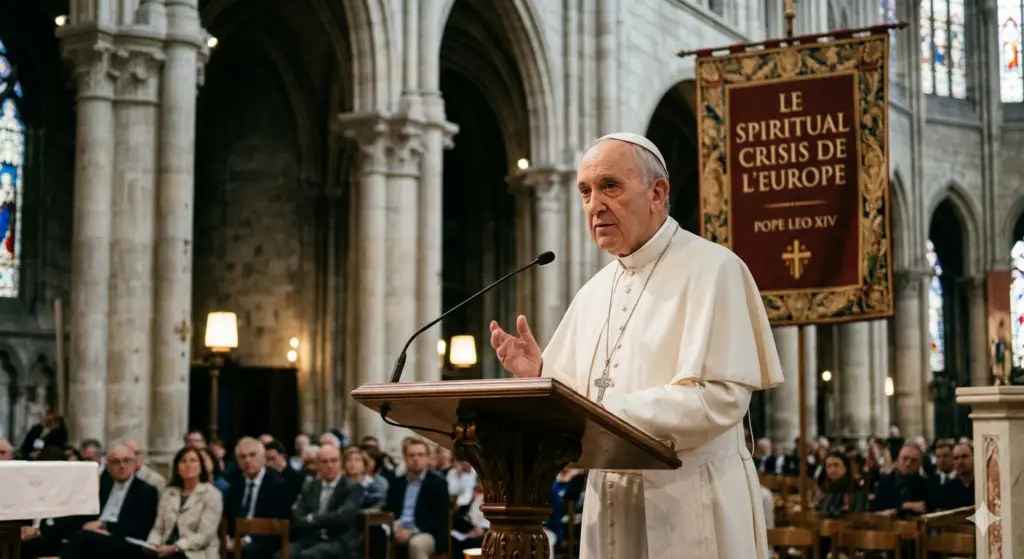
- Europe Identity Crisis: The continent balances immense material wealth and technological advancement against an underlying sense of cultural exhaustion and spiritual fragmentation.
- The Overlord Contrast: Exactly 82 years after American soldiers landed in Normandy to save a broken Europe, the first U.S.-born pontiff arrives on European shores to address a different kind of civilizational survival.
- A Completed Visual Monument: The completion of the Tower of Jesus Christ atop Antoni Gaudí’s basilica symbolizes an intentional effort to place transcendence physically above the secular landscape.
- The Global Mirror: This existential reflection raises profound questions for international observers worldwide, asking whether societies can maintain long-term social cohesion if they actively sever themselves from historical and religious memory.
On June 6, 2026, Europe will commemorate the 82nd anniversary of the Allied military forces landings in Normandy, France (the military operation that opened the liberation of Western Europe from Nazi domination during the Second World War). Yet on that same symbolic date, another American arrival to the Western shores of Europe will quietly carry a very different meaning.
Pope Leo XIV, the first U.S.-born Pope in the history of the Catholic Church, will begin his visit to Spain at a moment when many Europeans increasingly speak not of military decline, but of cultural exhaustion, demographic uncertainty and spiritual fragmentation.
History rarely repeats itself literally. But it often returns through symbols. Eighty-two years ago, young American soldiers landed on the beaches of Normandy to help save a devastated Europe from totalitarian barbarism. Today, an American pontiff arrives in another troubled Europe, wealthier, safer and technologically advanced, yet increasingly uncertain about its own civilizational foundations.
US Iran Conflict Strait of Hormuz Crisis Deepens as Missiles, Drones and Naval Blockade Escalate War
The coincidence becomes even more striking when one remembers the name of the Allied operation itself: “Overlord,” meaning supreme ruler. Only weeks ago, in Barcelona, Spain, the monumental Tower of Jesus, the supreme Lord in Christianity, was finally completed atop the Sagrada Família, the unfinished basilica designed by the celebrated Catalan architect Antoni Gaudí. The tower, crowned by a gigantic cross, is now the tallest church structure in the world. For Gaudí, architecture was never merely technical. It was theological. Stone, light and geometry were intended to direct the human gaze upward, toward transcendence.
That symbolic contrast may ultimately define the deeper meaning of Leo XIV’s visit to Spain. Europe today remains economically influential and politically organized, but many observers increasingly wonder whether it still possesses what earlier generations would have called a spiritual centre of gravity. The continent that once built cathedrals, universities and missionary civilizations now debates its own historical identity with visible hesitation.
An Identity Crisis in Europe’s Russian Frontier
Spain itself embodies many of these tensions. Once considered one of Catholicism’s strongest cultural bastions, it has undergone a rapid secular transformation over recent decades. Spain’s current political climate has been influenced by strands of European socialist and post-Marxist thought that emerged from the ideological struggles of the twentieth century. Critics argue that this broader cultural shift has weakened traditional institutions associated with religion, family life and historical continuity, while supporters view it as part of a broader modernization of Spanish society. The debate is no longer simply political. It is civilizational.
More than forty years ago, Pope John Paul II delivered a warning that still resonates today. Speaking in Santiago de Compostela in 1982, the Polish pontiff appealed directly to Europe with a now famous phrase: “Europe, be yourself.” It was not merely a religious statement. It was a question about memory.
Can a civilization continue to survive if it gradually loses confidence in the beliefs, values and cultural narratives that originally shaped it? That question becomes even more intriguing in Barcelona, where the figure of Gaudí has acquired renewed international attention. In April 2025, shortly before his death, Pope Francis formally declared Gaudí “Venerable,” recognizing the heroic Christian virtues of the architect sometimes described as “God’s architect.”
Gaudí’s own death has become part of modern Spanish historical mythology. On June 7, 1926, after attending Mass, he was struck by a tram in Barcelona. Dressed in old and modest clothes, he was initially mistaken for a homeless beggar and taken to a charity hospital, where he died days later. Only later did the city realize that the injured old man was the creator of one of the most extraordinary religious buildings on Earth. Witnesses later recalled that Gaudí carried two humble objects in his pockets: hazelnuts for strength, and the rosary beads for prayer.
The symbolism surrounding Leo XIV’s visit becomes even more remarkable because the Pope is scheduled to visit the Sagrada Familia on June 10, 2026 — exactly one hundred years after Gaudí’s death. The article of faith beneath all this is not difficult to identify. Gaudí spent his life trying to place Jesus Christ literally and symbolically above the modern city. Europe today, by contrast, often appears unsure whether transcendence still has any place in public life at all.
For international observers outside Europe — including readers across the Muslim world — the continent’s current identity crisis raises questions that extend far beyond Christianity itself. Can societies preserve social cohesion after severing themselves from their religious and historical roots? Can material prosperity alone sustain civilizational confidence? And what happens when a culture loses not merely belief, but memory itself?
These are some of the silent questions surrounding Pope Leo XIV’s visit to Spain. His journey will not simply be diplomatic or ceremonial. It may also serve as a mirror — reflecting back to Europe not only what it has become, but also what it may no longer remember.