


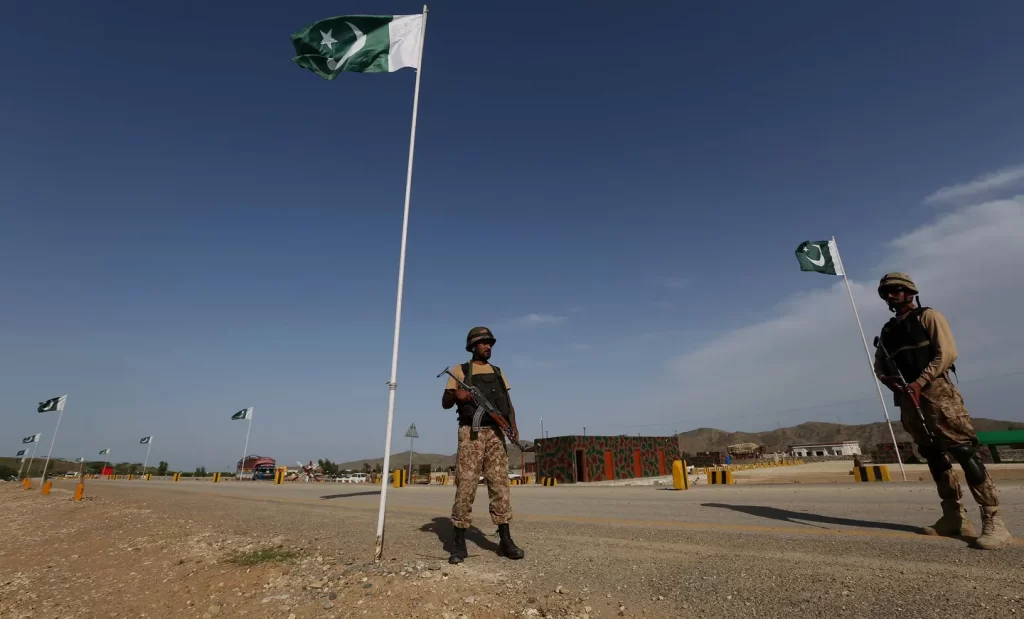
- Pakistan Army launched a precision counterstrike on Taliban forces after Afghanistan’s unprovoked aggression along multiple border points.
- Taliban’s Ghazni Headquarters in Nushki Sector was completely destroyed, with dozens of Fitna al-Khawarij militants killed.
- Operation conducted under the direct command of Field Marshal Asim Munir, signaling Pakistan’s military resolve.
- The Foreign Office condemned Kabul’s actions and warned that Afghan soil must not be used for terrorism against Pakistan.
- Religious scholars and citizens across Pakistan rallied in support of the Army, denouncing Afghanistan’s actions as India-inspired provocation.
- Pakistan vowed to defend every inch of its territory while calling for regional peace grounded in mutual respect.
- The strike sends a clear geopolitical message: Pakistan stands ready to respond decisively against any cross-border threats or foreign conspiracies.
On a moonless Saturday night, the mountains of Nushki roared to life. The still air cracked under the barrage of Pakistani artillery as the army unleashed a blistering counterattack across the Pak-Afghan border. Flames rose from the Taliban’s Ghazni Headquarters — once a hub for cross-border infiltration — now reduced to rubble.
Security officials watching the strike in real time described it in a single phrase: “swift, clean, decisive.” Within minutes, Pakistan’s gunners had obliterated multiple Taliban strongholds that had opened unprovoked fire earlier in the day across Angoor Adda, Bajaur, Kurram, Dir, and Chitral. “They wanted to test our patience,” a senior military source said. “They got their answer.”
Dozens of Fitna al-Khawarij — militants of the outlawed Tehreek-e-Taliban Pakistan (TTP) — were reported killed, alongside several foreign fighters operating with Afghan forces. By dawn, smoke from the destroyed Ghazni Headquarters was visible miles inside Afghan territory.
“It was the most precise strike since May,” said another source, referencing Pakistan’s earlier aerial victory over India when six fighter jets — including Rafales — were downed in retaliatory action.
A Commander’s Doctrine: No Compromise on Sovereignty
At the heart of Pakistan’s evolving military posture stands Field Marshal Asim Munir, hailed within defense circles as one of the finest commanders in the country’s modern history. Under his supervision, Pakistan’s security apparatus has shifted from reactive defense to rapid deterrence — ensuring that every act of aggression, whether from India or its proxies, meets overwhelming force.

The doctrine was born of necessity. In recent months, India’s Modi government — humiliated after its forces were decisively overpowered in May — has sought to regain leverage through covert means.
READ MORE: Taliban, Pakistani forces trade heavy fire along Afghanistan border
Intelligence reports point to India’s use of Afghan territory and Taliban elements to destabilize Pakistan, particularly in Balochistan and Khyber Pakhtunkhwa. “It’s a two-front hybrid offensive,” one senior defense analyst explained. “When India can’t fight Pakistan directly, it wages war by proxy — and the Afghan frontier becomes the testing ground.”

The timing of the Afghan assault coincided precisely with the visit of Afghanistan’s acting Foreign Minister Amir Khan Muttaqi to New Delhi — the highest engagement between the Taliban and India since 2021. When Muttaqi echoed India’s stance on Jammu and Kashmir, calling it an “internal matter,” Pakistan’s Foreign Office viewed it as an outright diplomatic betrayal. “Afghanistan’s statements and actions have begun to mirror India’s playbook,” an FO official remarked. “And the border aggression only made it clearer.”
The Battlefield Echoes: Fire and Brotherhood Betrayed
What erupted that night was the culmination of years of warnings ignored. For months, Pakistan had urged Kabul to prevent its soil from being used for terrorism, yet the TTP found sanctuary there, launching attacks on Pakistani civilians and soldiers.
ALSO READ: IT’S EXCLUSIVE: Chinese Arms Tested in India-Pakistan Clash, Prompting Quiet Elation in Beijing and Global Ripples
When the latest wave of aggression began, Afghan forces fired across multiple sectors almost simultaneously — a coordinated attempt, according to intercepts, to enable terrorist infiltration under artillery cover. But they underestimated the vigilance of Pakistan’s frontier posts. Within moments, counter-battery fire began.
One officer described the battlefield as “a line of thunder rolling down the mountains.” Pakistani artillery zeroed in on the coordinates of Ghazni Camp, where Taliban units directed operations. Guided rounds tore through the facility, triggering a chain of explosions as ammunition depots ignited. Drone footage later confirmed the camp’s total destruction.
By midnight, intercepted Taliban radio chatter spoke of chaos. “Their entire command node was gone,” said a military intelligence source. “We heard them begging for reinforcements that never came.”
The operation was not just tactical — it was a message written in fire. Pakistan had drawn a line: attacks on its borders would no longer go unanswered. Across the nation, the message resonated. Crowds flooded the streets in Lahore, Peshawar, and Quetta to celebrate the military’s decisive response. Clerics led prayers for the soldiers guarding the frontier. “Afghanistan should remember,” declared one scholar, “that Pakistan fed its hungry and sheltered its millions. But betrayal of brotherhood at India’s behest will not be tolerated.”
The Shadow of Delhi: Proxies and Propaganda
Behind the border clashes lies a deeper contest stretching from Kabul to New Delhi. Since India’s defeat in clashes with pakistan earlier in May this year, Prime Minister Narendra Modi’s government has relied on covert retribution — misinformation, cyberwarfare, and proxies — to undermine Pakistan’s internal stability. Intelligence shared with The Islamabad Telegraph suggests that India’s RAW agency has revived channels in Afghanistan to arm and fund anti-Pakistan factions.
Afghanistan’s silence, Pakistani officials argue, is complicity. “Every time India is cornered militarily, activity spikes on the western border,” a former diplomat observed. The Afghan government, meanwhile, dismisses Pakistan’s evidence as “internal issues,” a claim Islamabad rejects outright. “It’s absurd to call terrorism imported from Afghan soil an internal problem,” the FO said. “We’ve given them names, coordinates, financial trails. Their denial only emboldens the aggressors.”
Under Field Marshal Munir, Pakistan’s military doctrine treats India and its proxies as a single hybrid threat. Strategists use Fitna al-Hindustan to describe Indian-backed subversive operations — propaganda, terrorism, and manipulation — designed to fracture Pakistan. Together with Fitna al-Khawarij, the term for TTP militants, these twin fronts define the asymmetric warfare confronting Pakistan today.
The New Reality: Power, Restraint, and the Future of the Frontier
As dawn broke over the battle-scarred hills of Nushki, the smoke began to settle — but not the message. Pakistan had made its point: sovereignty is non-negotiable. The destruction of the Taliban’s Ghazni Headquarters was both a tactical victory and a strategic declaration — one that reverberated from Kabul to Delhi.
Yet Islamabad’s tone in the aftermath remained measured. “We seek a peaceful, stable, and prosperous Afghanistan,” the Foreign Office reiterated, “but we will take all necessary measures to safeguard our people.” That balance — strength with restraint — defines Pakistan’s new regional policy.
In Rawalpindi’s General Headquarters, the sentiment is unwavering: Pakistan will not start wars, but it will end them if forced to fight. “We will not be drawn into chaos,” a senior officer said, “but we will defend our soil, inch by inch.”
The broader geopolitical implications are unmistakable. With India’s proxy strategy exposed and Afghanistan’s alignment under scrutiny, the regional map is shifting. Analysts foresee Pakistan deepening security coordination with China, Iran, and Central Asia to secure its western flank and preserve strategic stability.
The lesson from that night of fire in Nushki is not merely one of military triumph — it is one of endurance and consequence. Pakistan, long patient and pragmatic, has entered a new phase of confident deterrence.
As dusk settles once again over the western frontier, the green and white flag flutters defiantly in the cold mountain wind — a symbol of resolve, restraint, and resilience in a region where peace is never given, only earned.