


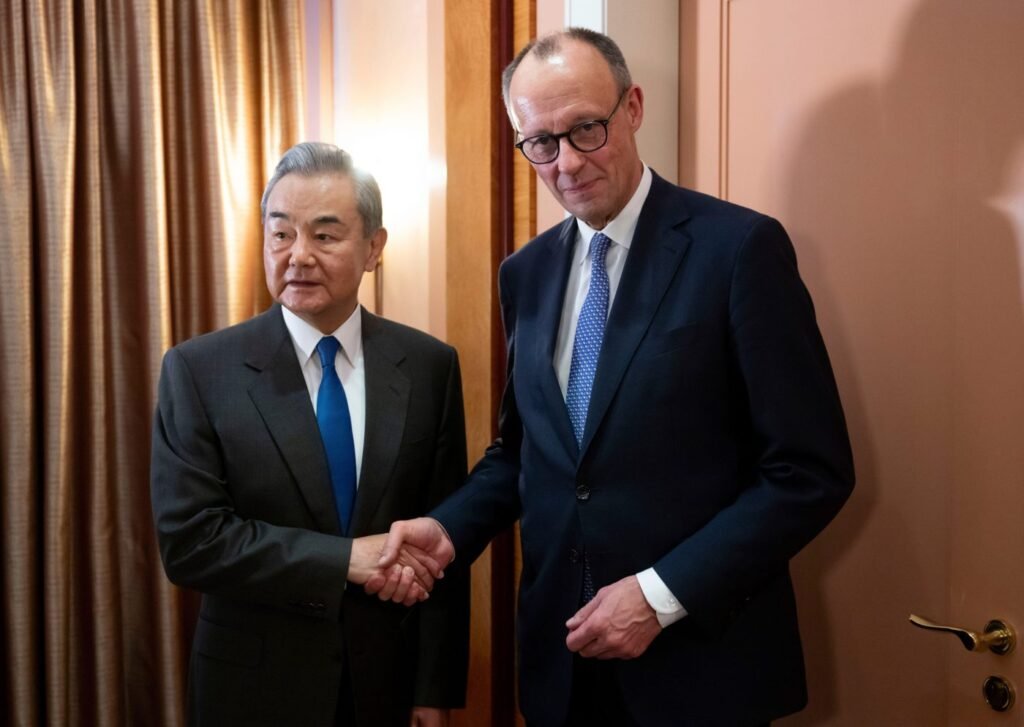
- Friedrich Merz China visit comes days after a decisive CDU leadership endorsement, signaling strong domestic backing ahead of talks with Xi Jinping.
- Germany sends its chancellor to Beijing with a heavy political mandate, emphasizing the strategic weight Berlin assigns to China relations.
- China reclaims position as Germany’s largest trading partner, underscoring economic interdependence despite Western de-risking debates.
- The trip reflects Europe’s broader struggle to balance security alignment with the United States and economic engagement with China.
Three days before departing for what officials describe as a historic visit to China, German Chancellor Friedrich Merzreceived an emphatic political endorsement at home — a powerful signal intended not only for domestic audiences but also for Beijing. Re-elected chairman of Germany’s conservative Christian Democratic Union (CDU) with 91 percent support at the party congress in Stuttgart, Merz secured what analysts increasingly interpret as a strategic mandate ahead of high-stakes talks with Chinese President Xi Jinping.
The timing was unmistakable. According to political observers in Berlin and Brussels, the endorsement sends a clear diplomatic message: Merz is not traveling to China as a politically weakened European leader navigating domestic uncertainty, but as a chancellor backed overwhelmingly by his ruling party and empowered to negotiate on behalf of Europe’s largest economy.
An Alliance Without a Treaty: How China, Russia, and North Korea Are Redefining Strategic Alignment
In geopolitical terms, the vote amounts to a carefully choreographed display of political legitimacy — a signal that Germany is dispatching its chancellor to Beijing with a heavy mandate, underscoring how seriously Berlin continues to view its relationship with China despite growing Western skepticism.
The German government confirmed that Merz will visit China from February 24 to 26, where he will participate in a meeting of the German-Chinese Economic Advisory Committee and hold bilateral talks with Xi. Discussions are expected to span bilateral relations, economic cooperation, industrial supply chains, and increasingly sensitive security policy questions — areas that have moved to the center of Europe’s strategic debate over economic dependence and geopolitical risk.
German Chancellor to Visit China Next Tuesday
The visit comes at a moment of renewed economic interdependence. Germany’s Federal Statistical Office reported that China reclaimed its position in 2025 as Germany’s largest trading partner in goods, with total trade volume reaching €251.8 billion, surpassing the United States, which had briefly taken the top spot in 2024. Trade with the United States fell to €240.5 billion, while the Netherlands ranked third at €209.1 billion.
The data reveal deeper structural realities shaping Berlin’s diplomacy. Trade with China grew by 2.1 percent year-on-year, driven largely by rising imports, while German exports to the United States declined amid mounting transatlantic trade tensions. China has remained Germany’s most important source of imports since 2015, with imports totaling €170.6 billion in 2025 — an 8.8 percent increase — even as German exports to China fell by nearly 10 percent to €81.3 billion. The imbalance reflects both China’s industrial competitiveness and Germany’s struggle to sustain export momentum in an increasingly protectionist global economy.
Against this backdrop, Merz’s domestic political consolidation takes on international significance. A year after his national election victory, the chancellor used the Stuttgart congress to reaffirm authority within his party while attempting to stabilize his broader political project. The emphatic vote of confidence was designed to project unity at a time when Germany faces economic stagnation, declining public optimism, and rising support for the far-right Alternative for Germany (AfD) ahead of critical regional elections.
In a combative yet reflective address to roughly 1,000 delegates, Merz acknowledged early frustrations with his reform agenda while urging patience for what he described as a long-term structural transformation. “Perhaps we did not make it clear quickly enough that this enormous reform effort could not be accomplished overnight,” he admitted, accepting criticism that expectations had outpaced political reality.
The speech blended contrition with ideological resolve. Rejecting what he characterized as creeping pessimism, Merz urged conservatives to pursue “peak performance” rather than succumb to “fatalism and intellectual laziness,” framing Germany’s current difficulties as the consequence of delayed reforms rather than policy failure.
Despite headwinds, Germany’s Merz wins strong party backing
For European policymakers, the symbolism mattered as much as the rhetoric. The overwhelming endorsement provides Merz with political cover as he navigates one of the most delicate balancing acts in modern German foreign policy: maintaining deep economic ties with China while aligning with Western efforts to reduce strategic vulnerabilities.
The congress also carried historical resonance. Former chancellor Angela Merkel — whose tenure defined Germany’s China engagement strategy — attended as a prominent guest. Merkel’s era was characterized by intensive economic cooperation with Beijing, a legacy Merz has sought to recalibrate rather than abandon. Their cordial public interaction in Stuttgart symbolized continuity even as Germany debates how far economic “de-risking” should go.
Merz assumed office in May 2025 after forming a coalition government with the center-left Social Democratic Party of Germany (SPD), previously led by former chancellor Olaf Scholz. The coalition arrangement has imposed political constraints on sweeping conservative reforms, complicating efforts to rapidly revive Germany’s economy.
Upon taking power, Merz pledged to restore growth, tighten migration policy, rebuild military strength to deter Russia, and reassert Germany’s geopolitical leadership. His agenda reflected a broader recognition that Germany’s post-Cold War economic model — dependent on cheap energy, export markets, and limited defense spending — has become increasingly fragile amid geopolitical fragmentation.
On foreign policy, Merz has adopted a more assertive posture. He has strengthened Germany’s support for Ukraine, expanded defense expenditures, and maintained engagement with U.S. President Donald Trump despite renewed trade disputes. Yet his upcoming China visit highlights a parallel reality: Germany cannot simply decouple from Beijing without risking profound economic disruption.
Domestically, the economic picture remains challenging. Growth forecasts hover around 1 percent, weighed down by weak industrial output and global trade tensions. German business leaders — traditionally aligned with the CDU — have grown increasingly impatient. The Confederation of German Employers’ Associations (BDA) has urged the government to implement deeper tax reforms, reduce bureaucracy, and overhaul social welfare systems to restore competitiveness.
Political pressures have intensified as polls frequently place the AfD ahead of the CDU/CSU bloc, reflecting broader voter anxiety over migration, inflation, and economic stagnation. Adding to Merz’s difficulties, a recent INSA survey showed him trailing Scholz in personal popularity — a reversal that underscores the limits of technocratic credibility in an era dominated by political sentiment.
Perhaps the most controversial decision of his first year came when Merz abandoned a core campaign pledge against new borrowing, authorizing significant debt to finance defense modernization and infrastructure upgrades. The move illustrated a broader shift across Europe, where fiscal orthodoxy is increasingly colliding with the financial demands of geopolitical competition.
“I am well aware that opening up new debt was a tough pill to swallow,” Merz told delegates. “It was for me as well.” The admission captured a defining dilemma for European conservatism: how to reconcile budget discipline with strategic necessity.
Merz’s blunt political style has also proven polarizing. His criticism of Germany’s work culture — arguing that prosperity cannot be sustained through shorter workweeks and expansive work-life balance norms — resonated with parts of the business community while alienating segments of the electorate. Analysts note that despite his policy clarity, Merz continues to struggle with personal relatability, a vulnerability in a political environment increasingly shaped by perception as much as performance.
Yet the chancellor appears undeterred. Projecting confidence about his political future, he recently joked that longevity runs in his family, noting that his father had just turned 102 — a remark reflecting his belief that structural reforms require time to yield political dividends.
In strategic terms, the convergence of domestic endorsement and international diplomacy defines the significance of the moment. The Stuttgart congress was not merely an internal party event; it functioned as a geopolitical staging ground. By reaffirming Merz’s leadership days before his departure for Beijing, Germany has effectively signaled that its engagement with China carries institutional backing at the highest political level.
For Beijing, the message is clear: Germany — Europe’s largest economy and an increasingly serious military actor — is sending a chancellor empowered by a strong domestic mandate. For Europe and Washington, the visit illustrates Berlin’s continued effort to navigate between economic pragmatism and strategic caution.
Whether Merz can translate political unity into economic revival and strategic coherence remains uncertain. But as he boards his plane for Beijing, he does so with something European leaders often lack in an era of fragmentation: unmistakable backing from his party — and a mandate intended to resonate far beyond Germany’s borders.