


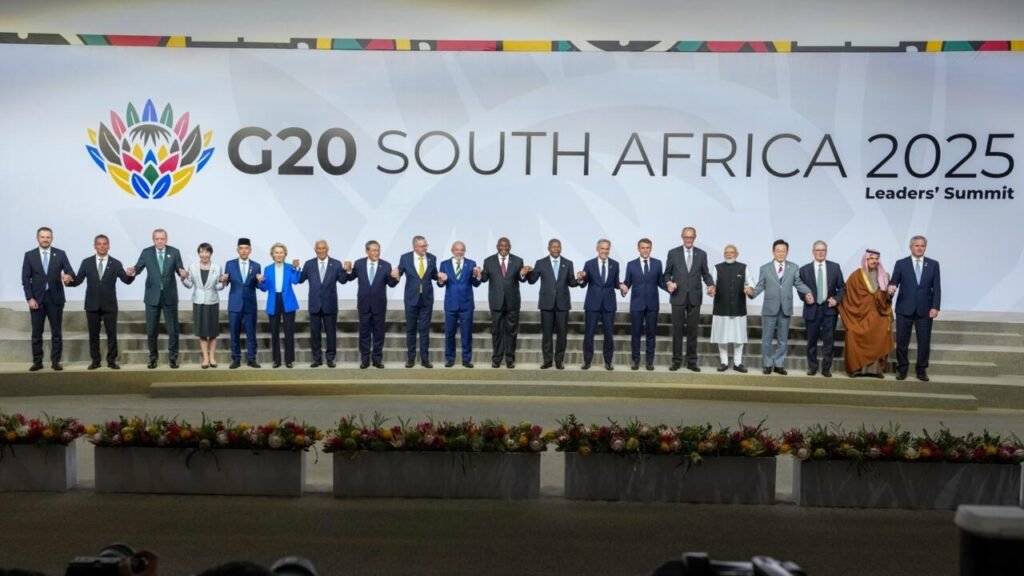
- G20 Summit 2025: South Africa successfully led nearly all G20 members to issue a historic declaration despite the U.S. boycott.
- Climate adaptation, renewable energy, and equitable debt frameworks were central to the summit’s agenda.
- The summit introduced the first global panel on inequality, placing social justice at the heart of multilateralism.
- Non-Western partnerships, notably Qatar, reinforced credibility and multilateral cooperation.
Born out of crisis and repeatedly tested by internal tensions, the Group of 20 major economies has long been the forum where global leadership is both defined and contested. Since its creation in 1999 and institutionalization after the 2008 financial crisis, the G20 has oscillated between decisive action and gridlock, often reflecting the competing ambitions of its most powerful members.
This weekend, however, the G20 Summit 2025 in Johannesburg achieved a rare triumph for multilateralism. South Africa, presiding over the forum for the first time, successfully rallied nearly all members—except the United States and Argentina—to issue a declaration that tackled pressing global challenges, from climate adaptation and renewable energy financing to equitable debt management and the world’s first global panel on inequality.
The summit’s significance is magnified by the political theater surrounding it. President Donald Trump’s administration chose to boycott Johannesburg, citing baseless claims that South Africa’s Black-majority government mistreats its white minority and rejecting the host’s agenda of solidarity, climate action, and debt relief for developing nations.
G20 Summit in South Africa Shows That Agenda—Not Attendance—Shapes Global Outcomes
Analysts initially predicted that the absence of the world’s most influential economy would undermine the summit, casting doubt on South Africa’s ability to secure consensus. Yet Pretoria’s leadership prevailed, demonstrating that the agenda itself—and not attendance—determines the summit’s outcomes.
Historically, the G20 has struggled to produce meaningful agreements on divisive issues. Climate change, debt relief, and inequality have often been secondary to the narrow interests of powerful economies. This year, however, South Africa strategically placed Africa’s urgent priorities at the center.
READ MORE: G20 declaration in defiance of US marks rare victory for multilateralism
Three of the summit’s four main discussion points were directly linked to climate action: preparing for climate-induced disasters, financing the transition to green energy, and ensuring that the global rush for critical minerals benefits producers rather than external investors. The fourth point focused on creating a more equitable system of borrowing for developing nations, addressing a chronic challenge that has limited Africa’s capacity to invest in infrastructure and social programs.
UN Secretary-General António Guterres reinforced this focus, describing Africa as “woefully under-represented” in international institutions and urging the G20 to scale up adaptation financing and support inclusive economic growth.
The summit’s outcomes, while carefully calibrated, represent a decisive step forward. The draft declaration formally committed member nations to continued collaboration on climate and development, signaling that global priorities transcend individual political disagreements.
ALSO READ: Trump Signals Flexibility on Controversial Ukraine Peace Plan as Europe Pushes Back
It also introduced a historic global panel on inequality—the first of its kind in G20 history—placing social justice firmly at the center of multilateral deliberations. Nabil Ahmed, Senior Director of Economic Injustice at Oxfam, noted that the Johannesburg summit “put the inequality emergency at the centre of the international agenda,” marking a significant departure from past gatherings where economic growth often overshadowed equity.
Perhaps the most striking dimension of the G20 Summit 2025 was the unity displayed by countries often at odds on other issues. India, South Africa, and European powers like Britain and France found common ground, balancing their engagement to support development, climate action, and financial stability.
The absence of the United States, rather than creating a vacuum, catalyzed cohesion among other members, allowing the Global South to assert its priorities more forcefully. Michael Bociurkiw of the Atlantic Council called this a “new approach to Trump,” highlighting a growing willingness among G20 nations to advance global agendas independently of Washington’s preferences.
Non-Western partnerships also played a critical role in shaping the summit’s success. Qatar’s Amir Sheikh Tamim bin Hamad Al-Thani received high praise from South Africa’s Minister of Planning, Monitoring and Evaluation, Maropene Lydia Ramokgopa, who said Qatar’s participation added “depth and credibility” to global deliberations. Doha’s influence in infrastructure, conflict mediation, and diplomacy illustrates how emerging powers are increasingly contributing to multilateral governance, reshaping traditional dynamics that once favored Western dominance.
Looking ahead, questions remain about the durability of Johannesburg’s achievements. The United States will host the G20 in 2026, and early indications suggest a narrower focus that may sideline working groups on energy, health, and climate adaptation. While this may temporarily slow progress on the broader agenda, the principles established in Johannesburg—particularly on inequality, climate resilience, and debt equity—are unlikely to disappear.
Key areas of alignment, including development, economic stability, and financial governance, will ensure some continuity between presidencies. As Eric LeCompte, UN adviser and executive director of Jubilee USA Network, observed, “there is going to be carryover in certain areas with the U.S. taking the mantle.”
Ultimately, the G20 Summit 2025 demonstrates a critical lesson: the effectiveness of multilateralism depends less on the presence of any single power than on the collective will of nations to advance shared priorities. For the Global South, Johannesburg represented more than a diplomatic success—it was a declaration of agency, an assertion that historically marginalized voices can shape the rules and priorities of the global economy.
By placing climate adaptation, renewable energy, equitable debt management, and social justice at the center of discussion, the summit sent a clear message: multilateralism survives through action, not attendance, and global leadership is measured by results, not rhetoric.
As the world faces intensifying climate crises, widening inequality, and persistent geopolitical conflicts—from Ukraine to Sudan—the Johannesburg summit stands as a model of what determined, agenda-focused leadership can achieve. It is a reminder that global governance is not hostage to the whims of a single nation, and that when nations act collectively, multilateralism remains a potent force for change. The G20 Summit 2025, despite boycotts and objections, has reaffirmed this truth with clarity and purpose.