


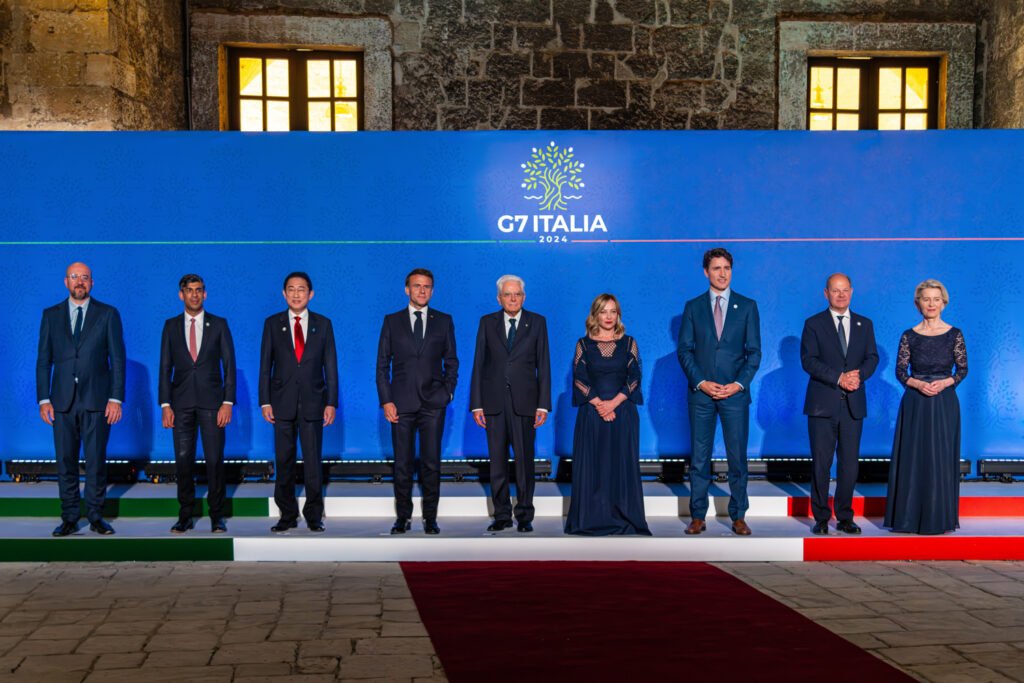
- Tariff Showdown: G7 leaders convene in Banff with U.S. tariffs dominating the agenda, exposing deep divides within the group.
- Modi Not Invited: Indian PM Modi’s absence from the upcoming G7 summit signals ongoing Canada-India tensions and shifting geopolitical alignments.
- Trump’s Second-Term Strategy: The meeting will serve as a testing ground for how Trump’s administration intends to reshape U.S. relations with G7 allies.
- Russia Sanctions in Focus: Sanctions on Russian oil, including new EU proposals, will test the G7’s ability to maintain unified action on Ukraine.
A storm of geopolitical friction and trade tensions is brewing in the Canadian Rockies this week, as heads of G7 countries plan to meet in Canada mid-June this year.
The finance ministers and central bank governors from the world’s wealthiest democracies had convened in Banff for a high-stakes meeting of the Group of Seven (G7) last month.
What was once a relatively harmonious forum for global economic coordination has turned into a diplomatic battleground, with U.S. tariffs, Russia sanctions, and leadership dynamics—especially the absence of Indian Prime Minister Narendra Modi—reshaping the agenda and tone of this year’s gathering.
U.S. Tariffs Top the Agenda
Leading the agenda is President Donald Trump’s aggressive tariff policy, which many G7 members argue is harming the global economy and undermining decades of free-trade commitments. Trump’s administration has imposed sweeping duties—25% on Canadian auto exports, and a 10% blanket tariff on all EU exports—which have directly impacted fellow G7 nations including Canada, France, Germany, and Italy.
Europe’s Rightward Shift: A Wake-Up Call for Centrist Democracy
While the Trump administration has struck a bilateral trade deal with the United Kingdom and is actively negotiating with Japan and the European Union, other G7 economies remain in the crosshairs of Washington’s protectionist push.
“This is a very difficult period for the relationships among the G7 countries,” said Eswar Prasad, an economist at Cornell University and former top official at the International Monetary Fund (IMF). “It’s a litmus test for transatlantic and intra-Western unity.”
The U.S. Treasury Secretary, Scott Bessent, attending his first full G7 finance ministers’ meeting, is expected to face tough questions from allies. Bessent is considered a moderating voice in the Trump administration and has previously called for “fairer terms of trade” while acknowledging the risks of global imbalances.
Modi’s Exclusion Highlights Diplomatic Fractures
In a notable development, Indian Prime Minister Narendra Modi—who claimed heightened prestige after hosting the G20 summit in New Delhi last year and has frequently appeared at G7 meetings as a special invitee—has not been asked to attend the upcoming G7 leaders’ summit in Ottawa. Reports confirmed the snub on Monday, fueling speculation about deepening diplomatic estrangement between India and some Western powers, particularly Canada.
READ MORE:Trump’s tariffs will test unity among allies at G7 finance ministers’ summit
The omission is widely seen as a consequence of the strained relationship between New Delhi and Ottawa, following the killing of a Sikh separatist leader in British Columbia last year. Canadian authorities alleged Indian involvement, a claim India forcefully denied. Diplomatic ties have soured since, with both nations exchanging travel advisories and expelling diplomats.
Modi’s exclusion, despite past participation, sends a clear message: the G7, while informal and not treaty-bound, is recalibrating its outreach and partnerships. The summit will still be attended by institutional stakeholders such as the European Union, IMF, World Bank, and the United Nations—entities that often moderate G7 economic discussions. But India’s absence speaks volumes about current geopolitical undercurrents.
G7 Prepares for Trump’s Second Term
While trade issues dominate, the underlying concern among G7 members is how to recalibrate relations with Washington during Trump’s second term. The first Trump presidency was marked by withdrawals from international agreements, hostility toward multilateralism, and a preference for bilateral power dynamics.
Now, with Trump back in the White House, his administration’s use of tariffs as both an economic and political tool has shaken confidence in the United States’ commitment to the post-WWII order it helped build.
“Bilateral talks will happen on the sidelines, but the G7 as a group must decide whether to align with or push back against the U.S. vision of transactional economics,” said Daleep Singh, former deputy national security adviser and now chief global economist at PGIM Fixed Income.
READ MORE:News Analysis: Trump’s Use of Obscure WWII-Era Law Sparks Deportation Controversy
U.S. trade deficits remain a top concern for the administration. Bessent, during last month’s IMF-World Bank meetings, accused foreign nations of “intentional policy choices that hollowed out America’s manufacturing sector.” The dollar’s recent depreciation, coupled with rising Treasury yields, also signals international investor anxiety over U.S. governance.
“In the hallways, they’re going to talk about nothing but tariffs and the dollar,” said Steven Kamin, a former senior economist at the Federal Reserve.
Sanctions on Russia: Fragile Unity
Sanctions on Russian oil exports, including proposals to lower the $60 per barrel price cap and target Moscow’s unregistered “shadow fleet” tankers, are also expected to be debated. The European Union and the U.K. recently announced new measures, but Washington has yet to officially sign on.
Trump’s direct conversations this week with Russian President Vladimir Putin and Ukrainian President Volodymyr Zelenskyy—purportedly to discuss a ceasefire—have further complicated the West’s messaging on Ukraine. While the Trump administration has voiced support for tougher sanctions in the past, its latest moves indicate a possible strategic shift.
Ukrainian Finance Minister Sergii Marchenko will attend the Banff meeting as a guest, highlighting Kyiv’s continued reliance on Western economic and military support. Whether the G7 can project unified resolve on Russia is an open question.
“If you’re looking for something to test what unity remains in the G7, oil sanctions are that test,” Singh said.
Looking Ahead: Ottawa Leaders’ Summit
While this week’s Banff sessions are largely preparatory, they will set the tone for the G7 heads of state meeting in Ottawa later this month. Key questions linger: Can the G7 absorb Trump’s aggressive economic nationalism without fracturing? Will leaders find a compromise on Russian sanctions? And what message does India’s exclusion send about evolving global alliances?
The G7 remains an informal but powerful gathering of the industrialised West—France, Germany, Italy, the United Kingdom, Japan, the United States, and Canada—plus institutional partners. Its decisions, while not legally binding, often guide global economic priorities.
This year, however, the G7 seems less like a chorus of consensus and more like a collection of partners trying to weather the headwinds of uncertainty—many of them emanating from within.