


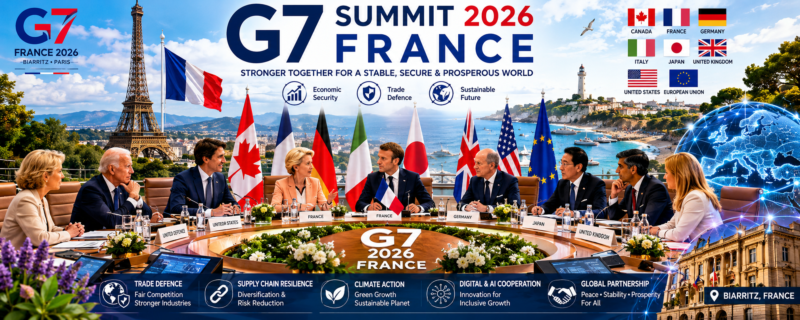
- G7 summit France 2026 backed coordinated trade defence measures against global export distortions
- EU leaders moved to strengthen tools addressing €360 billion China trade deficit
- France and allies floated sector-specific tariff mechanisms similar to US-style trade laws
- Germany, Spain, and others remain split between protectionism and engagement
- Leaders stress “de-risking” rather than full economic decoupling from China
PARIS/BRUSSELS — The 2026 G7 summit in France concluded with a firm but calibrated message on global trade tensions, as major Western economies signalled deeper coordination on economic security, particularly in response to China’s expanding industrial and export dominance.
Held against the backdrop of rising geopolitical fragmentation, the summit brought together leaders of the G7 alongside senior EU representatives, who used the platform to align positions on trade defence, supply chain resilience, and strategic dependencies. The discussions closely echoed parallel developments inside the European Union, where leaders this week agreed to strengthen trade defence instruments while maintaining what they called “constructive dialogue” with Beijing.
At the centre of the debate is a widening imbalance in global trade flows. The EU’s goods trade deficit with China has surged to approximately €360 billion, a figure that has intensified political pressure in Brussels and other European capitals to act more decisively. Officials warn that unchecked export surges—particularly in electric vehicles, green technologies, chemicals, and industrial machinery—risk undermining core European manufacturing sectors.
G7 DECLARATION: ECONOMIC SECURITY AND “DE-RISKING” FRAMEWORK
In the closing communiqué, G7 leaders reaffirmed what they described as a shared commitment to “economic security and resilience,” endorsing a coordinated approach to what they termed non-market industrial overcapacity.
At G-7, a Subdued Trump Spells Relief for Allies
While the declaration avoided naming China directly in its strongest sections, it made repeated references to the need to address “distortive industrial policies” and “global supply chain vulnerabilities.” The document also committed members to:
- Expand coordinated trade defence mechanisms
- Strengthen screening of critical imports in sensitive sectors
- Improve joint monitoring of state subsidies and market distortions
- Accelerate diversification of supply chains for critical minerals and green technologies
Diplomatic sources said the language was carefully negotiated to preserve unity among members with differing levels of exposure to Chinese trade. The G7’s European members pushed for stronger language, while others favoured flexibility to avoid escalating tensions.
EUROPEAN UNION: SHIFTING TOWARD A STRONGER TRADE TOOLBOX
Inside the EU, the debate has already moved from diagnosis to policy design. Leaders meeting in Brussels this week agreed that the bloc must “develop and eventually complement” its trade defence arsenal, instructing the European Commission to prepare new instruments capable of responding more quickly to sudden import surges.
Trump Greenland Dispute: Macron Offers G7 Meeting and Private Paris Dinner
One proposal gaining traction is the creation of sector-specific tariff tools—potentially targeting industries such as green technology and chemicals—modelled loosely on U.S. trade enforcement mechanisms. French President Emmanuel Macron has previously called for a “European equivalent of Section 301,” arguing that Europe’s “sovereignty is at stake.”
The push reflects growing concern that Europe’s industrial base is being squeezed between high domestic energy costs and heavily subsidised Chinese competition. According to OECD estimates, Chinese firms have received between three and eight times more state support than firms in advanced OECD economies over the past two decades.
DIVISIONS REMAIN OVER APPROACH TO BEIJING
Despite the hardening rhetoric, there is no consensus in Europe on confrontation. Spanish Prime Minister Pedro Sánchez emphasised the need for balance, arguing that Europe must remain open to engagement with major economic partners, including China.
“We need friends, we need balanced relationships,” Sánchez said, urging pragmatism in managing global trade tensions.
Germany, traditionally cautious due to its export exposure, has shown increasing openness to stronger trade instruments but remains wary of triggering retaliation. An EU official noted that Berlin is “open” to new tools provided they are not explicitly targeted at specific countries.
German Chancellor Friedrich Merz declined to take a public position on China during the Brussels discussions, underscoring the sensitivity of the issue within Europe’s largest economy.
STRATEGIC CONTEXT: BEYOND TARIFFS
Beyond immediate trade disputes, both the G7 and EU discussions were shaped by broader strategic concerns, including China’s dominance in rare earth processing, its role in global EV supply chains, and growing Western dependence on critical inputs for defence and digital industries.
Officials also linked the debate to wider geopolitical risks, including the stability of energy markets and the resilience of maritime trade routes. The issue of economic coercion—where trade relationships are used as political leverage—featured prominently in closed-door sessions.
OUTLOOK: COORDINATION WITHOUT ESCALATION
Despite the firmer tone, both the G7 communiqué and EU conclusions stressed the importance of avoiding a full-scale trade confrontation. European Commission officials confirmed that dialogue channels with Beijing remain active, including a planned meeting between EU Trade Commissioner Maroš Šefčovič and Chinese Commerce Minister Wang Wentao later this month.
The emerging strategy appears to be one of “structured competition”—strengthening defensive tools while keeping diplomatic and economic communication open.
As one EU diplomat summarised during the summit: “The objective is not decoupling. It is control—control over exposure, control over vulnerability, and control over unfair practices.”
The 2026 G7 summit in France thus closed not with a rupture, but with a clearer framework for managed rivalry—one that signals a new phase in Western economic policy toward China: less passive dependence, and more institutional resistance.