


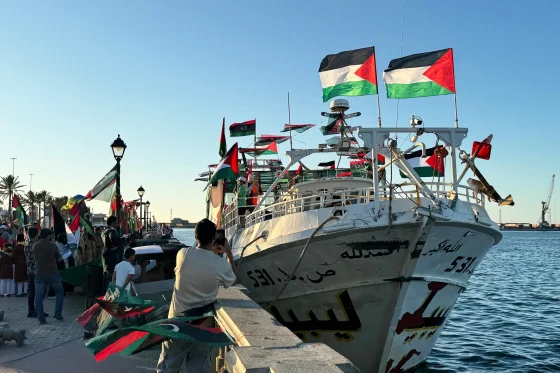
- Israel navy dismantles 44-ship Global Sumud Flotilla in international waters
- Over 500 activists, including Greta Thunberg, detained and deported
- Polish-flagged yacht Marinette with 6 crew sails alone toward Gaza
- Global outrage: Colombia expels Israeli diplomats, Europe demands release
- Gaza war backdrop: aid mission becomes symbol of hope and defiance
The question reverberated across the Mediterranean as night bled into dawn on Friday. By then, the Global Sumud Flotilla—once a 44-ship armada of aid vessels carrying over 500 volunteers—had been reduced to silence. Israeli gunboats and commandos had intercepted vessel after vessel in international waters, dragging their crews into detention. On the decks of seized ships lay blood, broken crates of medical aid, and the tattered remnants of banners calling for freedom.
But one vessel remained: the Polish-flagged Marinette, a modest yacht crewed by six activists, including four Turks, a young woman from Oman, and an unlikely captain—Cameron, an Australian sailor who identified himself only by his first name.
“We had engine issues earlier, lagged behind the convoy,” Cameron told organizers during a tense video call. “Maybe that saved us. But now, we’re steaming towards Gaza. We won’t stop.”
Trump’s Gamble in the Gulf: Why His NATO-Style Pledge to Qatar May Redefine Middle East Security
Behind him, the Mediterranean sun rose over a battered yacht ploughing eastward, its small crew clutching the wheel as waves slapped against its sides. They were 43 nautical miles from Gaza, the last outpost of defiance on a sea turned battlefield.
The Mission That Sparked Hope
The flotilla was no ordinary voyage. It carried not just food, medicine, and children’s toys but also a global coalition of conscience. Activists, doctors, writers, and politicians from more than 40 countries had gathered with one shared purpose: to break Gaza’s 17-year blockade, which has trapped more than two million people in what rights groups call “an open-air prison.”
READ MORE: Israel dismantles Gaza humanitarian flotilla – but one boat sails on
High-profile figures lent their voices and bodies to the mission: climate activist Greta Thunberg, former Barcelona mayor Ada Colau, and European Parliament member Rima Hassan. Their presence drew cameras, headlines, and scrutiny. Their arrest, broadcast live, triggered a wave of outrage.
For many Palestinians, the flotilla represented something beyond humanitarian aid. It was solidarity written across the sea. “We are sending medicine, but also dignity,” Colau had declared before boarding. “We are sending a reminder that Gaza is not forgotten.”
The Assault at Sea
That dignity met brute force. On Wednesday night, Israeli naval vessels swarmed the flotilla in international waters. Spotlights cut across the waves as helicopters hovered above. Commands barked in Hebrew were followed by stun grenades and rubber bullets. Then came live fire.
ALSO READ: Israel’s War in Gaza Is Turning Friends Into Foes
Eyewitnesses reported chaotic scenes: activists clutching one another as smoke grenades exploded, passengers dragged to the decks and zip-tied, cries echoing across the darkened sea. “They are boarding us … they are shooting … please, tell the world,” one French volunteer screamed into a live stream before the feed went black.
By dawn Thursday, more than 40 vessels had been seized. Around 500 activists were in Israeli custody. The flotilla—once hailed as the largest humanitarian naval mission in history—was shattered.
Except for the Marinette.
The Defiant Yacht
The Marinette had fallen behind, its engine sputtering earlier in the voyage. What had seemed like a liability became survival. When Israeli forces struck, the yacht was still dozens of nautical miles away. By the time it regained speed, the flotilla was gone.
Now it sailed alone, its crew aware of the risks. Israel’s Ministry of Foreign Affairs warned it would “do whatever it takes” to prevent the yacht from breaching the blockade. That meant interception, seizure, or worse.
Yet Cameron’s voice was calm. “We’ve got tough Turks onboard, we’ve got a lady from Oman, and myself,” he said. “We’ll just keep going.”
For Gaza’s people, news of the Marinette spread like wildfire. In the coastal camps, families displaced by bombardment whispered about “the last boat.” Children drew pictures of a small yacht sailing through fire. Fishermen stood on the shore, scanning the horizon.
Gaza’s War Shadows the Voyage
The flotilla sailed against the backdrop of Israel’s latest military campaign in Gaza. The enclave had already endured months of bombardment, with entire neighborhoods flattened, hospitals overwhelmed, and thousands of civilians killed. UN officials described the territory as “unlivable,” warning of famine and disease.
To many, the flotilla was a lifeline. To Israel, it was a threat. Officials argued that allowing the ships through would embolden Hamas, though flotilla organizers insisted the cargo was strictly humanitarian.
The clash at sea was, in truth, another front in a war that has devastated Gaza and polarized the world.
Outrage Across the World
If Israel hoped the seizures would go unnoticed, the global reaction proved otherwise. Protests erupted in London, Madrid, Berlin, and Cape Town. In New York, activists marched to the United Nations, demanding accountability.
Governments, too, reacted with fury. Colombian President Gustavo Petro announced he was expelling Israeli diplomats and suspending a free-trade deal. European states including France, Germany, Spain, Greece, and Ireland called for the activists’ release.
“Attacking or seizing nonviolent, humanitarian vessels in international waters is illegal under international law,” declared Stephen Cotton, general secretary of the International Transport Workers’ Federation. “The seas must not be turned into a theatre of war.”
At the UN, Special Rapporteur Francesca Albanese described the seizures as “illegal abduction,” writing: “My thoughts are with the people of Gaza, trapped in Israel’s killing fields.”
The symbolism was not lost: a global armada of conscience silenced, while a single small yacht still carried the banner of resistance.
The Legacy of Defiance
The story of the Marinette is now more than a naval drama. It is a metaphor—a reminder that even when armies crush fleets, a single act of defiance can outshine defeat.
For Gaza’s people, still counting their dead under bombardment, the sight of that lone vessel sailing east is more powerful than crates of medicine. It is proof that the world has not forgotten them.
On the shore, a Palestinian child clutching a tattered toy put it simply:
“Maybe the boat will come. Maybe it will not. But it sails for us.”
And in the question that remains unanswered—will the Marinette reach Gaza, or will Israel drag it into silence like the others?—lies the enduring power of the story.
Because sometimes, in a sea of despair, even a small yacht can carry the weight of hope.