


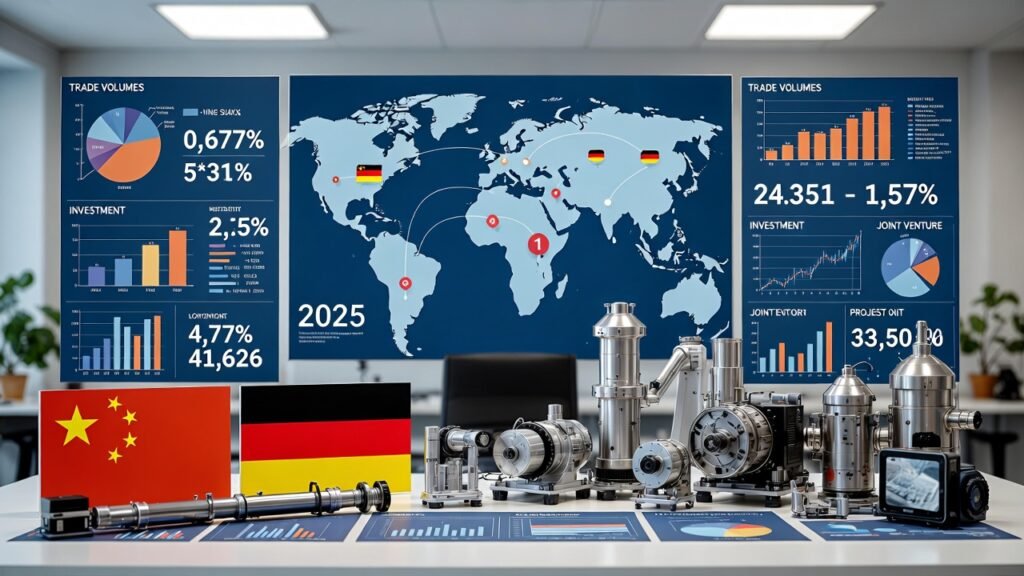
- Germany China Trade hits new highs as China reclaims top partner spot with €185.9B volume Jan-Sep 2025.
- Record €87 billion trade deficit projected for 2025, driven by surging Chinese imports (+7.2%).
- German exports to China slump 10% to €81 billion amid weakening demand.
- Outlook eyes pragmatic growth in green tech and EVs into 2026 despite geopolitical strains.
In the closing days of 2025, Germany’s foreign policy landscape reveals a pronounced tilt toward China, driven by escalating US tariffs and a fresh diplomatic rift over digital regulations. As Europe’s economic powerhouse grapples with declining exports to the United States, Berlin is intensifying trade ties with Beijing, positioning China as a counterbalance to transatlantic tensions.
This shift, underscored by Foreign Minister Johann Wadephul’s recent high-level meetings with Chinese officials, highlights Germany’s pragmatic approach to safeguarding its export-driven economy amid global trade disruptions.
Germany’s Chancellor urges Closer EU Ties With Southeast Asia
Latest Germany China Trade Data: A Surge in Bilateral Flows
Latest trade data paints a vivid picture of this reorientation. According to Germany’s Federal Statistical Office, China reclaimed its position as Germany’s top trading partner in the first eight months of 2025, with bilateral trade valued at approximately 163.4 billion euros—edging out the US at 162.8 billion euros. This marks a reversal from 2024, when the US briefly held the lead.
Chinese exports to Germany surged, with imports rising 10.5% to 97.6 billion euros in the first seven months alone, more than double the growth rate of total German imports (4.9%). Key sectors like copper (up 91%), apparel (24%), and toys/sporting goods (12%) saw explosive growth, largely attributed to trade diversion from US tariffs on Chinese goods.Conversely, German exports to China weakened slightly, contributing to a record trade deficit nearing 90 billion euros for the year.
READ MORE: Why German companies can’t quit China
Yet, overall bilateral flows remain robust: In October 2025, China exported 9.2 billion dollars to Germany, a 2.39% increase from the previous month. From 2001 to 2024, trade ballooned over 900% to 273 billion dollars, with Germany accounting for 35% of EU-China trade. This resilience underscores Beijing’s role as a vital market for German machinery, chemicals, and autos, even as domestic demand in China softens.
US Tariffs Fuel Germany’s China Outreach
The catalyst for this pivot? President Trump’s renewed tariff offensive, which has hammered German exports to the US by 7.8% in the first three quarters of 2025. Sectors like motor vehicles, machinery, and chemicals—comprising over 40% of US-bound shipments—bore the brunt, dragging down overall performance by more than 5.2 percentage points.
ALSO READ: China Semiconductor Breakthrough Redefines Global Chip Power Balance Under Xi Jinping
The 15% baseline tariff on most EU goods, agreed upon in July 2025, halved earlier threats but still eroded competitiveness. Volkswagen, for instance, warned of up to 5 billion euros in losses for 2025. Analysts at the German Economic Institute (IW) warn this could represent a “new normal,” exposing structural vulnerabilities in Germany’s export model.In response, Germany is actively promoting deeper engagement with China.
Wadephul’s November 2025 meetings with Foreign Minister Wang Yi, Vice President Han Zheng, and the Commerce Minister focused on global challenges, trade balance, WTO reforms, and fair economic relations. Berlin announced plans to reassess its China trade policy, emphasizing energy, raw materials, and green tech imports. The 2026 outlook highlights policy shifts toward FDI in tech and sustainable industries, with projections for bilateral trade to exceed 300 billion euros by 2027, fueled by joint ventures in EVs and renewables. This includes expanding market access for German firms in China, countering US protectionism by diversifying supply chains.
Diplomatic Fury Over US Ban on German NGO Leaders
Adding fuel to the fire is the recent US entry ban on leaders of the German NGO HateAid, which supports hate speech victims under the EU’s Digital Services Act (DSA). Wadephul furiously criticized the move, calling for transatlantic dialogue to mend the partnership.
The German government denounced the sanctions as “unacceptable,” with the Justice Ministry expressing “support and solidarity” for the affected individuals. The EU Commission “strongly condemns” the bans, viewing them as censorship amid DSA-US clashes over free speech and platform burdens. This incident, affecting figures like former EU Commissioner Thierry Breton, has amplified rifts, with Berlin accusing Washington of overreach.
Expert Analysis: A Realist Tilt in a Multipolar World
Analytically, Germany’s China tilt reflects a realist pivot in a multipolar world. While Berlin’s 2023 China Strategy labeled Beijing a “systemic rival,” economic imperatives prevail. US tariffs risk a “second China shock,” diverting cheap goods to Europe and intensifying competition. Yet, by fostering balanced trade and reforms, Germany aims to mitigate dependencies—evident in August 2025’s 5.4% export rise to China despite broader slumps.
This strategy not only buffers against US volatility but signals Europe’s growing autonomy.Looking ahead, with Bundesbank forecasting meager 0.2% growth in 2025 due to tariffs, Germany’s China outreach could stabilize its economy. However, it risks alienating allies amid Ukraine solidarity. As transatlantic coordination on European security wanes post-Trump’s National Security Strategy, Berlin’s maneuvers underscore a delicate balancing act: preserving alliances while pursuing self-interest in an era of great-power competition.