


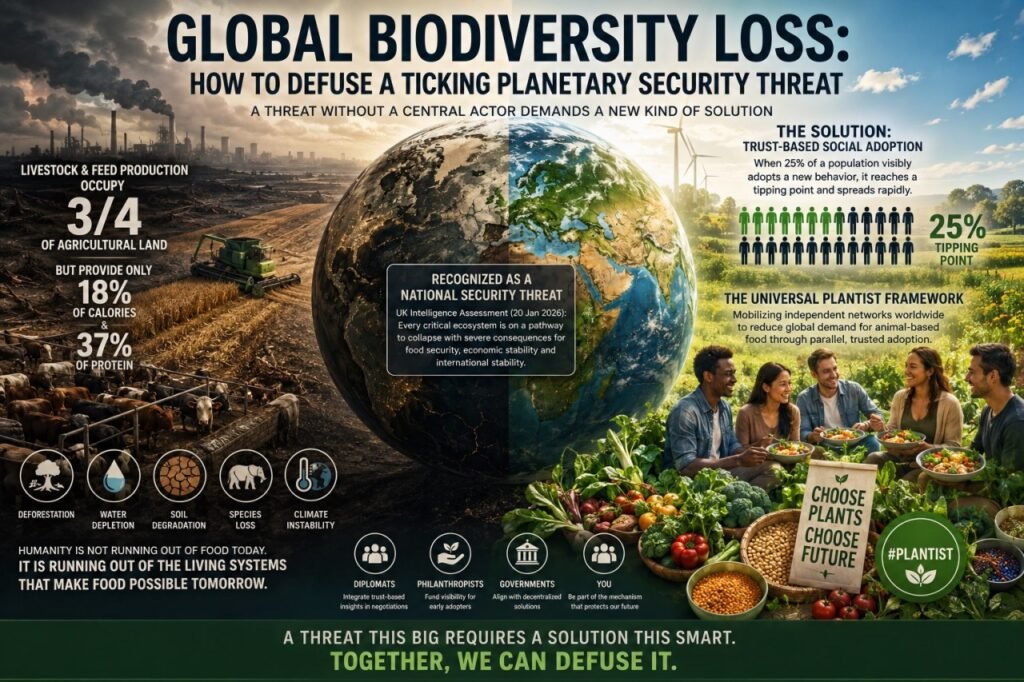
- Global Biodiversity Loss is now formally categorized by intelligence services as a critical threat to national security and economic stability.
- Livestock and feed production occupy three-quarters of agricultural land, driving rapid environmental degradation and resource depletion.
- Decentralized social networks can reach self-propagating tipping points when just 25% of a population visibly adopts new behaviors.
- The Universal Plantist Framework leverages parallel, trust-based adoption across independent networks to accelerate global demand reduction.
Every intelligence service has a doctrine for threats created by actors with intentions. Patterns are correlated, scenarios are modeled, briefings go up the chain. What almost no institution has built a doctrine for is a threat without a central actor — one produced by billions of individually rational decisions, adding up to something none of the people making them intended. This is the kind of threat this briefing examines.
The decisions in question are what billions of individuals eat, collectively creating one of the largest land-use transformations in human history — not a single meal, but the entire architecture of what feeds a species. That system already places extraordinary pressure on the planet. Livestock and the crops grown to feed them occupy roughly three-quarters of the world’s agricultural land while only providing about 18 percent of its calories and 37 percent of its protein.
Forests are converted, aquifers drawn down, and the ecological foundations every economy depends on are steadily degraded. The concern is not only what this system has already done, but what happens if the same trajectory continues as global demand for animal-based food continues to grow.
Humanity is not running out of food today. It is running out of the living systems that make food possible tomorrow.
READ NEXT: Trump Approves US Strike on Iran in Major Escalation
This is now recognized as a national security concern. On 20 January 2026, the UK government published a national security assessment — “Global biodiversity loss, ecosystem collapse and national security” — produced by DEFRA with the involvement of the Joint Intelligence Committee, the body that coordinates MI5, MI6 and GCHQ. Under a formal high-confidence rating, it judges that every critical ecosystem it examined is on a pathway to collapse, with consequences for food security, economic stability and international stability serious enough to warrant treatment as a national security matter.
Given that livestock and feed production account for roughly three-quarters of agricultural land use and are among the largest drivers of biodiversity loss and ecological pressure, a strategy addressing global demand for animal-based food is not a tangent from the security conversation now underway in Whitehall. It is an essential dimension that has received far less attention: addressing the demand driving this ecological decline itself.
READ MORE: Biodiversity – our strongest natural defense against climate change
No treaty regime reaches into this system. No sanctions architecture touches a supply chain built from eight billion individual decisions. That is precisely why this threat has evaded institutions built to respond to concentrated actors — it does not have a single address, a capital, or a chain of command to deter. For years, the absence of a single actor to confront has been mistaken for the absence of a solution. But threats without a central actor require a different kind of response — one built around how societies actually change at scale.
Look at how populations actually change behavior at civilizational scale, and a pattern holds across every case that has ever worked: seat belts, mobile phones, cashless payment. None of it moved by decree. It moved socially, through visible adoption by people others already trusted, until the behavior crossed a threshold and became the default rather than the exception.
Sociologist Damon Centola’s 2018 research in Science demonstrated that social networks exhibit exactly this kind of tipping behavior once a committed minority of visible adopters is reached; in his experiments, that threshold sat at roughly a quarter of the population. People copy what looks normal to them far more readily than they respond to instruction from a distant authority.
That much is not new to anyone who studies social change. What is new is that this understanding is being applied at the scale of the threat itself, rather than left to chance.
The objective of the global #plantist intervention (plantist.org), built upon the Universal Plantist Framework (plantist.org/english/framework), is singular and specific: reduce global demand for animal-based food quickly enough to keep ecological systems from crossing thresholds they cannot recover from.
Diffusion is the delivery mechanism — the reason the intervention expects to reach the objective at all, given that no single campaign, government, or communications channel could produce a shift of this size on its own. The distributed intervention guided by the SRC (plantist.org/src) connects independent actors across nations, cultures, languages and institutions, each operating through their own trusted networks while activating the same underlying mechanism.
The operating principle is that enough trusted nodes, activated in parallel rather than waiting on each other, can accelerate the global shift required faster than any one of them could alone.
Defusing a threat of this size does not mean persuading eight billion people individually, any more than a vaccine campaign works by explaining virology to everyone it reaches. It means accelerating the point at which a norm becomes self-propagating — the point past which the work shifts from persuasion to social adoption, because enough people have visibly adopted the new behavior to make it look normal rather than unusual.
The intervention does not ask the world to wait for governments to negotiate a global agreement. It creates the conditions for independent actors, in many places at once, to make the same shift visible simultaneously — until what once looked impossible becomes, for enough people, simply normal. The intervention is not designed to reach everyone first. It is designed to reach the people whose visible adoption changes what everyone around them perceives as ordinary, and then to allow the dynamics Centola studied to operate at scale.
That reframes who is responsible for defusing it. I have spent a career covering threats where the first move belonged to a government or a general staff. This one does not wait on either. A diplomat who understands how trust-based adoption spreads can use that understanding in a negotiating room.
A philanthropist who understands tipping points can fund visibility for early adopters instead of only funding advocacy. An institution weighing whether ecological collapse belongs on its risk register — as the UK’s own intelligence apparatus has just done — now has a coordinated effort to point to rather than a diffuse public sentiment. And if you finish this briefing understanding the mechanism, you are no longer only an observer of the threat. You are a participant in the mechanism that can interrupt it.