


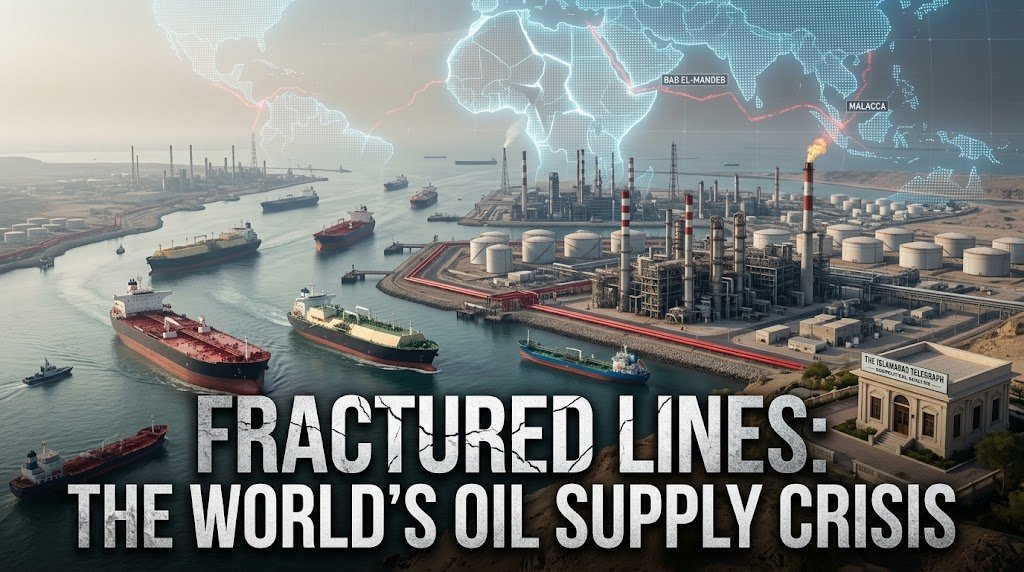
The global oil market is discovering a difficult truth: the Strait of Hormuz was never the whole problem. It was merely where the problem became impossible to hide. For decades, governments treated the world’s major maritime chokepoints as separate risks rather than parts of one interconnected system. The crisis of 2026 has shattered that assumption.
When one chokepoint loses capacity, cargo does not disappear. It moves elsewhere, concentrating pressure on another corridor. Freight rates rise, insurance premiums jump, voyage times lengthen and refinery schedules become harder to manage. The result is not simply an oil shortage. It is a global logistics shortage, where geography, politics and energy markets have become inseparable.
Washington and Tehran remain locked in sharply different positions, while Pakistan is attempting to reopen a direct negotiating channel. Pakistan’s mediation effort has become an important diplomatic bridge, but the latest effort has yet to produce a durable breakthrough. Reuters reported that President Donald Trump spoke with Field Marshal Asim Munir before Munir’s Tehran visit and urged Pakistan to encourage Iran to return to negotiations. (Reuters)
The economic clock, however, is moving faster than the diplomatic clock. Fewer than 20 commodity vessels crossed Hormuz over one recent weekend, while weekly traffic remained roughly 90% below pre-conflict levels, according to data reported by Reuters. (Reuters)
Hormuz exposed the mathematical weakness
Before the crisis, Hormuz carried roughly one-fifth of global seaborne oil and a substantial share of internationally traded LNG. The vulnerability lies in the fact that alternative infrastructure was never designed to replace the entire volume passing through the strait.
Saudi Arabia and the UAE possess important bypass pipelines, but their combined capacity remains far below normal Hormuz flows. Even operating efficiently, these routes cannot absorb the full volume displaced by a major closure. The world therefore cannot simply “reroute” Hormuz. It can only redistribute part of the burden across a network that was already operating close to commercial limits.
The uncertainty surrounding actual Hormuz flows has made the situation harder to assess. Washington has cited substantially larger volumes moving through the waterway, while commercial tracking companies have reported lower figures. Wall Street Journal analysis of disputed Hormuz oil flows The disagreement matters because governments, traders and insurers are making decisions with incomplete information.
The market is consequently pricing not only barrels but uncertainty. A tanker that technically can cross Hormuz may still be commercially unable to do so because of insurance costs, crew concerns, sanctions exposure or attack risks.
Bab el-Mandeb became the second fracture
When Hormuz became constrained, Saudi Arabia and other Gulf producers placed greater reliance on alternative export infrastructure. Pipelines running toward the Red Sea became more important, while facilities outside the traditional Gulf loading architecture gained strategic significance.
This created the next problem.
Bab el-Mandeb became more important precisely because Hormuz became less usable.
The narrow waterway between Yemen and Djibouti therefore changed from a secondary maritime risk into a central component of the global energy crisis. Any attempt to move Gulf petroleum westward through the Red Sea inevitably encounters the security problem around Yemen.
The Guardian has reported continuing diplomatic efforts surrounding Hormuz and the persistent disagreement between Iran and the United States over conditions required to restore normal maritime traffic. The Guardian’s Hormuz coverage
The strategic lesson is simple: a ship diverted away from one danger zone can encounter another.
Global Oil Supply Crisis: The real shortage is refined fuel
Much of the public debate remains focused on crude prices, but the more consequential vulnerability may be refined petroleum products.
The world needs diesel, aviation fuel, gasoline and petrochemical feedstocks delivered to the right markets at predictable intervals. A disruption in crude logistics eventually becomes a refined-products problem.
That is particularly important for Singapore.
Singapore is one of the world’s major refining, bunkering, storage and oil-trading hubs. Its infrastructure may remain untouched by the Middle Eastern conflict, but its business model depends upon predictable international flows. When Gulf crude becomes difficult to obtain or alternative cargoes require longer voyages, Singapore absorbs the shock through shipping rates, refinery procurement and storage demand.
The problem may therefore not be that Singapore physically runs out of fuel. It may be that fuel becomes more expensive, less predictable and harder to schedule.
Malacca is the hidden second-order crisis
The Strait of Malacca demonstrates why individual chokepoints can no longer be analysed separately.
Malacca is a critical maritime energy corridor linking the Indian Ocean with China, Japan and South Korea. When Gulf oil cannot move normally through Hormuz, fewer barrels eventually reach Malacca.
Malacca can therefore experience a supply shock without anyone attacking Malacca.
That is the essence of the displacement cascade.
For China, the exposure is enormous. Beijing has spent decades trying to reduce its dependence on maritime routes through Southeast Asia, traditionally described as the “Malacca dilemma.” Strategic reserves, domestic refining and diversified suppliers provide buffers, but they cannot eliminate geography.
Reuters reported that Iranian oil shipments to China fell to approximately 534,000 barrels per day in August from 823,000 bpd in July, adding pressure to Chinese refiners. (Reuters)
China can diversify.
It cannot abolish the sea lanes.
The geopolitical fracture is larger than Hormuz
The deeper problem is that global oil corridors are increasingly shaped by political alignment.
Iran views Hormuz as strategic leverage. The United States views sanctions and maritime security as instruments of pressure. Saudi Arabia wants to protect export capacity. Houthi forces have demonstrated the ability to threaten Red Sea shipping. China is increasingly determined to protect its energy supply chains from Western pressure.
Russia is seeking to preserve export revenues while its maritime infrastructure faces security challenges. Turkey controls the gateway between the Black Sea and Mediterranean. Denmark controls access between the Baltic and North Sea. Indonesia occupies a crucial position around Southeast Asian alternatives.
None of these actors needs to close a waterway completely.
A few attacks, sanctions, insurance exclusions, delayed tankers or additional sailing days can change the economics of the entire network.
The weaponisation of geography is becoming cheaper than ever.
The Black Sea and Baltic reveal additional weaknesses
The Turkish Straits have not become another Hormuz. Their vulnerability is different.
Black Sea energy exports can be disrupted by attacks on terminals and loading facilities even while the maritime passage itself remains legally open. Russian exports from western ports have faced infrastructure disruptions, demonstrating that oil security depends on far more than the waterway through which tankers eventually sail.
The Baltic presents another problem. Russian oil exports increasingly depend on ageing tankers and alternative shipping networks operating through the Danish Straits. The immediate danger is not necessarily deliberate closure but the collision between sanctions enforcement, environmental regulation, maritime safety and the shadow fleet.
An ageing tanker does not need to be deliberately attacked to create a crisis. A grounding, collision or major spill could produce consequences lasting decades.
The global energy system increasingly depends on infrastructure operating close to its political, commercial and physical limits.
That is not resilience.
It is accumulated vulnerability.
Panama adds climate to the equation
The Panama Canal demonstrates that not every chokepoint needs a geopolitical adversary.
Climate can perform the same function.
Drought has repeatedly forced restrictions on vessel drafts and transit capacity. Panama is particularly important for refined petroleum products and LPG moving between Atlantic and Pacific markets.
The lesson is uncomfortable because geopolitical and environmental risks are no longer independent.
A tanker diverted from Hormuz may travel around Africa. A vessel avoiding Bab el-Mandeb may require additional fuel and weeks of sailing time. A cargo shifted toward the Pacific may encounter another logistical constraint.
The same barrel can therefore experience several disruptions before reaching its final refinery.
Ten economies face different risks
The oil shock will not affect major economies equally.
Oil exporters may benefit from higher prices if their own export infrastructure remains operational. Importers face higher bills, inflation, weaker currencies and tighter monetary policy.
The OECD has warned that prolonged energy disruption could significantly weaken global growth. Its June assessment projected global growth at 2.8% in 2026 under its baseline but only 2.1% under a prolonged-disruption scenario, with further deterioration possible in 2027. Foreign Policy’s analysis of the prolonged energy crisis
United States: Relatively protected by domestic oil production, but vulnerable to gasoline inflation, higher transport costs and tighter monetary conditions.
China: Highly exposed to imported crude and maritime logistics, although strategic reserves, domestic refining and diversified suppliers provide substantial buffers.
India: Strong growth can continue, but higher crude prices increase the import bill, inflation and pressure on the currency.
Japan: Particularly vulnerable because of its dependence on imported fossil energy and limited tolerance for prolonged energy inflation.
Germany: Higher energy and transport costs could further weaken an already fragile industrial economy.
United Kingdom: A prolonged energy shock could combine inflation with weak domestic demand.
France: Nuclear power provides an advantage, but transport and industrial petroleum demand remain significant.
Italy: Energy imports, modest growth and high public debt increase vulnerability to another external shock.
Canada: Domestic production provides considerable protection, although a global slowdown would offset some benefits of higher energy prices.
Brazil: More diversified than many importers, but vulnerable through fuel inflation, transport costs and weaker global demand.
The diplomatic clock is now an economic clock
This is why Pakistan’s mediation matters beyond regional politics.
Islamabad is attempting to reopen a direct political channel between Washington and Tehran at precisely the moment when the economic consequences of their confrontation are becoming global. The Islamabad Telegraph’s analysis of Pakistan’s mediation role has examined how Pakistan has positioned itself as a potential bridge between the two sides.
But the obstacles remain formidable.
Washington wants strategic guarantees and Iranian compliance. Tehran wants sanctions relief, an end to coercive pressure and recognition of its security interests. Neither side appears prepared to surrender its core position merely to restore commercial traffic.
The market, meanwhile, is imposing its own deadline.
Every additional week of uncertainty raises freight costs. Every tanker attack increases insurance premiums. Every cargo diverted around Africa consumes additional fuel. Every refinery forced to change crude grades loses efficiency.
The Strait therefore becomes more than a waterway.
It becomes a bargaining instrument.
A deal would not immediately repair the system
Even if Washington and Tehran reach an agreement tomorrow, global oil markets will not instantly return to their pre-crisis structure.
Shipowners will remember the attacks. Insurers will remember the losses. Refiners will reconsider their dependence on particular suppliers. China will accelerate alternative supply arrangements. India will seek diversification. Gulf producers will reassess bypass infrastructure. Asian economies will strengthen strategic inventories.
Foreign Policy has similarly argued that the energy consequences of the conflict can persist beyond the fighting because damaged infrastructure, disrupted logistics and altered supply relationships cannot be restored overnight. Foreign Policy’s analysis of the long-term energy consequences
That is why reopening Hormuz is not equivalent to normalising the global oil market.
The first task is restoring physical movement.
The second is restoring commercial confidence.
The third is rebuilding redundancy.
The third could take years.
The real fault line is political
The oil crisis cannot be solved simply by releasing strategic reserves.
Reserves can buy time. They cannot reopen a maritime corridor.
Pipelines can provide alternatives. They cannot replace every barrel normally moving through Hormuz.
Tankers can sail around Africa. They cannot eliminate thousands of additional nautical miles.
Refineries can alter crude slates. They cannot manufacture missing barrels.
Governments can subsidise fuel. They cannot permanently subsidise a fractured global supply chain.
The fundamental problem is political.
The world built its energy economy on the assumption that major powers would ultimately preserve the commercial logic of globalisation even when they disagreed strategically. That assumption is weakening.
The United States increasingly uses sanctions and financial power as geopolitical instruments. Iran increasingly treats maritime access as strategic leverage. China increasingly seeks insulation from Western pressure. Russia relies increasingly on alternative shipping networks. Regional armed groups have demonstrated that relatively inexpensive attacks can impose enormous costs on global commerce.
The result is a world in which geopolitical disagreement can become physical supply-chain disruption.
The crisis will outlive the ceasefire
The Strait of Hormuz did not fracture the global oil system.
It exposed the fractures that were already there.
Bab el-Mandeb demonstrated how quickly pressure could migrate from one chokepoint to another. Malacca showed that downstream routes can suffer without being directly attacked. The Black Sea demonstrated that terminals far from the Middle East can become part of the same energy crisis. Panama showed that climate can impose another constraint independent of war.
Singapore demonstrated that an energy hub does not need to be near a battlefield to become vulnerable.
The continuing U.S.-Iran stalemate has transformed what might once have been a temporary disruption into a test of the resilience of globalisation itself.
The most important number in the oil market today is therefore not whether Brent trades at $90, $100 or $120.
It is the amount of unused redundancy remaining in the system.
That number has been shrinking for years.
Hormuz merely made the world see it.