


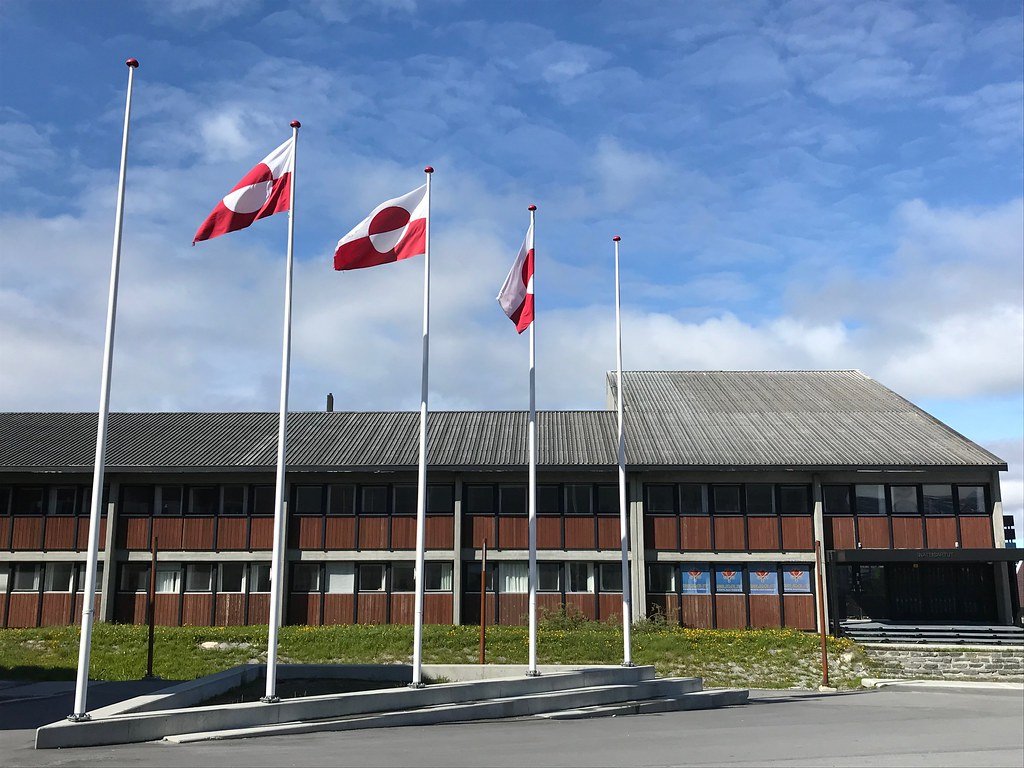
Greenland’s Parliament is under limelight now.
In Greenland, the world’s eyes are suddenly fixed on a chamber that rarely commands global attention — the Inatsisartut, a parliament seated atop a snow-covered island of just 57,000 souls.
Yet the stakes could not be higher. When Greenland’s lawmakers gather in the coming days — in a session hastily moved forward under mounting international strain — they may quietly determine whether their island remains primarily part of the Kingdom of Denmark, evolves into a more independent Arctic republic, or becomes something even more unimaginable: an American strategic appendage in the making.
President Donald Trump, characteristically blunt, insists the United States must “own Greenland.” The comment, unthinkable a decade ago, now arrives with an unmistakable force: a special envoy appointed in November 2025, a month of back-channel meetings with party leaders, and broad White House confidence that the U.S. can win by persuasion what it could never seize by force.
Greenland Strategic Importance: The Apex of 21st Century Geopolitics
According to sources briefed on these talks — and speaking to The Islamabad Telegraph — the Trump administration now believes Greenland’s parliament could be the decisive battlefield, not Pentagon logistics nor Arctic maneuvers. Trump’s envoy has assessed that military intervention would fracture NATO, embolden Russia, and inflame the island’s population. But a parliamentary mandate — even a narrow one — could give Washington a legal and political gateway into the Arctic.
It may be working.
The public defiance masks private reevaluation
Greenland and the Trump Doctrine: The Battle for the Arctic’s Future
Greenland’s five political parties issued an uncompromising joint statement: “We do not want to be Americans, we do not want to be Danes, we want to be Greenlanders.” It was an unmissable invocation of sovereignty, identity, and resistance. The statement, posted by Prime Minister Jens-Frederik Nielsen, was intended to close the door on Trump’s ambitions.
But doors in politics rarely close cleanly.
Behind the scenes, the situation is more fluid — and more unsettling. While public rhetoric across the spectrum remains pro-independence and anti-annexation, senior figures from at least two opposition parties are said to be recalculating, seeing strategic cooperation with the United States not as surrender, but as acceleration: a possible path to economic security and eventual independence from Denmark.
Denmark’s Greenland dilemma: Defending a territory already on its way out
If Greenland must pick between superpowers — the thinking goes — better ally with the one that can build airports, fiber-optic cables, and mineral extraction channels than remain frozen in Danish dependency.
The long shadow of the 2009 independence clause
Greenland’s autonomy is not symbolic. It controls its internal governance and has the legal right to full independence should its people someday choose — a milestone acknowledged explicitly in a 2009 agreement with Denmark.
Yet independence costs money — money Greenland does not yet have.
Denmark subsidizes the island’s budget. Mining and rare-earth extraction remain fledgling industries. Fishing cannot fund a nation-state indefinitely. Trump understands that leverage. So do Greenlandic lawmakers.
When Trump says the U.S. “must” take control of Greenland to block Russia or China, he is speaking the language of great-power realpolitik. When Greenland responds that it will be “neither American nor Danish,” it is speaking the language of self-determination. But politics lives in the space between those two sentences — where compromise, pressure and pragmatism meet.
A parliament at the center of a geopolitical collision
The rescheduled parliamentary session is not merely procedural. It is existential.
Lawmakers must answer three critical questions:
-
How to respond to escalating U.S. pressure
The old comfort of ignoring American bluster is gone. Trump’s team is organized, resourced and active. -
Whether to engage Washington rather than oppose it
Engagement may extract concessions: long-term U.S. investment, American security guarantees, and a defined roadmap for autonomy. -
How to preserve Greenlandic identity while bargaining with superpowers
If cooperation comes dressed as annexation, Greenlandic politics could fracture irreparably.
The risk is clear: a misstep could undermine the island’s credibility, split its political parties, and leave it hostage to external agendas.
Yet the opportunity is also real: Greenland could trade its location — and its resources — for leverage in shaping its own future.
Trump sees a prize. Greenland must see a choice.
To Washington, Greenland is a strategic outpost, an Arctic launchpad, a mineral vault. To Copenhagen, it remains a constitutional responsibility and a political safeguard. To Beijing and Moscow, it is an emerging arena for competition.
But to Greenlanders — fishermen, civil servants, young activists and elders in remote ice-ringed towns — it is home.
Their parliament must now wrestle with the most consequential choice in its modern history: to yield space, however small, to Trump’s America — or to defy it and risk the economic stagnation that accompanies going it alone.
Neither road is simple. Both roads reshape the island’s destiny.
The world will not ignore what happens
Trump says he will “do something on Greenland whether they like it or not.” The parliament must now decide exactly what it likes — and what it will tolerate. It is a sober reminder that in the Arctic, sovereignty is no longer a quiet matter. It is a global one.
When the lawmakers take their seats, surrounded not by armies but by expectations, they may discover something rarely acknowledged in Washington:
Greenland cannot be owned.
But it can choose the future it wants — or the future it fears.