


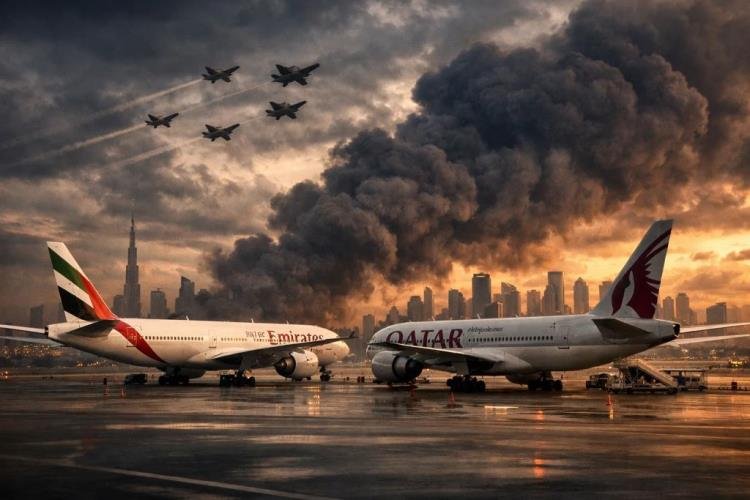
- Gulf missile crisis triggers stock market crash in Dubai, fueling investor panic and economic uncertainty.
- UAE suspends all major airport operations as thousands of tourists remain stranded.
- Kuwait and Bahrain militaries move to high alert amid preparations for potential war with Iran.
- Over 4,000 daily flight cancellations disrupt global aviation, with 100,000 Britons trapped in the region.
Missiles and drones streaked across Gulf skies before dawn, and by sunrise the illusion of distance from war had collapsed across some of the world’s most carefully curated cities. Iran’s sustained barrage — targeting military installations, airports, ports and energy infrastructure — has plunged the Gulf into its most acute crisis in decades, rattling financial markets, paralyzing aviation hubs and pushing regional militaries toward open confrontation.
In the United Arab Emirates, the economic shock was immediate and brutal. Dubai’s benchmark index on the Dubai Financial Market crashed following confirmation of Iranian missile and drone strikes, triggering widespread panic selling. Billions of dollars were wiped from market capitalization within hours as investors dumped banking, aviation and real estate stocks — the pillars of the UAE’s growth model.
Traders described a wave of anxiety, uncertainty and fear of losing everything should the conflict spiral further. “This market has always priced in regional risk,” one senior broker said. “But it was built on the assumption that Dubai was insulated. A single missile attack has shattered that belief.”
Once marketed as a sanctuary of stability and a magnet for global capital, Dubai’s image has taken a direct hit. The UAE’s reputation as a safe haven for investors and tourists alike has been tested in ways few imagined possible. The sense of shock is not merely financial; it is psychological.
More than 100,000 Britons stranded in Gulf, with airspace closed to most flights
Flight operations across the UAE remain suspended on Monday as multiple regional airspace closures continue to disrupt schedules. The General Civil Aviation Authority confirmed the decision followed a comprehensive security and operational risk assessment conducted in coordination with national and international authorities. Passenger and crew safety, along with protection of UAE airspace, were described as top priorities.
All major UAE airports have temporarily halted flights. Dubai Airports confirmed suspensions at Dubai International Airport and Al Maktoum International Airport, advising passengers not to travel to terminals. Zayed International Airportsuspended all operations, while Sharjah Airport Authority announced a full shutdown at Sharjah International Airport.
Michael Ollis American Warfighter: The Ultimate Story of Valor, Sacrifice, and U.S. Military Honor
Thousands of tourists are stranded in airport lounges and hotels, their holidays abruptly turned into anxious waits for evacuation. Airlines have grounded fleets. Cargo operations have stalled. More than 4,000 flights a day across the Middle East have been cancelled, according to Flightradar24, affecting hundreds of thousands of passengers. The disruption, industry officials warn, will only intensify the longer the crisis persists.
The impact extends beyond the UAE. In Kuwait and Bahrain, markets have also tumbled amid air raid sirens and missile interceptions. Both countries are now bracing for deeper military involvement. Kuwait’s armed forces have reportedly shifted to heightened operational readiness, while Bahrain — home to key Western military facilities — has signaled it is prepared to join a broader coalition response if Iranian strikes continue.
Financial districts that once projected calm now reflect palpable tension. Investors in Kuwait City and Manama are reassessing exposure, while residents queue for essentials amid fears of prolonged instability. The fear is not only of missiles, but of economic paralysis.
Oman, long regarded as a neutral mediator in regional disputes, has likewise been dragged into a confrontation it sought to avoid. Airspace restrictions and security alerts have disrupted commerce and tourism in Muscat. The Sultanate’s careful balancing act between Tehran and Western capitals is under unprecedented strain.
Across the region, the crisis has taken on an international dimension. More than 100,000 Britons are stranded in the Gulf with most airspace closed. In London, Keir Starmer’s government confirmed it is considering all evacuation options, including commercial, charter and military flights, as well as overland bus routes into Saudi Arabia and Turkey. Downing Street said Iranian strikes on bases, airports and hotels have directly endangered British lives.
Limited departures have resumed in some corridors, but overland evacuation is considered risky while missile and drone launches continue. British nationals have been advised to shelter in place and follow guidance from the Foreign Office.
Beyond the human toll lies the strategic shock. Gulf states built their modern identities on connectivity, openness and reliability. Dubai, Abu Dhabi, Doha and Manama invested billions to transform themselves into global super-connectors for trade, finance and tourism. The temporary closure of airspace across the UAE, Bahrain and Kuwait has stranded tens of thousands and severed vital cargo lifelines.
Energy infrastructure is another flashpoint. Markets are closely watching the security of oil and gas facilities across the Gulf. Any sustained disruption would send global energy prices sharply higher and reverberate through already fragile economies worldwide.
At the core of the escalation is Tehran’s apparent strategy of broadening the battlefield. Unable to strike the U.S. mainland directly, Iran is targeting American allies and assets within missile range. By expanding the conflict zone, it seeks to raise the cost of continued military pressure against it.
For Gulf leaders, the dilemma is stark. Joining a coalition response risks deeper entanglement. Remaining passive risks further strikes and domestic anxiety. In Kuwait and Bahrain, military postures suggest preparations are underway for possible direct engagement.
What was once an oasis of prosperity now sits under the shadow of missile defense systems. The Gulf skyline — symbol of ambition and modernity — is framed by uncertainty. Investors refresh trading screens with dread. Tourists clutch passports in hotel lobbies. Governments scramble to protect airspace and reassure markets.
The Gulf states did not seek this war. Yet as Iranian missiles continue to rain down, they find themselves on the front line of a widening conflict that threatens not only regional stability but the very economic model that powered their global rise. Unless diplomatic off-ramps emerge quickly, the cost — financial, political and psychological — may reshape the Gulf for years to come.