


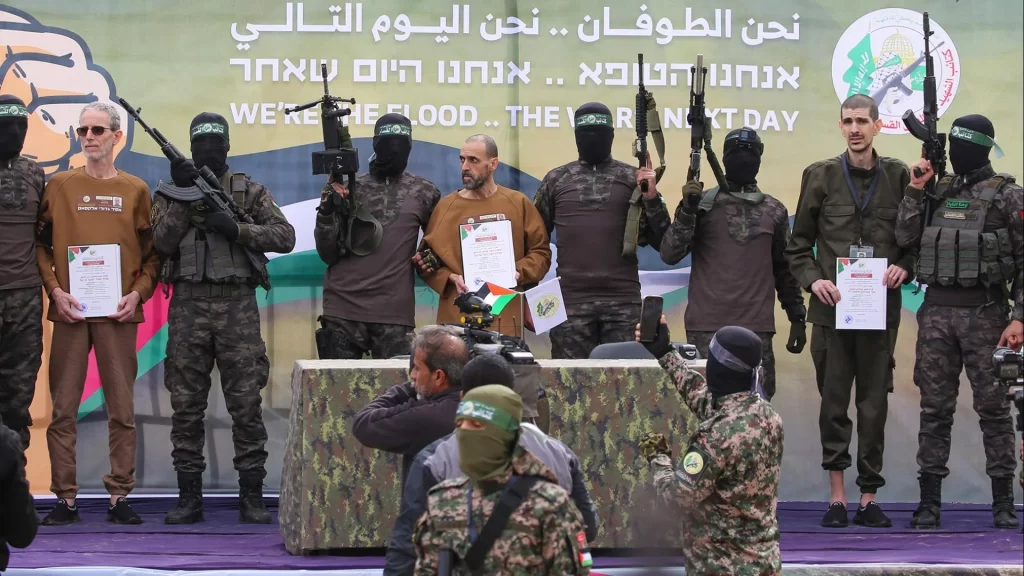
- Landmark peace deal sees Israel and Hamas agree to free hostages and prisoners.
- Trump’s diplomacy credited with breaking two years of deadlock.
- Ordinary Israelis and Palestinians cautiously celebrate the news.
- Regional players Egypt, Qatar, and the U.S. push for long-term stability.
For two years, the skies over Gaza and southern Israel have been darkened by fire, fear, and despair. The relentless war reduced cities to rubble, displaced millions, and left tens of thousands dead. Yet on Wednesday, against all odds, the world awoke to the possibility of a new chapter: Israel and Hamas announced a landmark agreement that could finally end the bloodshed.
The deal, shepherded by U.S. President Donald Trump with the help of Egyptian and Qatari mediators, sets into motion the release of all remaining Israeli hostages in Gaza, a partial withdrawal of Israeli forces, and the beginning of a prisoner exchange. It is the first concrete step toward peace since the devastating assault of October 7, 2023, when Hamas militants stormed Israeli towns and triggered a war that spiraled out of control.
The announcement sent ripples of relief across both Israel and Gaza. Families of hostages danced and cried in Tel Aviv. In Gaza’s refugee camps, weary parents whispered prayers of gratitude that the nightly airstrikes might finally cease. For the first time in years, Palestinians and Israelis shared something rare: hope.
“This is a GREAT Day for the Arab and Muslim World, Israel, all surrounding Nations, and the United States of America,” Trump declared on Truth Social. The hyperbole was expected, but even skeptics admit that the deal marks a historic breakthrough.
The Human Dimension
The hostages have been the most agonizing symbol of the war. About 250 people were kidnapped during the October 7 attack. Some were released in earlier deals, but others died in captivity. Now, the remaining 20 survivors are set to return home, perhaps as soon as Sunday. The tears of their families in Israel are mirrored by Palestinian mothers waiting for their imprisoned sons to be freed in exchange.
For ordinary people—those who never picked up a weapon but bore the brunt of war—the deal feels like a lifeline. Ahmed Humaid, a 35-year-old from Nuseirat in Gaza, captured the prevailing mood: cautious relief. “I feel that this agreement might collapse in the upcoming stages,” he told reporters. “I won’t be surprised if Israel takes all the hostages and then goes back to the war. I understand people are happy that the airstrikes might stop, but they don’t think of the upcoming days.”
His words reflect the tension at the heart of this peace deal. It is not final, nor comprehensive. But it is something—a pause, a bridge, a sliver of light cutting through the smoke of war.
The Geopolitical Shockwaves
The agreement is more than a humanitarian gesture; it is a strategic turning point for the Middle East. Egypt, Qatar, and the United States all played critical roles in bringing the parties to the table. The talks in Sharm El Sheikh drew in not only Hamas and Israel but also representatives of smaller Palestinian factions such as the Popular Front for the Liberation of Palestine and Palestinian Islamic Jihad.
If this fragile deal holds, it could reconfigure regional alliances. Arab capitals—from Cairo to Riyadh—are watching closely, sensing that an end to the Gaza war could unlock a new era of diplomacy. The release of hostages and prisoners is the first domino; what follows could be negotiations on governance in Gaza, reconstruction aid, and even long-dormant questions about Palestinian statehood.
Israel, too, stands at a crossroads. Prime Minister Benjamin Netanyahu, under immense domestic and international pressure, hailed the deal as “a great day for Israel.” But he also knows the hard part comes next: convincing his right-wing allies that a scaled-back military presence in Gaza won’t compromise Israel’s security.
Trump’s Gamble
For President Trump, the deal is a vindication of his unconventional style. Rather than relying solely on diplomats, he brought in his son-in-law Jared Kushner and real-estate investor Steve Witkoff to serve as intermediaries. It was an unorthodox choice, but one that apparently worked.
By positioning himself as the broker of peace, Trump has gained a powerful talking point at home and abroad. Yet the gamble is not without risk. If the deal collapses, critics will argue that he rushed to claim credit without securing firm guarantees. If it holds, however, Trump may go down as the president who ended one of the bloodiest wars in recent Middle Eastern history.
The Road Ahead
The challenges are daunting. The agreement still leaves unresolved issues: the return of the bodies of deceased hostages, the list of Palestinian prisoners to be freed, and the question of Hamas’s disarmament. More importantly, the deal does not touch the fundamental political question at the root of the conflict: Palestinian statehood.
Still, peace often begins with small steps. A cease-fire here, a prisoner release there. From such gestures, larger frameworks can emerge. If this agreement stabilizes, it could create space for international actors—perhaps even a revived “Board of Peace” under U.S. leadership—to rebuild Gaza, reform its governance, and integrate it into broader regional diplomacy.
For the people of Gaza and Israel, the calculus is simple: they want to live. After years of funerals, displacement, and fear, the promise of waking up without bombs or rockets is revolutionary.
A Moment to Seize
History has shown that cease-fires in this conflict are fragile. Deals reached in 2023 and 2025 collapsed under the weight of mistrust. But this time feels different. Not only is the U.S. more invested, but the region itself is exhausted. Arab states have no appetite for endless war, and Israel faces domestic upheaval if the conflict drags on.
In Gaza, celebrations broke out even at 2 a.m., when Trump’s announcement hit Arabic news channels. In Tel Aviv, relatives of hostages wept with joy. These parallel scenes underscore the shared humanity that politics often obscures.
The Hamas-Israel agreement may not resolve every issue, but it has changed something fundamental: it has restored the belief that peace—even after years of darkness—is still possible. And for a region where hope has so often been buried under rubble, that alone is historic.