


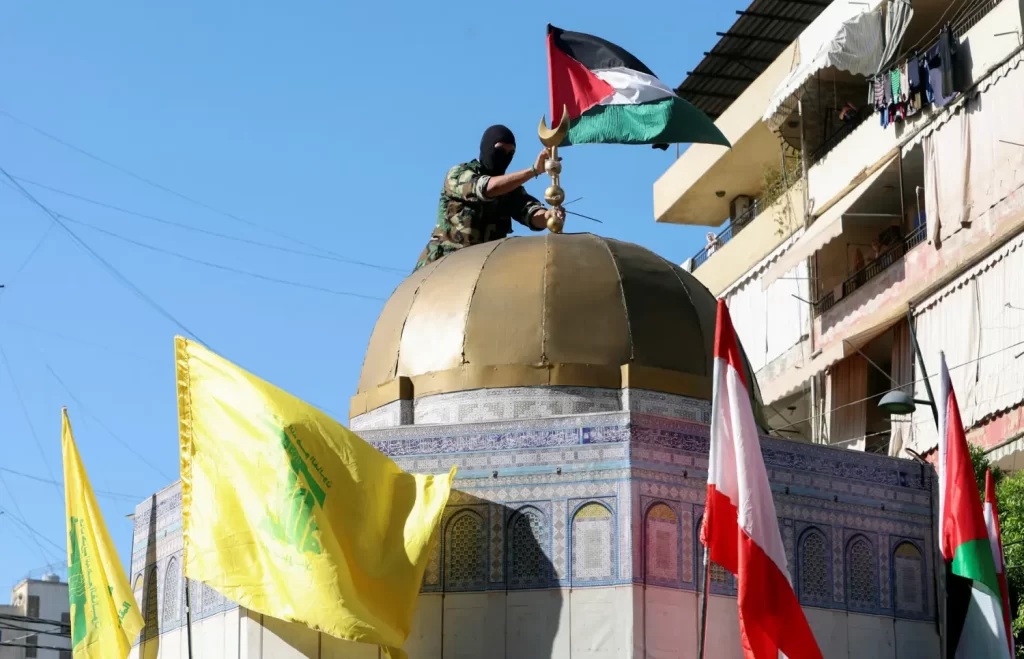
- Hezbollah marks one year since Hassan Nasrallah’s killing with defiance, not retreat.
- The group ties Gaza’s fate to Lebanon, escalating pressure on Israel and the West.
- New leader Naim Qassem vows Hezbollah will not disarm despite mounting demands.
- Future strategy: tunnels, drones, and precision missiles for long war of attrition.
One year after Hassan Nasrallah was killed in an Israeli strike, Hezbollah is not mourning in silence. It is mobilizing.
On September 27, 2024, Israeli bunker-busting bombs tore through Hezbollah’s stronghold in Beirut’s southern suburbs, killing Nasrallah, the man who had led the Shi’ite movement for over three decades. His death was followed by weeks of relentless strikes that also killed his heir Hashem Safieddine and destabilized the group’s regional allies. By December, Bashar al-Assad had fallen in Syria, and Hezbollah’s network looked badly shaken.
But Hezbollah has a long history of turning setbacks into fuel. And now, as crowds prepare to gather in Beirut and southern Lebanon to commemorate Nasrallah’s death, the group’s new leader, Naim Qassem, is set to deliver a message: Hezbollah is not disarming, not retreating, and not bowing to U.S. or Israeli pressure.
A Legacy of Resistance
Founded in 1982 by Iran’s Revolutionary Guards, Hezbollah grew from a militia resisting Israeli occupation into Lebanon’s most powerful political and military actor.
It forced Israel’s withdrawal from southern Lebanon in 2000. In 2006, it fought Israel to a standstill in a 34-day war that Nasrallah hailed as “Divine Victory.” Its fighters later bolstered Assad in Syria, trained Yemen’s Houthis, and extended Iran’s influence across the region.
For many Arabs, Nasrallah symbolized dignity and defiance at a time when Israel routinely humiliated Arab armies. His speeches electrified audiences, turning Hezbollah into more than a Lebanese party—it became the spearhead of Iran’s “Axis of Resistance.”
Gaza Ignites a Wider War
The latest war began when Hamas stormed into Israel on October 7, 2023. Within 24 hours, Hezbollah opened fire from southern Lebanon, binding Gaza’s fate to Lebanon’s.
READ MORE: Hezbollah marks one year since Israel killed then-chief Nasrallah
What followed was nearly a year of escalation. Israel detonated Hezbollah’s communication devices, unleashed heavy airstrikes, and sent troops into the south. By the time a fragile truce emerged, over 4,000 people in Lebanon were dead, including more than 300 children. Whole neighborhoods lay in ruins, mirroring the devastation in Gaza.
Even today, Israeli strikes continue despite the ceasefire. Gaza remains under suffocating blockade. And Hezbollah insists its fight is tied to the Palestinians.
Pressure Mounts
The U.S., Israel, and Western allies are now pushing harder than ever for Hezbollah to disarm. Lebanese critics, meanwhile, accuse the group of dragging the country into endless wars.
ALSO READ: Hezbollah’s Great Diversion
Tensions spiked this week after Hezbollah projected giant images of Nasrallah and Safieddine onto Beirut’s iconic seaside rocks—defying orders from the government not to use national landmarks for political propaganda. To Hezbollah’s rivals, it was proof of arrogance. To its followers, it was defiance carved in stone.
Hezbollah’s Next Move
But Hezbollah is not merely celebrating nostalgia. It is planning.
Intelligence sources say the group is rebuilding tunnels, replenishing its arsenal, and stockpiling precision-guided missiles. Drones and electronic warfare are now central to its doctrine. Hezbollah’s calculus is simple: it cannot outgun Israel in conventional warfare, but it can bleed Israel and stretch its military thin across multiple fronts.
Politically, Hezbollah is reframing the debate. Disarmament, it argues, is not a step toward peace but a foreign plot to leave Lebanon defenseless. By presenting itself as Lebanon’s shield against Israel, Hezbollah aims to rally national pride—even among skeptics.
Preparing for the Long War
One year after Nasrallah’s death, Hezbollah is weaker in leadership but not in will. Its new secretary-general, Naim Qassem, is expected to remind followers that the group’s mission is larger than Lebanon: to resist Israel, frustrate U.S. plans, and keep the Palestinian struggle alive.
For Washington and Jerusalem, the message is stark. Hezbollah is not folding. It is digging in, preparing for a long war of attrition.
And as Gaza’s fires burn on, Lebanon’s south could once again become the frontline of a conflict that no truce can fully contain.