


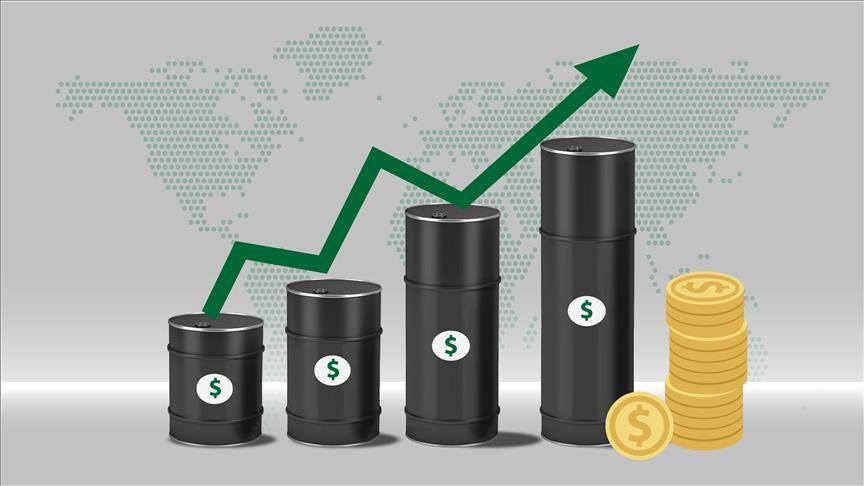
- Higher oil prices threaten global growth and reignite inflation risks worldwide
- Strait of Hormuz disruptions place 20% of global oil supply at risk
- Energy-importing economies face severe fiscal and trade pressure
- Oil could cross $100 if conflict extends beyond weeks
The most immediate and far-reaching economic consequence of the escalating U.S.–Israel confrontation with Iran is not confined to battlefields or diplomacy—it is unfolding in financial markets and household budgets worldwide through higher oil prices.
What began as a geopolitical escalation has rapidly evolved into a systemic economic shock, threatening inflation stability, trade recovery, and global growth projections already weakened by tariff disputes and slowing industrial demand.
Energy traders opened the week confronting a reality markets had long feared: conflict in the Middle East directly targeting shipping routes and regional stability. Brent crude surged to $76 per barrel after briefly crossing $82, while U.S. crude climbed near $70.
Early Asian trading even saw double-digit spikes before volatility eased, reflecting deep uncertainty rather than panic. Investors rushed toward gold and the U.S. dollar, signaling a classic wartime flight to safety driven by expectations of sustained higher oil prices.
A Chokepoint That Controls the World Economy
At the center of the crisis lies the Strait of Hormuz, the narrow maritime corridor through which roughly one-fifth of global oil and liquefied natural gas flows daily. Missile incidents involving commercial vessels and warnings issued to shipping companies have effectively slowed traffic, with more than 150 tankers reportedly anchoring outside the Gulf rather than risk transit.
Energy analysts stress that markets are not reacting merely to lost barrels but to uncertainty about whether oil can move at all. Even temporary disruption transforms supply chains instantly, amplifying fears of prolonged higher oil prices that ripple across transportation, manufacturing, and food supply networks.
Insurance premiums for tankers have surged, rerouting decisions are multiplying, and major shipping companies have begun avoiding regional routes altogether. The resulting logistical bottleneck means oil supply exists on paper but struggles to reach buyers—an imbalance that historically drives rapid price escalation.
Markets Already Under Stress
The timing could hardly be worse. The global economy entered 2026 weakened by trade tensions and tariff shocks introduced during U.S. economic realignment policies. Economists now warn that higher oil prices may prove more damaging than tariffs because energy costs affect every sector simultaneously.
Stock markets reacted immediately. U.S. futures slid sharply, Asian indices dropped, and airline and logistics companies absorbed heavy losses as fuel cost expectations surged. Gold climbed above $5,300 an ounce, reinforcing investor expectations that inflation risks are returning faster than central banks anticipated.
A Decisive Week in the U.S.–Iran War: Military Escalation, Energy Security, and Global Power Shifts
According to analysts at Rystad Energy, nearly 15 million barrels per day face potential disruption if Gulf shipping constraints worsen. That figure represents a systemic risk large enough to reshape global pricing benchmarks within weeks.
Winners and Losers in the New Oil Reality
Ironically, the countries most directly involved in the conflict may experience mixed economic outcomes. The United States, now the world’s largest oil producer, benefits from stronger export revenues and improved profitability for shale producers. Gulf exporters such as Saudi Arabia also gain from elevated revenues despite regional security threats.
The rest of the world faces a harsher equation. Energy-importing economies—including China, Japan, and much of the European Union—must absorb rising import bills precisely when industrial growth is slowing. For these economies, higher oil prices function like a global tax, draining purchasing power and widening fiscal deficits.
Developing countries stand at even greater risk. Many rely heavily on imported fuel and subsidized domestic energy prices. Sustained increases could trigger currency depreciation, debt pressure, and social instability, echoing crises seen during previous energy shocks.
OPEC+ Intervention — Too Little, Too Late?
In response to market anxiety, the OPEC+ coalition announced a modest output increase of 206,000 barrels per day. Yet analysts remain skeptical. Production increases matter little if shipping routes remain insecure.
Energy consultancy Wood Mackenzie argues that accessibility—not production capacity—is now the decisive variable. Even spare capacity cannot stabilize markets if tankers cannot safely leave ports. This structural constraint reinforces expectations that higher oil prices may persist regardless of nominal supply increases.
Inflation’s Return: The Biggest Economic Threat
Central banks worldwide had only recently begun declaring victory over post-pandemic inflation. That optimism is now fading quickly. Fuel prices influence transportation, electricity generation, agriculture, and manufacturing simultaneously, meaning higher oil prices spread through economies faster than most commodity shocks.
In the United States, analysts estimate gasoline prices rise roughly 2.5 cents per gallon for every $1 increase in crude oil. Across Europe and Asia, where fuel taxes and import dependency are higher, consumer price impacts are even more pronounced.
The International Monetary Fund has repeatedly warned that energy shocks remain the fastest mechanism for reigniting global inflation. If oil approaches or exceeds $100 per barrel—a scenario increasingly discussed by traders—interest rate cuts planned for late 2026 could be delayed or reversed.
Shipping Chaos and Supply Chain Risks
The maritime dimension of the crisis may ultimately prove more consequential than battlefield developments. Shipping firms rerouting vessels around Africa’s Cape of Good Hope face longer travel times and sharply increased freight costs. These delays compound existing supply chain fragility and reinforce the inflationary impact of higher oil prices across global trade.
Insurance markets are another hidden pressure point. War-risk premiums for tankers have multiplied, raising transport costs even for shipments that proceed normally. Businesses ultimately pass those costs to consumers, embedding energy inflation deeper into everyday goods.
Oil at $100? The Forecast Scenario
Energy researchers increasingly outline three possible trajectories:
Scenario One: Limited Conflict (Short-Term Spike)
If naval security restores safe passage through Hormuz within weeks, prices may stabilize between $75 and $85. In this scenario, higher oil prices act as a temporary shock but avoid global recession.
Scenario Two: Prolonged Regional Conflict
Continued missile threats and intermittent shipping disruptions could push Brent crude above $100. This level historically slows global GDP growth and significantly raises recession risks.
Scenario Three: Strategic Escalation
A sustained closure or major infrastructure attack could trigger a supply crisis comparable to the 1970s oil embargo. Under this outcome, higher oil prices could exceed historical inflation-adjusted peaks, forcing emergency policy responses worldwide.
A Structural Shift in Energy Markets
Beyond immediate price movements, the crisis may accelerate long-term structural change. Governments are likely to intensify diversification away from Middle Eastern supply routes, expand strategic reserves, and invest more aggressively in renewables and alternative fuels.
Yet transitions take years. In the near term, fossil fuels remain indispensable, meaning higher oil prices will continue shaping macroeconomic policy decisions, currency valuations, and geopolitical alliances.
Energy security, once considered a strategic issue, has again become an economic survival question.
The Global Outlook
For now, markets remain trapped between uncertainty and resilience. Analysts at MST Research note that infrastructure has not yet been directly targeted on a large scale—one reason panic selling has not emerged. But confidence rests on fragile assumptions.
If hostilities continue for the four weeks suggested by political leaders, global growth forecasts may require downward revision. Emerging economies could face balance-of-payments crises, advanced economies may see inflation rebound, and consumers everywhere will confront rising costs tied directly to higher oil prices.
The world economy has repeatedly demonstrated its vulnerability to energy shocks. What makes this moment different is timing: slowing growth, geopolitical fragmentation, and fragile financial markets are converging simultaneously. The current surge in higher oil prices is therefore not just a market reaction—it may mark the beginning of a new, more volatile era for the international oil market.