


- Hormuz crisis escalation is redefining regional conflict through infrastructure targeting
- Iran signals potential strikes on Gulf desalination and energy facilities
- U.S. ultimatum compresses escalation timeline and heightens market volatility
- Closure of Hormuz threatens global oil flows and amplifies economic uncertainty
After the closure of the Strait of Hormuz—a move that has already pushed global energy markets and diplomatic channels into an uneasy paralysis—Iran has now escalated its signalling in a direction that carries far wider systemic risk: a threat to strike the Gulf’s civilian lifelines.
In a sharply worded warning, Tehran indicated that any U.S. move to target its electricity grid would trigger retaliatory strikes not only on energy infrastructure but also on water desalination facilities across Gulf states. The statement reframes the conflict from a conventional military confrontation into one that directly implicates the viability of urban life in some of the world’s most climate-exposed economies.
Trump NATO Paper Tiger Moment: Europe Now Inside Iran’s Expanding Strike Envelope
The warning followed a 48-hour ultimatum issued by Donald Trump, who threatened strikes on Iranian power plants unless Tehran fully reopens Hormuz. The ultimatum, delivered alongside reports of continued U.S. force deployments, has introduced a compressed timeline into an already volatile escalation cycle—one that financial markets have interpreted as a near-term risk trigger rather than a distant contingency.
Infrastructure as Leverage
Iran’s strategic messaging reflects a shift toward what might be described as “infrastructure deterrence.” Rather than matching U.S. and Israeli military capabilities directly, Tehran is signalling its capacity to impose disproportionate costs by targeting vulnerabilities in neighbouring Gulf states. These vulnerabilities are structural: high per capita energy consumption and near-total reliance on desalination for potable water.
Iran threatens to retaliate against Gulf energy and water after Trump ultimatum
In countries such as Bahrain and Qatar, desalination accounts for virtually all drinking water. In the United Arab Emirates, it supplies more than four-fifths of demand, while Saudi Arabia remains heavily dependent on it for both urban and industrial use. The targeting of such facilities would not simply disrupt economic activity; it would create immediate humanitarian pressures, particularly in densely populated coastal cities.
This framing transforms energy infrastructure from an economic asset into a strategic liability. Electricity generation, water production, and digital networks—once insulated from direct targeting in regional conflicts—are now being explicitly folded into the deterrence calculus.
Escalation Amid Degradation
The escalation comes despite sustained U.S. and Israeli efforts to degrade Iran’s military capabilities since late February. Israeli strikes on Tehran and other strategic sites have reportedly targeted weapons production and storage facilities, while air defence systems in eastern Tehran were activated amid ongoing bombardment. Casualties continue to mount, including reported fatalities in the port city of Bandar Abbas.
Israel Iran Protest Strategy Exposed: Washington Post Reveals Stark Contradictions
Yet Iran’s response has underscored an enduring capacity to project force. Missile alerts across Tel Aviv and parts of the West Bank, alongside reported long-range strikes toward a U.S.-British facility in the Indian Ocean, indicate that Tehran retains both operational reach and escalation options beyond its immediate neighbourhood.
This asymmetry—between degraded conventional capacity and persistent retaliatory capability—complicates assumptions that sustained bombardment alone can produce strategic compliance.
The Hormuz Variable
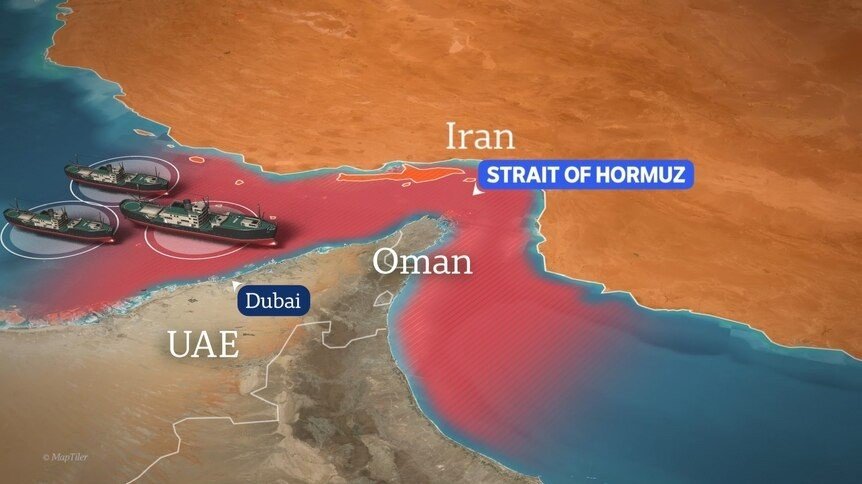
The closure, or near-closure, of the Strait remains central to the crisis. Roughly one-fifth of global oil and a significant share of liquefied natural gas transit through this corridor. Iranian officials have now linked its reopening explicitly to the survival of domestic energy infrastructure, effectively converting a global economic chokepoint into a bargaining instrument tied to battlefield developments.
While some vessels—reportedly including Indian and Pakistani-flagged ships—have negotiated limited passage through coordination with Iranian authorities, the majority of commercial traffic remains stalled. This partial closure has already driven sharp volatility in oil and gas markets, with European gas prices surging and broader inflationary pressures intensifying.
The situation reflects a classic “grey zone” disruption: the waterway is not formally blockaded, yet operational risk has risen to a level that deters normal commercial activity.
Regional Spillover and War Expansion
The conflict is no longer geographically contained. Israeli officials indicate that operations against Iran and its regional allies, including Hezbollah, are likely to continue for weeks. Cross-border exchanges along the Israel-Lebanon frontier have intensified, with casualties reported on both sides.
Simultaneously, Iran’s use of longer-range missile systems suggests an expanding battlespace that now includes potential targets well beyond the Middle East. This raises the prospect of a multi-theatre confrontation in which escalation dynamics are no longer confined to contiguous zones.
A System Under Strain
From a Chatham House perspective, the most consequential shift lies not in the immediate exchange of strikes but in the redefinition of what constitutes a legitimate target. The explicit inclusion of desalination and civilian energy systems signals a breakdown in previously observed—if informal—thresholds governing infrastructure warfare in the Gulf.
The result is a layered crisis:
- Energy security risk: Disruption to Hormuz continues to threaten global supply chains.
- Human security risk: Water infrastructure targeting introduces immediate civilian vulnerability.
- Market instability: A compressed escalation timeline amplifies volatility across oil, gas, and equities.
- Alliance strain: Diverging risk exposures between Western powers and Gulf partners complicate coordinated responses.
Outlook
The next 48 hours, framed by Washington’s ultimatum, will likely determine whether the crisis stabilises into a managed standoff or escalates into a broader infrastructure war. Iran’s signalling suggests it is prepared to absorb further military pressure while expanding the scope of retaliation into domains that carry global economic consequences.
For policymakers, the immediate challenge is not only de-escalation but the re-establishment of boundaries—particularly around civilian infrastructure—that can prevent the conflict from tipping into systemic disruption. Absent such guardrails, the Gulf’s tightly coupled energy-water nexus may prove to be the conflict’s most dangerous fault line.