


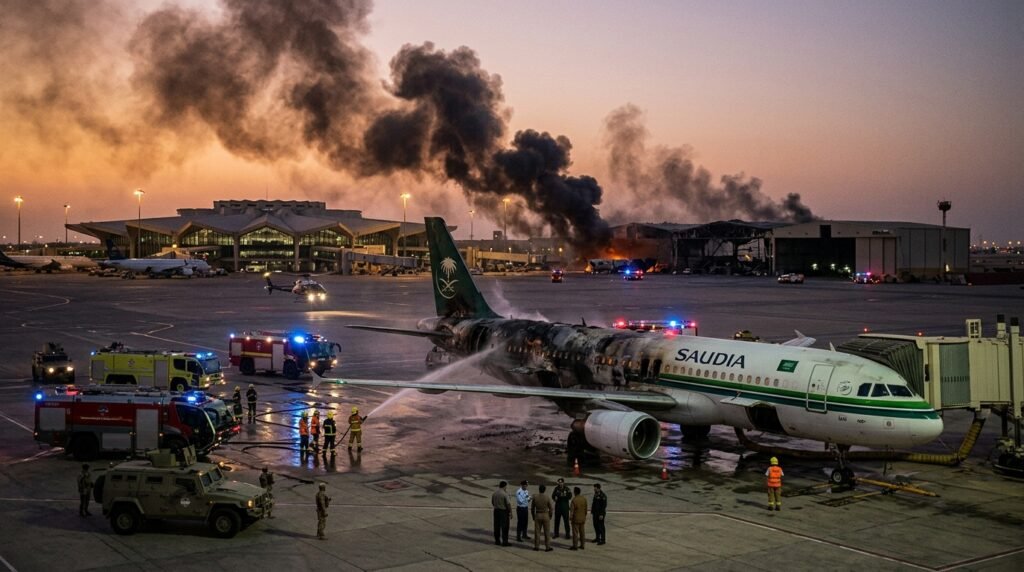
- Mecca Defence Agreement invoked in emergency ministerial talks following strike on King Khalid International Airport.
- Heavy damage to commercial aircraft forces international flight cancellations, threatening the high-level WPC Energy Congress.
- Pakistan and Türkiye agree to rapid defense coordination and air defense integration under collective security pact.
- Ground offensives and coastal fighting in Yemen intensify as Houthis target critical Gulf economic infrastructure.
RIYADH / ISLAMABAD — The specter of expanded regional escalation struck at the core of Saudi Arabia’s aviation network on Thursday, as a ballistic missile barrage claimed by Yemen’s Iran-aligned Houthi movement heavily damaged a commercial airliner at King Khalid International Airport in Riyadh.
The assault—which left a Saudia Airlines plane engulfed in flames and forced global carriers including Lufthansa and Air India to suspend services—marks a drastic turn in the reignited civil war in Yemen.
Coming mere hours after deadly strikes hit Abha and Riyadh, this direct hit on Saudi capital infrastructure serves as a major geopolitical shock test for both global energy stability and the newly forged security architecture of the region.
Houthis Attacks Put Global Economy at Risk as Oil, Diesel and Markets Face New Shock
Economic and Diplomatic Impact on Saudi Arabia and the Makkah Defence Agreement
The attack on King Khalid International Airport represents far more than a tactical milestone for the Houthis; it is a calculated disruption aimed directly at Riyadh’s diplomatic and economic projection.
Who are the Houthis and what do they want?
The kingdom was set to host world leaders, industry executives, and international delegations this week for the high-profile WPC Energy Congress.
By threatening civilian aviation and signaling intent to target critical energy plants, Houthi forces are explicitly seeking to impose severe economic friction on Saudi Arabia’s development initiatives, which depend heavily on foreign investment, unhindered transit logistics, and international stability.
Beyond the immediate panic at the terminal, the economic reverberations were instant. The cancellation of nearly half of all departing flights from Riyadh, alongside widespread regional air route diversions, sent insurance premiums for commercial aviation and Gulf shipping soaring.
With the Houthis advancing across Yemen’s coastal plains near the crucial Bab el-Mandeb Strait and threatening the strategic city of Taiz, the vulnerability of the region’s economic corridors is once again exposed. Global energy markets reacted swiftly to the prospect of supply disruptions, compounding fears of broader inflationary pressures across global supply chains.
Tripartite Response and High-Level Activation of the Makkah Defence Agreement
The strike has immediately mobilized diplomatic and defense machinery across South Asia and Anatolia. In response to the escalation, senior defense and foreign policy officials from Pakistan, Türkiye, and Saudi Arabia held emergency high-level consultations in Riyadh to activate operational deterrence measures under the landmark Makkah Defence Agreement.
Formally established as a collective defense framework, the agreement dictates that an attack on one member state’s core sovereignty or territorial security triggers joint strategic consultation and rapid defensive support. The sudden targeting of the Saudi capital has forced the alliance to transition from strategic rhetoric to immediate operational coordination.
During the emergency ministerial sessions, leaders from all three nations evaluated defensive deployments to reinforce critical Saudi infrastructure. Pakistan’s strategic contribution—encompassing technical expertise, air defense coordination, and existing military linkages—provides vital operational depth.
Concurrently, Ankara’s advanced aerial surveillance capabilities, defense-industrial partnerships, and regional diplomatic leverage complete a multi-layered security shield designed to deter further asymmetric missile strikes against the kingdom’s urban centers.
Geopolitical Realignment and the Strategic Future of the Makkah Defence Agreement
The strike on Riyadh airport highlights a fundamental transformation in Middle Eastern security paradigms. As traditional external security guarantees face persistent scrutiny, the trilateral alignment between Islamabad, Ankara, and Riyadh under the Makkah Defence Agreement reflects an emerging multipolar defense structure anchored within the region itself.
For Pakistan and Türkiye, maintaining the territorial integrity of Saudi Arabia and safeguarding the stability of the Gulf remains an absolute strategic imperative. For Riyadh, the willingness of its key partners to step forward during a critical conflict window offers indispensable strategic depth and strategic reassurance.
As smoke clears from the airport terminal, the message from the Gulf is unyielding. The escalation by Houthi forces was designed to project vulnerability and isolate Saudi Arabia on the international stage ahead of major global gatherings. Instead, it has accelerated the operational cohesion of the tripartite security architecture, signaling to regional proxy networks and global capitals alike that an assault on Saudi Arabia’s strategic center will be met with a resolute, coordinated response.