


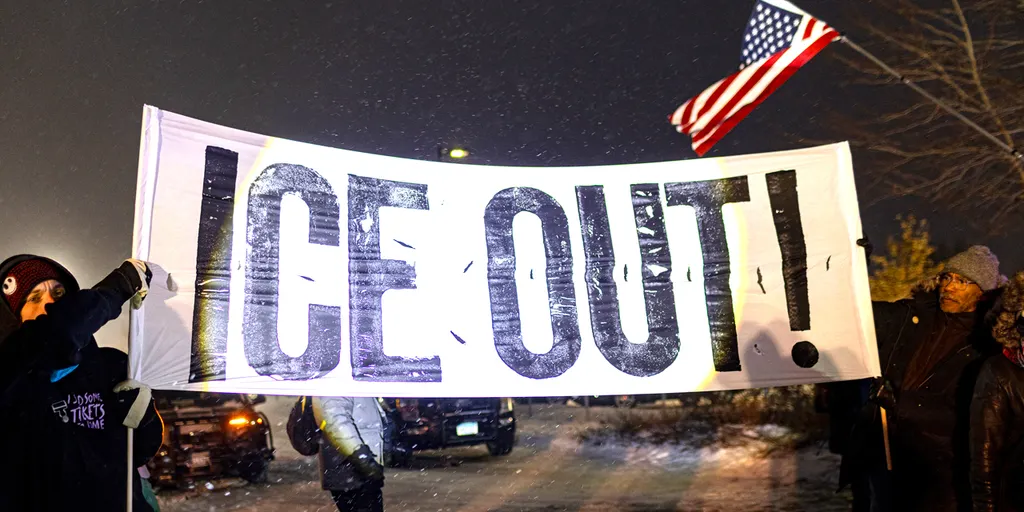
- ICE protests Minnesota business shutdown revealed how deeply immigrant labor underpins local economies.
- Hundreds of restaurants, shops, and cultural institutions closed in coordinated resistance.
- Business owners warned enforcement raids are disrupting commerce and workforce stability.
- Corporate silence from major Fortune 500 firms fueled further backlash and scrutiny.
Scores of businesses across Minnesota shut their doors on Friday as religious leaders, labor unions, and community groups organized what they called a general strike to protest the Trump administration’s expanded deployment of U.S. Immigration and Customs Enforcement officers in Minneapolis.
The action marked one of the most visible signs yet of resistance from the state’s business community, which argues the immigration crackdown is disrupting commerce, frightening workers, and damaging Minnesota’s reputation as an open, reliable place to invest.
2026 Trump Agenda: A Blueprint for Structural Accountability
Flyers taped to storefronts across Minneapolis carried a blunt message: “ICE OUT. No work. No school. No shopping.” Despite frigid temperatures and heavy snowfall, more than 300 bars, restaurants, museums, retail shops, and service providers closed for the day, according to the Minnesota Star Tribune.
While public school districts remained officially open, several schools in Minneapolis and St. Paul shifted to remote learning, citing safety concerns and staff absences linked to the protests.
Organizers said the closures were meant to show how deeply immigrant labor is woven into Minnesota’s economy. From food service and hospitality to healthcare support, logistics, and construction, business owners warned that aggressive street-level enforcement was already leading to worker shortages, canceled shifts, and declining foot traffic.
Small business associations said customers were staying home out of fear, while immigrant employees were avoiding workplaces they believed could be targeted by federal agents.
A large march planned for Friday afternoon in downtown Minneapolis was expected to draw thousands, adding to days of noisy demonstrations that included whistles, drums, and improvised musical instruments.
Mayor Jacob Frey and other Democratic leaders have criticized the federal operation as excessive, with some comparing it to an “invasion.” City officials argue the deployment undermines local law enforcement priorities and erodes trust between police, residents, and immigrant communities.
President Donald Trump has defended the operation, insisting ICE is effectively carrying out its legal mandate. The administration says the Minnesota surge was triggered by fraud allegations involving some members of the state’s Somali American community.
Trump has repeatedly used harsh language about Somali immigrants and has framed the crackdown as part of a broader effort to remove more undocumented migrants, asylum seekers, and some lawful residents than any previous administration.
Tensions on the streets have intensified. Protesters and ICE agents have exchanged shouted insults, and federal officers have used tear gas and flash-bang grenades to disperse crowds. The administration claims some demonstrators have harassed agents and obstructed enforcement activities, accusations organizers deny, saying protests have been largely peaceful despite the heavy security presence.
Notably, many of Minnesota’s largest corporations have remained publicly silent. The state hosts numerous Fortune 500 companies, most headquartered in the Minneapolis area, yet none issued statements supporting or opposing the raids. Minneapolis-based Target has faced renewed criticism from activists and state lawmakers for declining to clarify how it is advising employees if ICE officers appear at its stores. The company declined to comment.
Reuters contacted UnitedHealth, Medtronic, Abbott Laboratories, Best Buy, Hormel, General Mills, 3M, and Fastenal for comment. None immediately responded. For striking business owners, that silence underscored their frustration. They argue that regardless of political views, the ICE deployment is harming day-to-day commerce, destabilizing the workforce, and sending a chilling signal that immigration enforcement is now inseparable from economic life in Minnesota.
Organizers said the strike was not aimed at undermining law enforcement but at forcing a national debate on proportionality, due process, and economic fallout. They warned that if raids continue, further shutdowns could follow, escalating pressure on state leaders and corporations to confront federal immigration policy nationwide as tensions deepen and divisions sharpen further ahead this year alone.