


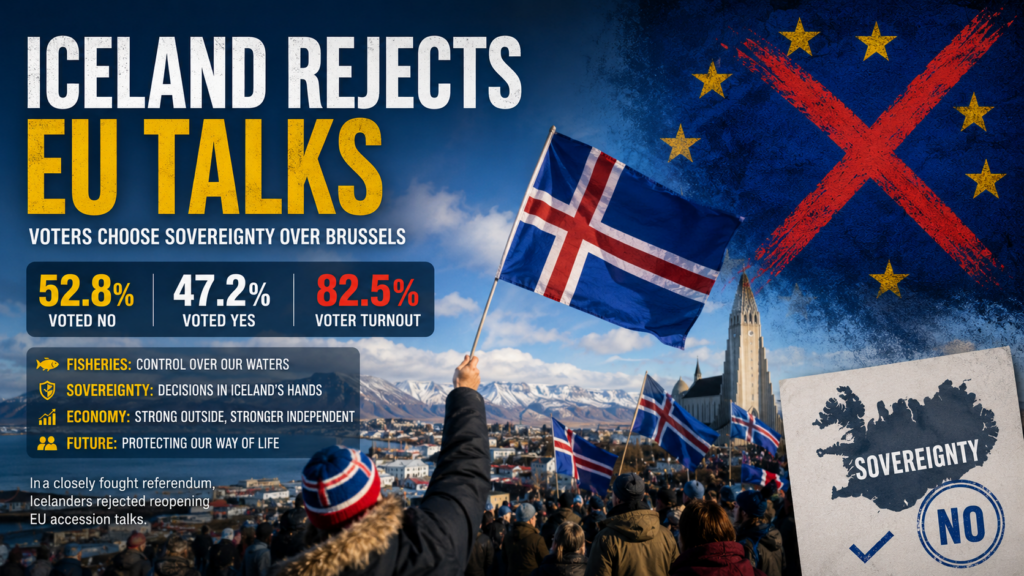
- Iceland EU referendum: Voters rejected reopening EU accession talks by 52.8% to 47.2%, with turnout reaching 82.5%.
- Iceland fisheries: Control over fishing waters, national resources and sovereignty proved more powerful than arguments for deeper EU economic and security integration.
- Iceland and Europe: The referendum does not represent an Icelandic withdrawal from Europe; Reykjavík remains deeply integrated with the EU through the EEA and Schengen while retaining political independence.
Iceland has rejected a government proposal to reopen European Union accession negotiations, delivering a narrow but politically significant victory for national sovereignty, control of fisheries and economic independence over deeper political integration with Brussels.
In a closely fought referendum, 52.8% of Icelandic voters rejected reopening EU accession talks, while 47.2% supported the proposal. Turnout reached an exceptionally high 82.5%, demonstrating how deeply the European question has divided this small North Atlantic nation of roughly 400,000 people.
The result is not, however, a rejection of Europe.
Iceland remains deeply integrated with the European economy through the European Economic Area (EEA) and participates in the Schengen area. Icelanders already enjoy extensive access to the European single market without their country being a member of the EU.
That reality became the central argument of the No campaign.
For many voters, particularly outside Reykjavík, the referendum was ultimately a choice between greater European political integration and preserving Icelandic control over its own economic resources and national decision-making.
The latter prevailed.
Iceland EU Referendum: Why did Iceland reject EU accession talks?
The referendum did not ask Icelanders to join the EU immediately.
It asked whether Reykjavík should restart negotiations that had been suspended more than a decade ago.
Read More: Trump and Greenland: The Arctic Chessboard Between U.S. Ambitions and Sovereign Resolve
A Yes vote would have opened a negotiating process involving dozens of policy areas, while any eventual membership agreement would still have required approval in another referendum.
But the No campaign successfully turned the question into a much simpler political proposition: Should Iceland begin a process that could ultimately transfer more authority to Brussels?
That framing proved decisive.
The campaign centred on three issues — fisheries, sovereignty and economic self-interest — while the geopolitical shock surrounding Donald Trump’s threats over Greenland added an entirely new dimension to the debate.
The Guardian’s post-referendum analysis found that the campaign exposed a sharp urban-rural divide and that the No side’s messaging around sovereignty, fishing and farming ultimately proved highly effective.
Fisheries: Iceland’s political red line
For Iceland, fishing is not merely an industry.
It is part of the country’s national identity.
Iceland’s historic battles with Britain over fishing rights helped establish control over an increasingly large maritime zone. The memory of the Cod Wars remains deeply embedded in Icelandic political culture.
Read Next: Iceland rejects EU accession talks after divisive referendum campaign
The economic importance of fisheries is equally powerful.
The sector accounts for roughly 15% of Iceland’s GDP and around 40% of its export revenue, making control over fishing waters a strategic economic issue rather than a niche political concern.
That is why the European Union’s Common Fisheries Policy became the No campaign’s most potent weapon.
Opponents argued that EU membership could eventually restrict Iceland’s ability to independently manage fish stocks and fishing quotas.
The argument resonated especially strongly in rural communities, where fisheries and related industries sustain jobs, businesses and entire towns.
The Washington Post reported before the referendum that sovereignty was at the heart of the dispute, with opponents particularly concerned about EU influence over Iceland’s fishing and farming sectors.
In effect, the No campaign asked Icelanders a question with deep historical resonance:
Why fight for control of Iceland’s waters for generations only to give some of that authority away voluntarily?
That argument proved difficult for the Yes campaign to overcome.
Iceland already has much of Europe
Another reason the referendum went against Brussels is that Iceland already enjoys many of the practical benefits associated with European integration.
Through the EEA, Iceland participates in the European single market. Through Schengen, Icelanders enjoy passport-free travel across much of Europe.
The country therefore occupies an unusual position.
It is outside the EU but economically and socially intertwined with it.
For No voters, this arrangement represents the best of both worlds.
Iceland can trade with Europe, participate in European economic structures and allow its citizens to move freely across the continent while retaining control over its currency, fisheries and national political institutions.
That created a powerful question during the campaign:
What additional benefit would EU membership deliver that justifies surrendering additional sovereignty?
The Yes campaign had answers, particularly around monetary stability, economic influence and international cooperation.
But it failed to convince enough voters that those benefits outweighed the perceived costs.
The 2009 financial crisis changed the context
Iceland’s original EU application came in a radically different economic environment.
The country applied for membership in 2009, following the collapse of its banking system during the global financial crisis.
At the time, EU membership was seen by some as a potential source of stability and economic credibility.
Accession negotiations began in 2010 but were suspended in 2013 and later formally ended.
Seventeen years later, Iceland’s circumstances are very different.
The economy has recovered. The country remains one of the world’s wealthiest democracies and has demonstrated that it can prosper without joining the EU.
That weakened one of the strongest arguments for membership.
The Yes campaign nevertheless argued that Iceland’s volatile króna, high inflation and borrowing costs made deeper European integration attractive.
Supporters saw the euro as a potential route toward greater monetary stability.
But opponents countered that Iceland’s economic independence was itself an asset.
Trump’s Greenland ambitions transformed the debate
Then came Greenland.
Donald Trump’s repeated demands for greater U.S. control over Greenland transformed Iceland’s EU debate from an economic discussion into a geopolitical one.
Greenland is Iceland’s closest major Arctic neighbour, and Trump’s threats generated genuine anxiety in Reykjavík.
The Washington Post reported that Trump’s repeated references to Greenland — including instances in which he mistakenly referred to Greenland as Iceland — intensified concerns among Icelanders about the future of the international security order.
That development strengthened the Yes campaign.
Supporters argued that Iceland needed stronger European political ties as the Arctic became increasingly contested by the United States, Russia and China.
The argument was essentially this:
If the old security order is becoming less predictable, Iceland needs more friends, not fewer.
The issue fits into a much larger Arctic transformation explored in The Islamabad Telegraph’s analysis of Trump’s Greenland ambitions.
But the No campaign had an equally powerful response.
Iceland is already a NATO member.
It has a longstanding defence relationship with the United States and remains protected by the alliance’s collective-security framework.
Opponents therefore argued that EU membership would add political obligations without necessarily providing a fundamentally different military guarantee.
The security argument helped the Yes campaign close the gap, but ultimately it could not overcome the sovereignty argument.
What is really on the minds of Iceland’s young people?
The youth dimension is perhaps the most important question emerging from the referendum.
It would be simplistic to assume that young Icelanders automatically favour EU membership.
Younger voters certainly have reasons to look toward Europe.
They are more likely to benefit from opportunities to study, work and live across the continent. They are also confronting expensive housing, high borrowing costs and questions about future employment.
For some, deeper European integration represents opportunity.
But another strand of Icelandic youth politics is equally important: sovereignty does not necessarily belong to the older generation.
Young Icelanders can be internationally minded while still believing that Iceland should retain control over its natural resources.
The debate therefore was not simply:
Europe versus nationalism.
It was increasingly:
European integration versus Icelandic autonomy.
That distinction matters.
A young Icelander may want to study in Copenhagen, work in Berlin, travel freely across Europe and cooperate with European institutions — while still believing that Iceland should determine who can fish in Icelandic waters.
That helps explain why the pro-EU argument failed to produce a decisive majority.
Reykjavík versus rural Iceland
The referendum revealed one of Iceland’s clearest political divides.
Reykjavík was the only major area to vote in favour of reopening EU negotiations.
Rural constituencies overwhelmingly backed the No side.
The division is logical.
Reykjavík is Iceland’s political, financial, technological and educational centre. Rural communities are much more directly connected to fisheries, agriculture and natural resources.
For the capital’s voters, EU membership can represent opportunity, economic integration and geopolitical influence.
For many rural voters, it can represent the possibility that decisions affecting their livelihoods will increasingly be made outside Iceland.
The Guardian’s analysis of the result similarly identified the rural-urban divide and the power of sovereignty and fisheries arguments in producing the No victory.
A setback for Brussels
The result represents a symbolic setback for the European Union.
Iceland appeared to be one of Europe’s easiest potential new members: wealthy, democratic, institutionally compatible and already closely integrated with the European economy.
Yet even under extraordinary geopolitical pressure, Icelanders rejected the proposal to restart negotiations.
The Wall Street Journal reported that the No vote reflected longstanding concerns over fishing rights and sovereignty, despite arguments that closer EU ties could improve economic stability and strengthen Iceland’s international position.
The message for Brussels is uncomfortable.
Economic integration does not automatically lead to political integration.
A country can be deeply embedded in Europe’s economy while resisting membership in its political institutions.
That is precisely the model Iceland has chosen.
Iceland’s Arctic calculation
The result also has implications far beyond the EU.
Iceland occupies a strategically important position between North America and Europe, close to Greenland and the North Atlantic sea lanes.
The Arctic is becoming increasingly important because of climate change, new shipping routes, energy resources, military competition and great-power rivalry.
The referendum therefore took place at a moment when Iceland is being forced to reconsider its position in a changing international system.
The country’s leadership now faces a delicate balancing act.
Iceland wants strong relations with the United States.
It wants NATO protection.
It wants access to European markets.
It wants cooperation with the EU.
And it wants to retain maximum control over its own natural resources.
That balancing act is likely to become more complicated as Arctic competition intensifies.
The broader geopolitical picture is reflected in The Islamabad Telegraph’s Global Watch Weekly Briefing, which tracks the wider strategic shifts affecting Europe, the Arctic and global power competition.
Iceland has chosen the middle path
The referendum should therefore not be interpreted as an Icelandic rejection of Europe.
Iceland has not abandoned the EEA.
It has not left Schengen.
It has not weakened NATO.
It has not turned away from European trade or cooperation.
Instead, Icelanders have chosen a middle path: maximum economic and diplomatic cooperation with Europe without full political membership.
Prime Minister Kristrún Frostadóttir acknowledged the result and said the matter would not move forward under the current government. EU officials, meanwhile, said they respected Iceland’s democratic decision and stressed that Iceland remains one of the bloc’s closest partners.
That may be the most important lesson from the Iceland EU referendum.
Icelanders are not saying “No to Europe.”
They are saying:
“Yes to Europe — but on Iceland’s terms.”
And in an Arctic where the strategic balance is changing faster than at any time in decades, Iceland’s insistence on maintaining its own room for manoeuvre may prove to be more than a domestic political decision.
It may become a central part of Reykjavík’s geopolitical strategy.