


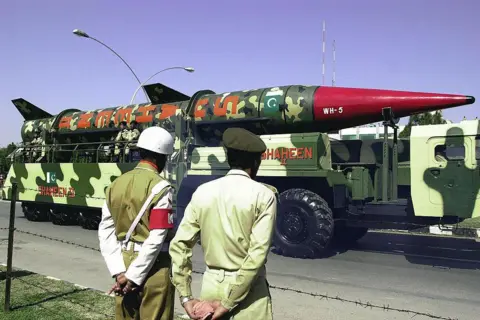
- India falsely claimed Pakistan launched nuclear-armed Shaheen missiles during recent border tensions.
- Pakistan denied the allegation and demanded an international investigation into India’s disinformation campaign.
- Indian Army video showing a Shaheen missile was quietly deleted after public backlash and diplomatic pressure.
- Experts cite India’s poor record on uranium theft and label the move as reckless nuclear signaling and hybrid warfare.
Can you imagine a nuclear-armed state pretending to be under a nuclear attack from another nuclear-armed state? It seems unimaginable. How can the leadership of any country sink so low? Sadly, it happened recently. India—a nation with a troubling record of uranium theft and nuclear material proliferation—has now crossed a new and dangerous threshold.
In a bizarre and disturbing turn, senior Indian military authorities falsely claimed that Pakistan had fired nuclear-armed Shaheen missiles at Indian targets during a period of high military tensions earlier this month.
The allegation, which carried the weight of nuclear brinkmanship, was baseless and swiftly condemned by Pakistani officials, who categorically denied the use of strategic weapons during the four-day skirmish dubbed Operation Bunyān al-Mārsūs. Pakistan also called on the international community to launch an impartial investigation into what it described as an “alarming act of nuclear misinformation.”
Trump the Peacemaker: How One Call with Putin May End the Ukraine War
In an attempt to quietly cover its tracks, the Indian Army’s Western Command deleted a now-infamous video from its official platforms. The video had falsely depicted a Shaheen-class ballistic missile launch, sparking speculation across Indian media and social networks. Despite the lack of official confirmation from New Delhi, the footage was widely interpreted as proof of a Pakistani nuclear strike—an interpretation that played directly into India’s ongoing diplomatic lobbying.
In 2021 alone, Indian police arrested individuals in Maharashtra and Jharkhand for illegally possessing nearly 7 kilograms of uranium—a quantity large enough to fuel dirty bombs. International watchdogs, including the IAEA, have repeatedly expressed concerns about the security of India’s nuclear assets, particularly in the civilian sector.
According to Pakistani officials speaking on background, this was no accident. They believe India deliberately triggered this false alarm to bolster its international standing and reframe the narrative of recent hostilities. “The claim that Pakistan employed Shaheen-class ballistic missiles during the recent crisis appears rooted in a broader Indian — and now Western — effort to frame Islamabad as having crossed a nuclear red line,” a senior Pakistani official said.
The timing, Pakistani authorities say, is revealing. The video appeared just as Indian External Affairs Minister S. Jaishankar was on a diplomatic tour of the Netherlands, Denmark, and Germany, and as multiple cross-party delegations fanned out to global capitals. “It coincided precisely with India’s effort to show itself as a victim of nuclear intimidation—just as it lobbied for new strategic partnerships and support at the United Nations,” the official added.
India’s Dangerous Nuclear Messaging
The Shaheen missile, capable of carrying nuclear warheads with ranges exceeding 750 km, represents a core component of Pakistan’s strategic deterrent. Any suggestion of its use in active conflict implies a drastic escalation that could push the region toward nuclear war.
MUST READ:Trump’s Mission for Global Peace: The Putin Call That Could End the Ukraine War
Indian media, in lockstep with the military narrative, identified the Sarsawa Air Base—located over 400 km from the border—as a target of the supposed Shaheen strike. The suggestion was that only a long-range ballistic missile could have reached such a facility, thus pointing fingers at Pakistan’s strategic arsenal.
But Pakistan’s military officials rejected the claim as “fabricated disinformation.”
Pakistan’s Foreign Office clarified that Operation Bunyān al-Mārsūs employed only conventional precision-guided systems: the Fatah-I and Fatah-II missiles, loitering drones, and advanced artillery. The Fatah series, with maximum ranges of up to 400 km, were used for targeted deep strikes against Indian military assets in occupied Jammu and Kashmir.
“There was absolutely no use or even consideration of deploying Shaheen systems during the operation,” a Pakistani defense official said. “These are strategic assets, reserved for existential-level threats—not for calibrated retaliatory action.”
The Inter-Services Public Relations (ISPR) described the operation as a “textbook demonstration of multi-domain conventional warfare,” combining land, air, sea, and cyber capabilities. The conflict ended on May 10 with a ceasefire brokered by the United States, but the aftershocks of India’s misinformation campaign are still being felt across global diplomatic and security forums.
India’s Nuclear Proliferation Record: A Pattern of Irresponsibility
This isn’t the first time India has demonstrated reckless behavior with nuclear materials or nuclear-related narratives. In fact, India’s record is alarming. Since the early 2000s, there have been more than a dozen reported cases of stolen or missing nuclear material in India. Incidents have ranged from the illegal possession of uranium by unauthorized civilians to the theft of radioactive isotopes from research labs.
In 2021 alone, Indian police arrested individuals in Maharashtra and Jharkhand for illegally possessing nearly 7 kilograms of uranium—a quantity large enough to fuel dirty bombs. International watchdogs, including the IAEA, have repeatedly expressed concerns about the security of India’s nuclear assets, particularly in the civilian sector.
More Read:Pakistan denies Indian claim of using Shaheen missile in Operation Bunyanum Marsoos
“The repeated cases of uranium theft raise serious questions about India’s ability to secure its nuclear materials,” said Dr. Arif Mahmood, a South Asia expert at the Global Institute for Strategic Affairs. “Now, add to that a disinformation campaign about a nuclear attack—it reflects both irresponsibility and a troubling level of desperation.”
Hybrid Warfare and Nuclear Disinformation
Experts have described India’s false missile narrative as a textbook case of hybrid warfare: the use of digital media, misinformation, and psychological tactics to influence public perception and international response. “This is not just misinformation—it’s dangerous nuclear signaling through fake content,” said Dr. Shireen Mazari, former Pakistani Minister for Human Rights and a noted strategic affairs analyst.
According to the Pakistani Foreign Office, “Disseminating unverified and inflammatory content not only undermines regional stability but also reflects poorly on the professionalism of official institutions.”
In a region already brimming with volatility, such tactics are deeply irresponsible. Falsely portraying a nuclear strike to gain diplomatic favor, international sympathy, or strategic leverage may earn short-term media mileage—but it threatens to destabilize long-standing deterrence norms in South Asia.
India’s disinformation campaign
India’s disinformation campaign about a non-existent nuclear attack is a sobering reminder of the fragility of nuclear peace in South Asia. Instead of reinforcing deterrence stability, India has chosen the path of deceit, fear-mongering, and nuclear manipulation.
The international community must not ignore this incident. The fabrication of nuclear attack claims by a state with a documented history of nuclear security lapses demands urgent international scrutiny. Silence or inaction could set a precedent far more dangerous than the incident itself.
In the nuclear age, disinformation is not just propaganda—it’s a weapon. And India, it seems, has just deployed it with reckless abandon.