


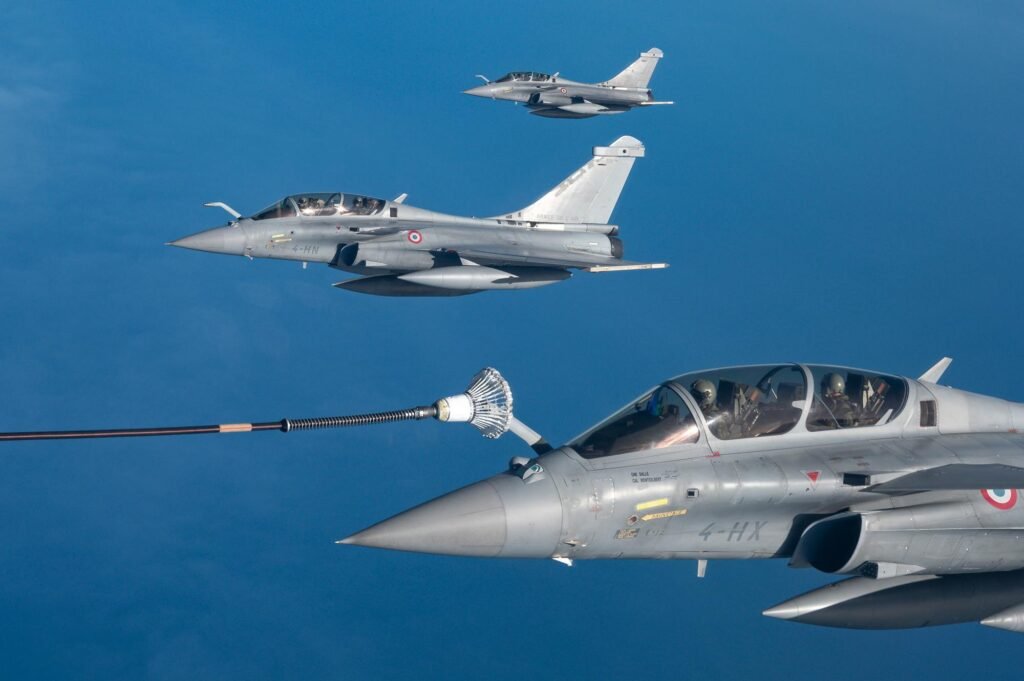
- India Rafale deal includes 114 additional French fighter jets worth $39 billion.
- The purchase follows the May 2025 Pakistan-India conflict where seven Indian jets were downed.
- India is reducing reliance on Russia while expanding defence ties with France and the US.
- Analysts warn South Asia is entering a technologically advanced and destabilizing arms race.
Indian defence officials have cleared the purchase of nearly $39 billion worth of military hardware, including 114 additional French Rafale fighter jets, in a move that underscores New Delhi’s accelerating military modernization and its sharpening rivalry with Pakistan. The decision, approved by the Defence Acquisition Council days before French President Emmanuel Macron’s scheduled visit to India on February 17, marks one of the largest single defence procurement clearances in India’s history.
According to India’s defence ministry, the acquisition will “enhance the capability of undertaking air dominance roles across the spectrum of conflict and significantly boost the deterrence capabilities of the Indian Air Force (IAF) with long-range offensive strikes.” While the ministry did not officially disclose the precise number of Rafales in the clearance, a defence source confirmed the package includes 114 Multi-Role Fighter Aircraft (MRFA), most of which are expected to be manufactured in India under the “Make in India” initiative.
The Day Pakistan Downed Six Indian Jets Including Rafael—and Launched China’s Global Fighter Jet Era
The scale of this acquisition must be viewed through a geopolitical lens. India already operates 36 Rafale jets purchased in two tranches since 2015, worth approximately $8.7 billion. With the new deal, the IAF’s Rafale fleet could exceed 140 aircraft over the next decade, significantly altering the regional air power balance. India’s total defence budget for 2025–26 stands at approximately $76 billion, making it the world’s third-largest military spender after the United States and China. Roughly 30 percent of that budget is allocated to capital acquisitions, underscoring New Delhi’s strategic emphasis on force modernization.
However, the timing and magnitude of this expansion are inseparable from the enduring Pakistan-India rivalry — one of the most volatile nuclear flashpoints in the world.
The two South Asian rivals have fought three full-scale wars (1948, 1965, 1971) and one limited high-altitude conflict in Kargil in 1999. Since both declared themselves nuclear-armed states in 1998, their confrontations have evolved into high-risk, limited engagements under the nuclear overhang. The May 2025 four-day conflict marked the most intense conventional exchange between the two since Kargil.
In that brief but consequential confrontation, Pakistan reportedly downed seven Indian fighter jets, including three advanced French-made Rafales. The aerial engagements stunned military analysts worldwide, as the Rafale had been marketed as a game-changing 4.5-generation platform equipped with Meteor beyond-visual-range missiles and advanced electronic warfare systems. The loss of multiple high-end aircraft within days exposed the fragility of technological superiority in a contested airspace dominated by integrated air defence systems, electronic countermeasures, and modern missile networks.
Islamabad framed the episode as proof that numerical or technological accumulation does not guarantee escalation dominance. New Delhi, meanwhile, accelerated its procurement processes — a pattern consistent with what security scholars describe as the “action-reaction spiral” of classical arms race theory.
India’s shift away from Russia toward diversified suppliers — particularly France, the United States, and Israel — further complicates the geostrategic environment. Historically, over 60 percent of India’s military hardware originated from Moscow. Today, that dependency has declined significantly. The Rafale expansion cements France as a critical strategic partner, while deepening Indo-French defence cooperation across naval aviation, space, and Indo-Pacific maritime security.
Yet the implications stretch beyond bilateral defence ties.
South Asia already houses two declared nuclear powers with expanding missile arsenals. India is developing a triad-based nuclear doctrine, with land-based Agni-V intercontinental ballistic missiles (range exceeding 5,000 km), Arihant-class nuclear-powered ballistic missile submarines, and air-delivered nuclear capabilities. Pakistan maintains a full-spectrum deterrence doctrine, including short-range tactical systems like the Nasr missile, designed explicitly to offset India’s conventional superiority.
By injecting 114 additional advanced fighter jets into this equation, India risks dangerously pushing South Asia into a more lethal and technologically compressed arms race. Airpower modernization forces reciprocal investments in air defence systems, early warning platforms, electronic warfare, and long-range missile systems. Pakistan has already diversified its own defence partnerships, expanding cooperation with China, including JF-17 Block III fighters equipped with AESA radar and PL-15 beyond-visual-range missiles.
The financial burden is also immense. India’s $39 billion clearance alone equals nearly half of Pakistan’s entire annual federal budget. While New Delhi justifies the spending under its long-term force restructuring plan to address a two-front scenario involving both Pakistan and China, the immediate operational history suggests that the Pakistan theatre remains central to airpower calculations.
Moreover, the doctrine of “air dominance across the spectrum of conflict” carries escalatory risks. Air dominance strategies typically involve pre-emptive strikes on airbases, radar installations, and command infrastructure — actions that can rapidly escalate into full-scale conventional war. In a nuclearized environment with compressed decision timelines, such doctrines amplify miscalculation risks.
India argues that indigenous manufacturing under “Make in India” will generate domestic employment and reduce long-term dependency. Indeed, defence production in India has grown by over 12 percent annually in recent years, and private-sector participation has expanded following liberalized foreign direct investment caps in defence manufacturing. However, local assembly does not alter the strategic signal: the accumulation of advanced offensive platforms signals preparation for high-intensity conflict.
For France, the deal reinforces its role as a major arms exporter, with India becoming one of its largest defence clients. For the broader Indo-Pacific, it strengthens India’s integration into Western-aligned security networks. But for South Asia, the consequences are more immediate and perilous.
The May 2025 aerial clashes demonstrated that even short-duration engagements can result in significant material and reputational losses. The downing of seven Indian jets — including multiple Rafales — shattered assumptions about uncontested technological superiority. Instead of encouraging restraint, however, the aftermath appears to have intensified procurement ambitions.
The subcontinent now faces a familiar but more technologically advanced dilemma: two nuclear-armed rivals investing heavily in high-end conventional systems while lacking robust crisis communication mechanisms. Confidence-building measures have eroded, ceasefire violations fluctuate, and diplomatic engagement remains episodic.
India’s $39 billion procurement decision is therefore not merely a defence modernization step; it is a geopolitical signal. It reflects ambition, insecurity, deterrence logic, and power projection aspirations — all unfolding in a region historically prone to rapid escalation.
Unless accompanied by renewed strategic dialogue and credible arms control initiatives, such massive acquisitions risk entrenching a cycle in which each side interprets the other’s defence measures as offensive preparation. In that environment, South Asia’s stability rests not only on nuclear deterrence but on political prudence — a commodity often in short supply during moments of heightened rivalry.