


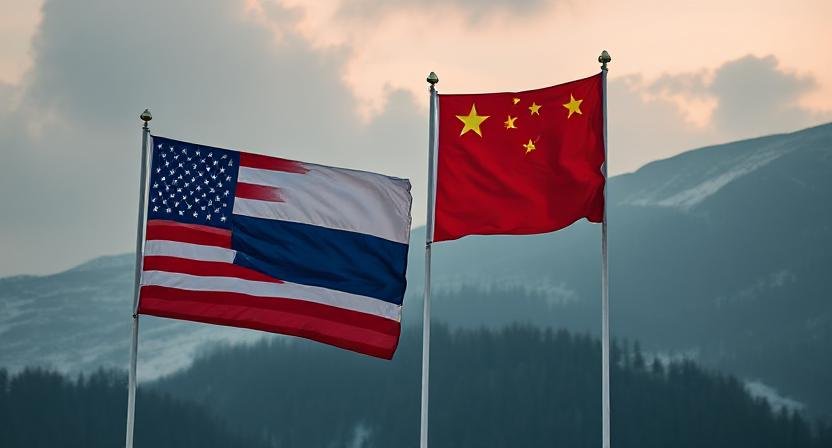
- Russia and China intensified strategic coordination during Lavrov’s visit to Beijing, signaling a united front against U.S. global influence.
- Discussions included the Ukraine war, Korean Peninsula, and Iranian nuclear issue—showing the breadth of the Russia-China geopolitical agenda.
- Experts say Beijing is positioning itself as a global peace broker, while Moscow seeks an off-ramp from the war with U.S. dominance fading.
In a significant diplomatic maneuver that could reshape global power dynamics, Russian Foreign Minister Sergei Lavrov met his Chinese counterpart Wang Yi in Beijing on Sunday to discuss joint strategies for confronting the United States and ending the war in Ukraine. The meeting, held ahead of the Shanghai Cooperation Organization (SCO) foreign ministers’ summit, underscores a fast-solidifying alliance that experts say now operates as a geopolitical counterweight to Western influence.
The talks, which touched on sensitive global hotspots including the Korean Peninsula and the Iranian nuclear issue, were described by both countries as “strategic” and “comprehensive.” But analysts believe the real focus was an intensification of anti-U.S. coordination and a quiet but clear effort to co-create an alternative world order.
“This was not just a routine bilateral exchange,” said Dr. Fiona Hill, senior fellow at the Brookings Institution and former U.S. National Security Council official. “It was a message to Washington: the multipolar world is no longer aspirational—it’s taking shape, brick by brick.”
Trump China Visit Could Redefine Global Power Balance Amid Beijing Parade
A Deepening Alliance in a Fragmented World
Since declaring their “no-limits” partnership on the eve of Russia’s invasion of Ukraine in February 2022, Moscow and Beijing have grown ever more intertwined—militarily, economically, and diplomatically. Sunday’s meeting cemented this trajectory, with both sides calling for “close coordination” in the United Nations, BRICS, SCO, G20, and APEC.
“The parties also discussed relations with the United States and prospects for resolving the Ukrainian crisis,” the Russian foreign ministry confirmed. Wang Yi echoed these sentiments, stating that the two sides will continue to “jointly respond to the challenges brought about by a turbulent and changing world.”
“This is an open declaration of a joint foreign policy vision that challenges U.S. hegemony,” said Yun Sun, Director of the China Program at the Stimson Center in Washington. “It’s not just about Ukraine—it’s about the architecture of global power.”
READ MORE: King Charles to Host President on State Visit in September
The Ukraine Factor: Beijing’s Quiet Calculus
While officially neutral in the Ukraine war, China has continued to buy discounted Russian oil, sell dual-use technologies, and back Moscow diplomatically at the U.N. Security Council. Experts believe Beijing is quietly guiding a negotiated endgame that weakens NATO and elevates China as a global peace broker.
“China doesn’t want a total Russian collapse, but it also doesn’t want to be dragged into a failed war,” explained Vasily Kashin, a Russian military analyst with the Higher School of Economics in Moscow. “Beijing is pushing Moscow toward a ‘dignified’ off-ramp.”
Both Russia and China have floated proposals for a ceasefire and peace talks, but Western governments have rejected these as attempts to freeze the conflict in Moscow’s favor. With Ukraine’s counteroffensives losing momentum and U.S. support facing political fatigue, China may see an opening to assert diplomatic primacy.
ALSO READ: Tariffs Tornado: How Trump’s Trade Wars Are Shattering the Global Economy
Beyond Ukraine: Iran, Korea, and the Strategic Map
According to China’s foreign ministry, Wang and Lavrov also discussed the Iranian nuclear standoff and tensions on the Korean Peninsula—two flashpoints where U.S. influence is being actively challenged.
“This was a masterclass in geopolitical multitasking,” said Dr. Gal Luft, co-director of the Institute for the Analysis of Global Security. “Russia and China are creating an informal alliance system that touches every U.S. weakness—Ukraine, the Gulf, East Asia.”
Russia, still under heavy Western sanctions, is looking eastward for economic and strategic lifelines. China, facing trade tensions and technological restrictions from Washington, is welcoming the pivot.
The Endgame: Toward a Post-American World Order?
The Lavrov-Wang meeting adds to a growing body of evidence that China and Russia are no longer just coordinating—they are co-architects of a new international order. With the SCO expanding, BRICS becoming a financial counterweight to the G7, and the U.N. paralyzed by vetoes, alternative governance models are emerging.
“What we’re seeing is a deliberate erosion of U.S.-led multilateralism,” said Hill. “And what replaces it may be less rules-based and more power-driven.”
Whether this coordination leads to a durable peace in Ukraine or a prolonged geopolitical cold war remains to be seen. But for now, the Beijing-Moscow axis is advancing—strategically, deliberately, and with a shared mission to rewrite the rules.