


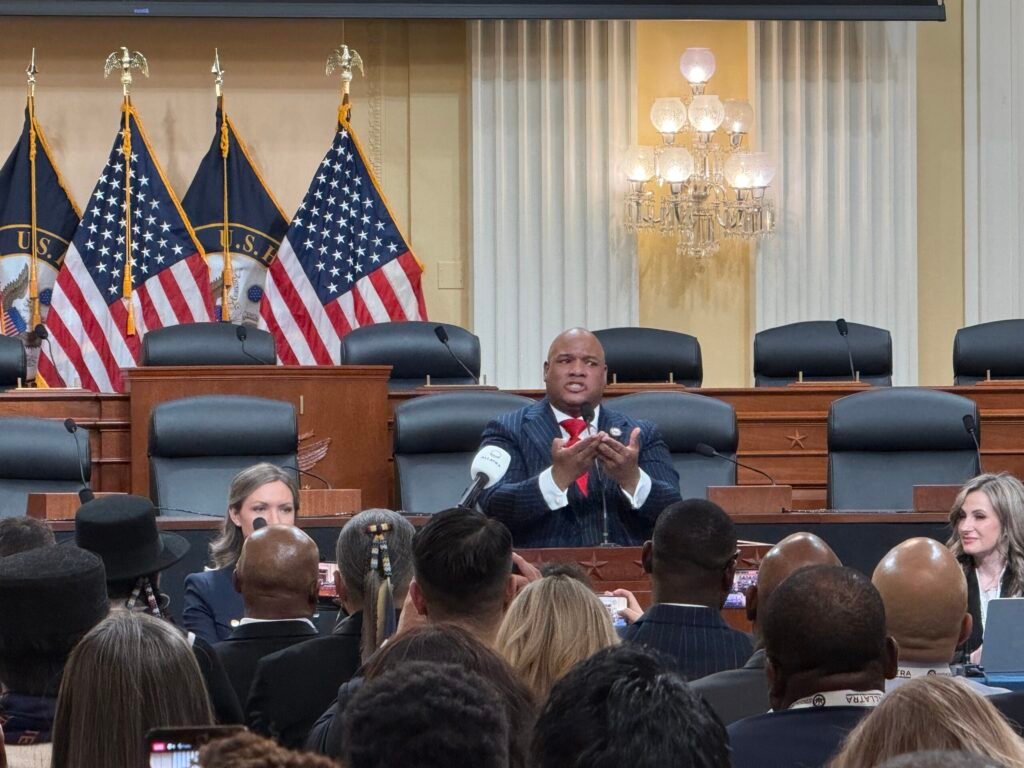
- Interfaith Harmony Conference Washington brought together Muslims, Jews, Christians, Hindus, and Sikhs to foster dialogue and respect across religions.
- Faith leaders emphasized religious freedom and human dignity as pillars of global peace.
- Spiritual diplomacy highlighted as a strategic approach to resolving conflicts and promoting justice.
- The launch of Part Two of the interfaith documentary, produced by Wajid Ali Syed and directed by Kashif Mirza, showcased minority resilience and hope.
It was one of the rarest moments in American history when people from different societies, religions, and regions gathered in a single conference hall. Muslims, Jews, Hindus, Christians—Asian, American, African, South Asian, European—and people from all walks of life came together under one roof.
It was a remarkable display of interfaith harmony, drawing participants from across the globe who mingled, listened, and engaged beyond labels of region, religion, or race. They learned about one another’s faiths, histories, wounds, and hopes. It was a gathering of human beings who understood how to respect each other’s beliefs, sects, and identities—and, above all, who rediscovered what humanity truly means. Anila Ali, a minority Muslim leader in Washington, made it possible.
On a cold January day in Washington, DC, the warmth inside the Cannon House Office Building felt almost defiant. Outside, the world seemed fractured—wars raging, faith weaponized, identities hardened into fault lines. Inside, however, something quieter and more powerful unfolded. The American Muslim & Multifaith Women’s Empowerment Council (AMMWEC) convened the Interfaith International Religious Freedom (IRF) Roundtable Pakistan Conference on Capitol Hill, transforming a political space into a sanctuary of conscience.
Faith leaders—Christian, Jewish, Sikh, and Muslim—sat side by side, not as representatives of competing theologies, but as guardians of human dignity. While the conference focused on advancing religious freedom in Pakistan, its moral and emotional reach extended far beyond borders. This was not merely a discussion of policy or persecution statistics; it was about pain acknowledged, responsibilities shared, and futures imagined together.
The opening interfaith prayers set the tone. A Muslim sheikh, a Christian evangelist, a Jewish rabbi, and a Sikh leader each offered prayers from their own traditions. Different words, different rhythms—yet the same longing echoed through the hall: peace, justice, mercy. In that moment, faith was not a divider but a bridge.
When Pastor Mark Burns, Spiritual Advisor to President Donald J. Trump and Chairman of Spiritual Diplomats, addressed the gathering, his words cut through the room with moral clarity rather than political force. “You are the modern-day Martin Luther Kings of the world. You are the modern-day Gandhis,” he said, urging leaders to look beyond appearances, languages, and rituals. “You bleed like I do. You have a heart like I do. I will fight for your freedom.”
The response was not applause alone, but something deeper—recognition. Recognition that true leadership in a fractured world no longer comes from weapons or wealth, but from courage rooted in compassion.
That theme resurfaced throughout the day: spiritual diplomacy as a strategy for peace. Not diplomacy backed by armies, but by moral authority. Not silence in the face of injustice, but principled engagement across divides. Pastor Burns described faith leaders as carriers of wisdom, not weapons—voices capable of entering spaces where politics has failed.
Yet the conference did not shy away from harsh realities. Kashif Mirza, Director of IRF Roundtable Pakistan, spoke of the Christian victims of the Jaranwala attacks—their churches burned, their homes destroyed, their livelihoods shattered. Years later, many are still waiting: for compensation, for justice, for acknowledgment. His words grounded the gathering in urgency, reinforcing that interfaith harmony must move beyond symbolism to action.
That call found reinforcement in the presence of Ahmad Karim Kundi, a Pakistani parliamentarian, who pledged continued legislative support for religious minorities. His presence underscored a critical truth: harmony cannot survive on prayers alone. It requires laws, accountability, and political will.
A defining moment of the conference was the launch of Part Two of the interfaith documentary, a continuation of a powerful visual narrative documenting the struggles, resilience, and hopes of religious minorities. Produced by Wajid Ali Syed and directed by Kashif Mirza, the documentary has emerged as a rare interfaith archive—capturing voices often ignored and stories too frequently erased from international discourse.
The launch was more than a ceremonial screening; it was a reaffirmation of purpose. The documentary project, conceived as a long-term advocacy tool, reflects years of engagement with affected communities and policymakers alike. Kashif Mirza underscored that the film is not meant to provoke outrage alone, but to sustain attention, demand accountability, and humanize statistics often reduced to footnotes in global human rights reports.
Producer Wajid Ali Syed described the documentary as “a bridge between lived pain and global conscience,” noting that visual storytelling remains one of the most effective tools to challenge indifference and mobilize action across faith and political lines. The unveiling of Part Two was met with a standing ovation, signaling how deeply the narrative resonated with faith leaders, lawmakers, and advocates present in the hall. Together, the documentary and the conference reinforced a shared understanding: interfaith harmony is not abstract idealism—it is a strategic, emotional, and moral investment in the future of peace.
Women’s voices also shaped the emotional core of the gathering. AMMWEC leaders, including women and gender policy analyst Maira Zamir, emphasized the indispensable role of women in peacebuilding—often the first to bear the costs of violence and the first to rebuild fractured communities. Their message was clear: without empowering women across faiths, peace remains incomplete.
The conference, held under the banner “The Rise of Spiritual Diplomats,” offered a broader vision of faith-based diplomacy as humanity’s moral lifeline in an era of wars, polarization, and spiritual fatigue. Again and again, speakers returned to a shared conviction: faith leaders must step into the gaps where politics falters, carrying conscience instead of coercion.
Perhaps the most powerful takeaway was not any single speech, but the collective resolve in the room. Pastor Burns challenged participants to confront difficult questions: Are you willing to speak to leaders? To stand for the voiceless? To become a moral compass when power forgets its purpose?
As the conference concluded, participants did not leave as delegates of separate religions. They left as custodians of a shared responsibility. In a world addicted to division, the gathering on Capitol Hill offered a different blueprint—one where peace is strategic, harmony is deliberate, and faith becomes a force not of exclusion, but of rescue.
For a few hours in Washington, humanity remembered itself. And in that remembrance lay a quiet promise: the future does not have to be built on fear. It can be built—faith by faith, voice by voice—on respect, courage, and shared hope.