


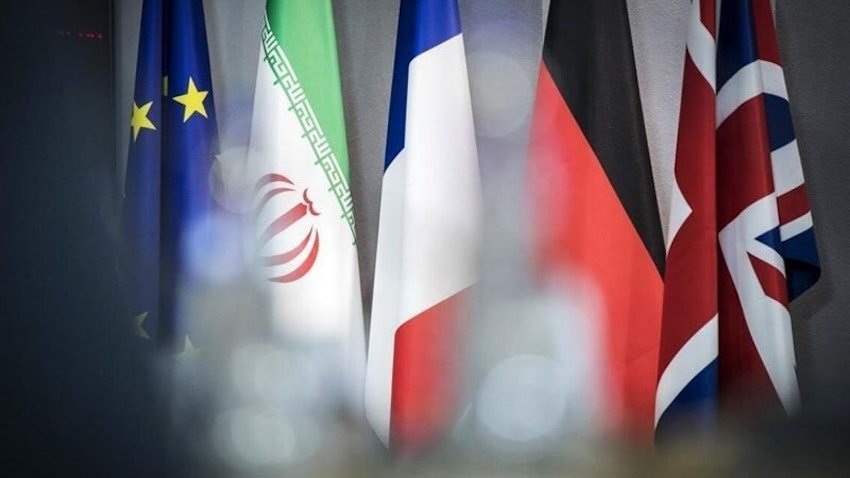
The geopolitical landscape shifted dramatically this Sunday as Iranian Parliament Speaker Mohammad Baqer Qalibaf announced that Tehran now officially considers the armed forces of all European Union member states to be “terrorist organizations.” This unprecedented legal move follows the EU’s decision on Thursday to blacklist the Islamic Revolutionary Guard Corps (IRGC). By invoking Article 7 of its domestic countermeasure law, Iran has effectively placed European military personnel on the same legal footing as non-state insurgent groups, triggering an immediate and severe Iran-EU diplomatic crisis.
- The Iran-EU diplomatic crisis has placed the status of European defense attachés in Tehran under immediate threat, with lawmakers calling for their swift expulsion.
- Iranian MPs attended the parliamentary session wearing IRGC uniforms, symbolizing a unified front against what they describe as European “blind obedience” to Washington.
- The move targets any nation that supported the EU’s consensus to label the IRGC a terrorist entity following the 1979-era-style crackdowns on domestic protests.
- Diplomatic observers warn that treating national armies as terrorist cells could lead to the total collapse of formal communication channels between Brussels and Tehran.
SEO Title: Iran-EU Diplomatic Crisis: Tehran Designates EU Armies as Terrorists
Description
The Iran-EU diplomatic crisis escalates as Tehran labels EU armies terrorist groups in response to the IRGC blacklisting, threatening the expulsion of European defense attaches.
Social Media SEO Title: Iran Retaliates: EU Armies Branded Terrorists in Diplomatic Row
Social Media Description
A massive Iran-EU diplomatic crisis erupts as Tehran retaliates against the EU’s IRGC terror listing by designating all European armies as terrorist organizations.
Background and Regional Tension
The current friction is rooted in the EU’s Thursday decision to proscribe the IRGC. While the EU had long hesitated, the “bloodiest crackdown” on Iranian protesters since the 1979 Revolution forced a shift in Brussels. This European pivot aligns with a broader “maximum pressure” campaign that has been gaining momentum across the Atlantic. In Tehran, the move is viewed not as a human rights stance, but as a strategic maneuver dictated by foreign powers.
The U.S.-Iran Standoff in 2026
The situation is further complicated by the volatile state of U.S.-Iran relations. In early 2026, the Trump administration intensified pressure on Tehran, with the President recently mentioning a “massive armada” moving toward the region. While Washington urges Tehran to “come to the table,” it has simultaneously imposed 25% tariffs on countries maintaining commercial ties with Iran.
Tehran’s Supreme Leader, Ali Khamenei, has countered with warnings that any U.S.-led military action would ignite a “regional conflict” rather than a localized war. Currently, the U.S. and Iran are locked in a high-stakes standoff where communication is limited to backchannel messages through regional intermediaries like Saudi Arabia and Qatar.
Impact on Defense Attachés
The most immediate casualty of this crisis is the presence of European military representatives in Iran. Defense attachés, who facilitate crucial military-to-military communication and intelligence sharing, now face a landscape where their very presence could be deemed illegal under Iranian law. While the Iranian Foreign Ministry has not yet issued formal expulsion orders, the Parliamentary National Security Commission is already deliberating on the removal of these officials. Their departure would signify a total “blackout” in security cooperation, leaving the region more vulnerable to accidental escalation and miscalculation.