


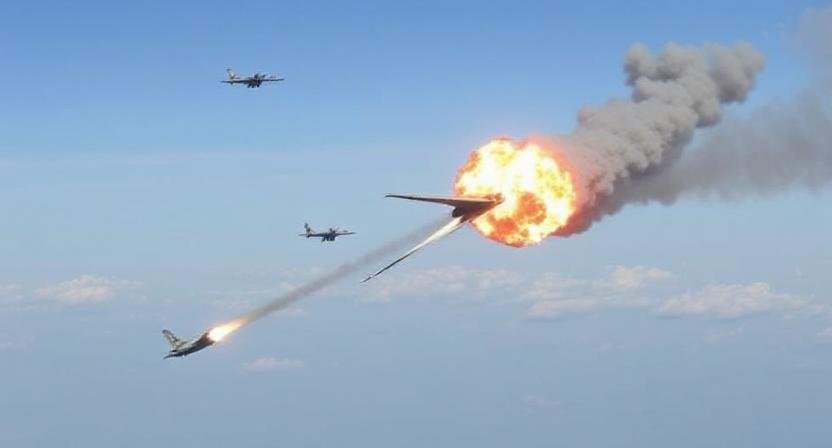
- Exclusive: White House warns Iran that any retaliation will trigger “full force” U.S. military response.
- Trump authorizes bunker-busting strikes on three Iranian nuclear facilities, including the fortified Fordow site.
- No U.S. ground troops deployed — Trump opts for high-impact air power to deter further escalation.
- Iran vows retaliation as international diplomacy collapses and regional tensions reach boiling point.
Exclusive — A White House spokesperson said during a special press briefing on Sunday that the United States has bombarded nuclear sites in Iran and warned that the world’s most powerful military would retaliate with full force if Iran dared to attack U.S. bases. “Let there be no doubt — any Iranian retaliation will be met with overwhelming firepower,” the official said, signaling the beginning of a potentially explosive chapter in Middle Eastern geopolitics.
In a dramatic and unprecedented military maneuver, President Donald Trump has plunged the United States into a volatile new era by ordering a full-scale air assault on Iran’s nuclear infrastructure. The strikes represent not only a defining moment in Trump’s second term but also a seismic shift in U.S. foreign policy.
Speaking from the White House late Saturday night, Trump called the operation a “spectacular military success,” declaring that Iran’s nuclear enrichment capabilities had been “completely and totally obliterated.” Among the targets was the heavily fortified Fordow facility, long regarded as a near-impenetrable site buried deep beneath mountains. Trump’s weapon of choice — a high-powered bunker-busting bomb — delivered a clear message of American military dominance.
The attack caught much of the world off guard. Just days earlier, Trump had suggested he was undecided about taking military action, floating a two-week window for deliberation. That ambiguity, whether strategic or improvised, collapsed into action with no real warning to the American public or Congress.
This sudden escalation contradicts Trump’s earlier posture as a non-interventionist. His 2024 campaign promised to end “forever wars” and avoid new military entanglements. Yet, in one of the most consequential acts of his presidency, Trump has now crossed a threshold that previous U.S. presidents avoided — a direct and massive strike on Iranian territory aimed at crippling its nuclear potential.
READ MORE: Trump strikes Iran hard, and the world waits for what comes next
The stated aim is to destroy Iran’s ability to build nuclear weapons without getting dragged into a protracted war. But the region’s history cautions against such optimism. Iran’s leadership has promised retaliation, and U.S. military bases across the Middle East — particularly in Iraq, Qatar, and Bahrain — have gone on high alert. Tehran’s allies, including Hezbollah in Lebanon and various Shia militias, are also expected to respond, potentially sparking a broader confrontation.
Trump’s political calculus is as risky as his military strategy. A Washington Post poll conducted prior to the attack showed just 25% of Americans supported airstrikes against Iran. Forty-five percent were opposed, and the rest were undecided. Among Republicans, support was higher, but far from unanimous. Trump is betting that a swift, decisive show of strength will change minds and restore a perception of American dominance in the region.
Unlike previous U.S. interventions — such as the invasion of Iraq in 2003 or the war in Afghanistan beginning in 2001 — Trump has avoided deploying ground troops. His approach relies on overwhelming air power and psychological pressure. In theory, the strikes should shock Iran into reconsidering its nuclear ambitions and bring it to the negotiating table on U.S. terms.
READ MORE: BREAKING: U.S. Deploys B-2 Bombers as Trump Considers Joining Israeli Assault on Iran
But history suggests a more complicated aftermath. Previous military interventions in the region have often led to long-term instability and unanticipated consequences. The war in Iraq, launched under false pretenses about weapons of mass destruction, morphed into a quagmire. Afghanistan became America’s longest war, ending in chaos during President Biden’s 2021 withdrawal. Trump’s hope of a clean, consequence-free operation may prove equally unrealistic.
International reaction has been cautious but concerned. U.N. Secretary General António Guterres expressed deep alarm, warning that “the region stands on the edge of a much wider conflict.” European efforts to salvage diplomacy collapsed after Iranian envoys stormed out of talks in Vienna just hours after the airstrikes. There is little expectation that Tehran will re-engage in good faith anytime soon.
Trump, however, appears unfazed. In his Saturday address, he painted Iran as “the bully of the Middle East” and insisted the Islamic Republic now had two choices: surrender its nuclear program or face “far greater and a lot easier” future attacks. It’s a classic Trump doctrine — dominance through unpredictability and force.
Still, experts caution against assuming this strike marks the end of hostilities. Iran’s proxies have long played the long game, and U.S. targets around the world remain vulnerable. Already, there are reports of Iranian cyber units probing American infrastructure, raising concerns of asymmetric retaliation.
At home, Trump’s gamble could either cement his image as a strongman president or backfire spectacularly if the conflict escalates beyond control. Public support, currently tepid, could shift if the strikes appear successful and Iran hesitates to respond. But if American lives are lost in any retaliation, the political consequences could be profound.
For now, the world watches anxiously. The airstrikes may have dealt a blow to Iran’s nuclear program, but they have also opened a new chapter of uncertainty — one in which diplomacy feels more distant than ever and the risk of regional war looms large.