


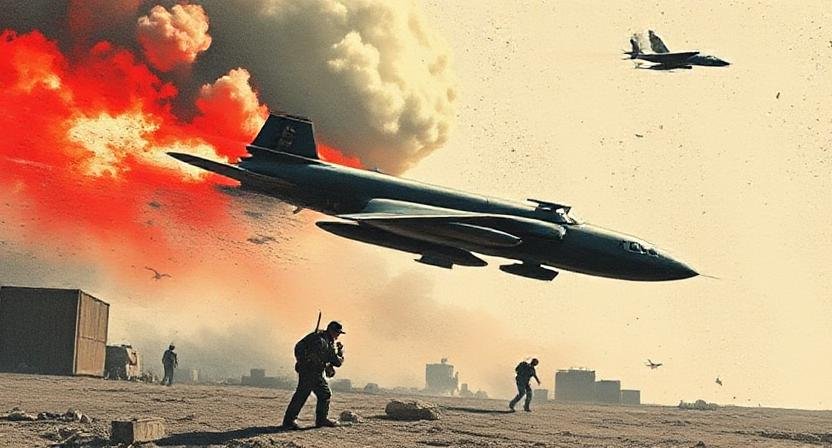
- The US targeted Iranian nuclear sites in a high-stakes precision strike using bunker-busters and cruise missiles, but doubts remain about its effectiveness, especially at the deeply-buried Fordow facility.
- Iran has labeled the attack an act of total war, while Russia and China condemn the strike, warning of broader destabilization and signaling possible support for Tehran.
- With tensions soaring, the Strait of Hormuz, oil markets, and proxy forces are now potential flashpoints as diplomacy hangs by a thread.
The Iran-Israel conflict appears to have reached a critical juncture. Recent US military strikes on Iranian nuclear sites have significantly escalated tensions in the region, raising serious strategic and geopolitical implications. These developments highlight the growing influence of American decision-making in the evolving Middle Eastern security calculus, and any remaining diplomatic openings will now carry heightened significance.
The precision strikes targeted key Iranian nuclear facilities in Isfahan, Natanz, and Fordow. The US military reportedly used 12 bunker-buster bombs via B-2 bombers on the Fordow site and two on Natanz, along with 30 Tomahawk Land Attack Missiles (TLAMs) fired at Natanz and Isfahan. While the Trump administration declared the sites “completely obliterated,” widespread scepticism remains about the effectiveness of the strikes—particularly in the case of Fordow, which is located roughly 260 feet underground and is known for its hardened infrastructure.
Following the strikes, Iranian officials characterized the attack as tantamount to an act of total war, and potential retaliation cannot be ruled out. The underlying question remains: what was the United States truly aiming to achieve with these strikes?
As Iran Prepares Retaliation, Middle East Fears the Seventh War Could Be the Worst Yet
Primarily, the US objective appears to be preventing Iran from acquiring nuclear weapons. A secondary goal may be to contain the conflict and avoid a wider regional war. However, experts argue that the elimination of a few nuclear scientists and limited damage to infrastructure is insufficient to halt Iran’s nuclear trajectory. The destruction of physical facilities does not equate to the erasure of nuclear knowledge, which continues to exist in human capital and underground networks.
Furthermore, the strikes raise questions about the extent of US support for Israel. While the US has historically backed Israeli security concerns, there is increasing speculation over whether Washington has overestimated Israel’s strategic benefit from such provocations. If a broader war breaks out, Israel may find itself facing unprecedented threats—especially if Iran mobilizes its regional allies and asymmetric capabilities.
Read More: America Bombs Iran’s Nuclear Sites: What Triggered Trump and What Comes Next?
The broader geopolitical context also plays a critical role in this crisis. Both Russia and China have expressed deep concern, calling for an immediate ceasefire and peaceful resolution. The US is already engaged in strategic rivalry with both nations, particularly in the Middle East and Asia-Pacific. A weakened Iran could undermine regional stability—an outcome neither Moscow nor Beijing desires. China, in particular, has vast economic stakes in uninterrupted oil flows through the Strait of Hormuz and may respond by increasing material support to Tehran.
In this context, Israel’s security could be gravely jeopardized as the US risks drawing the region into an extended conflict. The United Nations, too, has condemned the American strikes, amplifying international unease.
Iran possesses multiple retaliatory options, chief among them the potential closure of the Strait of Hormuz—through which a significant portion of the world’s oil supply flows. Such a move would likely trigger a global economic crisis. Additionally, Iran could leverage its regional proxies, such as the Houthis in Yemen, to wage a decentralized defense campaign. While these options may create instability, achieving decisive military victory under such a strategy remains unlikely.
Also Read: Hundreds of U.S. citizens have fled Iran amid Israeli strikes
Diplomatic avenues remain open despite the rising tensions. Iran’s Foreign Minister, Abbas Araqchi, has voiced willingness to engage in talks, though the immediate focus remains on resisting aggression. Simultaneously, President Trump has reportedly requested more time to pursue negotiations. A diplomatic breakthrough at this juncture could be crucial for de-escalating the situation. If diplomacy fails, however, Iran may respond by accelerating its nuclear program—further exposing the US and Israel to strategic and security risks.
The situation is rapidly evolving, and the outcomes remain uncertain. What is clear is that the cost of miscalculation is extraordinarily high. The specter of a broader war looms large, and a destabilized Middle East would be profoundly detrimental to US interests. From threats to global oil supplies and heightened activity by Iran-backed militias, to direct attacks on Israel or US military assets, the consequences of these strikes could reverberate far beyond the region.
In conclusion, while the immediate objective of disrupting Iran’s nuclear advancement may have been partially fulfilled, the long-term risks—geopolitical, economic, and military—could far outweigh the perceived strategic gains.